With reference to the writs issued by the Courts in India, consider the following statements: 1. Mandamus will not lie against a private organisation unless it is entrusted with a public duty. 2. Mandamus will not lie against a Company even though it may be a Government Company. 3. Any public minded person can be a petitioner to move the Court to obtain the writ of Quo Warranto. Which of the statements given above are correct?

- A1 and 2 only
- B2 and 3 only
- C1 and 3 onlyCorrect
- D1, 2 and 3
Explanation
Analysis of the three statements on writs issued by Indian Courts:
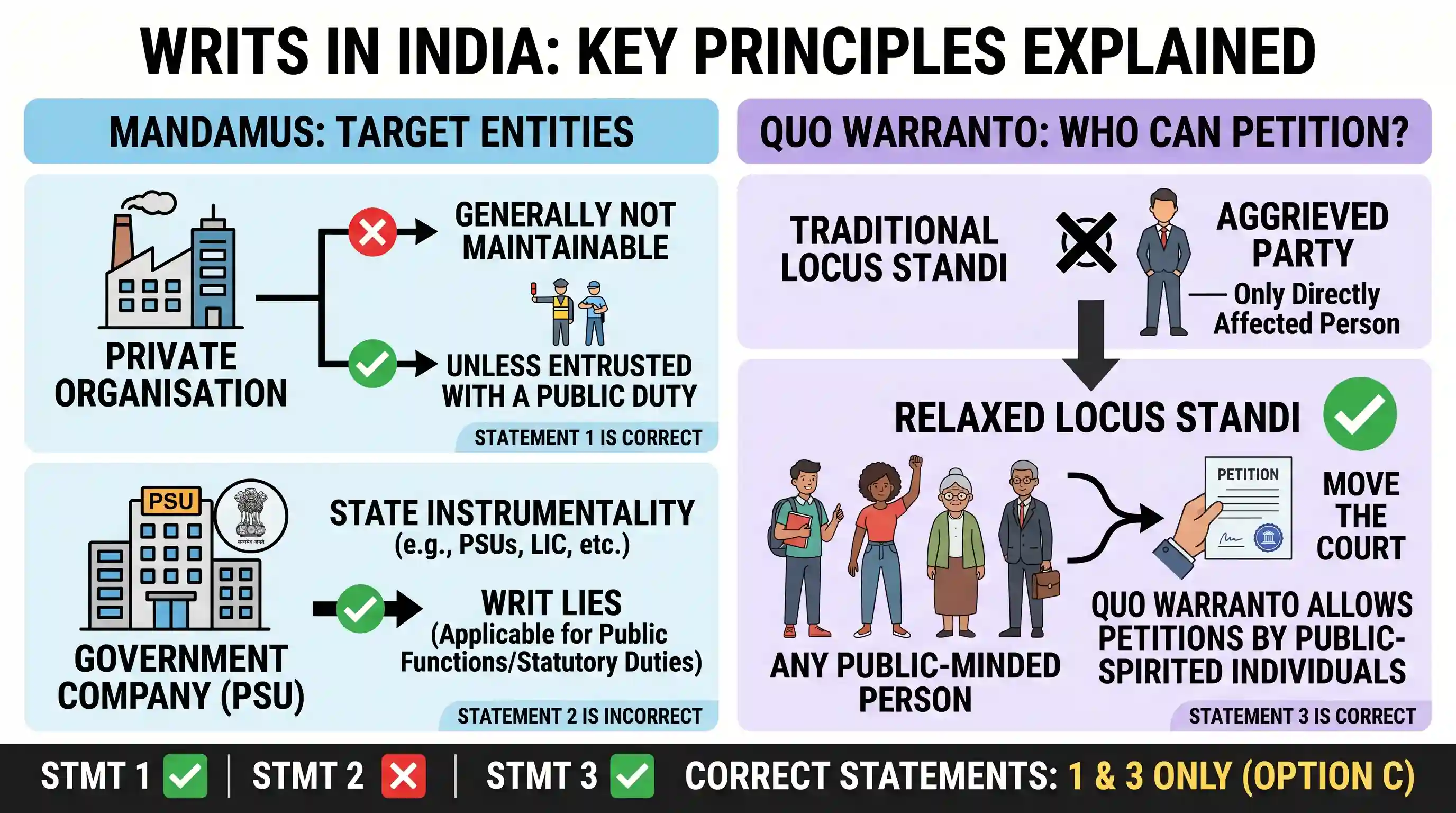
Statement 1 is correct. Mandamus (literally 'we command') is a writ commanding a public authority to perform a public or statutory duty it has failed to discharge. As a general rule it does not lie against a private individual or a purely private organisation. The well-established exception is that if a private body has been entrusted with a public duty (statutory or otherwise), mandamus can be issued against it to enforce that duty. So the statement is accurate.
Statement 2 is incorrect. A Government Company (e.g., a Public Sector Undertaking) is treated as an instrumentality of the State under Article 12 (per R.D. Shetty v. International Airport Authority, Sukhdev Singh v. Bhagatram, etc.) and is amenable to writ jurisdiction. Where such a company is discharging a public function or a public/statutory duty, the writ of mandamus can certainly be issued against it. The blanket assertion that mandamus 'will not lie against a Company even though it may be a Government Company' is therefore wrong.
Statement 3 is correct. Quo Warranto (literally 'by what authority') calls upon a person holding a public office to show under what authority they hold it. Unlike most other writs, the rule of locus standi is relaxed for Quo Warranto — any public-spirited person (not just the aggrieved party) can move the High Court or Supreme Court for this writ to challenge an illegal usurpation of public office.
Therefore, only statements 1 and 3 are correct, and the answer is option C.
Related questions
More UPSC Prelims practice from the same subject and topic.
- Prelims 2022GS1polity-and-governance
Consider the following statements: 1. Pursuant to the report of H.N. Sanyal Committee, the Contempt of Courts Act, 1971 was passed. 2. The Constitution of India empowers the Supreme Court and the High…
- Prelims 2022GS1polity-and-governance
With reference to the "G20 Common Framework", consider the following statements: 1. It is an initiative endorsed by the G20 together with the Paris Club. 2. It is an initiative to support Low Income C…
- Prelims 2022GS1polity-and-governance
With reference to India, consider the following statements: 1. Government law officers and legal firms are recognised as advocates, but corporate lawyers and patent attorneys are excluded from recogni…
- Prelims 2022GS1polity-and-governance
Consider the following statements: 1. A bill amending the Constitution requires a prior recommendation of the President of India. 2. When a Constitution Amendment Bill is presented to the President of…
- Prelims 2022GS1polity-and-governance
Consider the following statements: 1. The Constitution of India classifies the ministers into four ranks viz. Cabinet Minister, Minister of State with Independent Charge, Minister of State and Deputy …
- Prelims 2022GS1polity-and-governance
Which of the following is/are the exclusive power(s) of Lok Sabha ? 1. To ratify the declaration of Emergency 2. To pass a motion of no-confidence against the Council of Ministers 3. To impeach the Pr…