DNA Barcoding can be a tool to: 1. assess the age of a plant or animal. 2. distinguish among species that look alike. 3. identify undesirable animal or plant materials in processed foods. Which of the statements given above is/are correct?

- A1 only
- B3 only
- C1 and 2
- D2 and 3Correct
Explanation
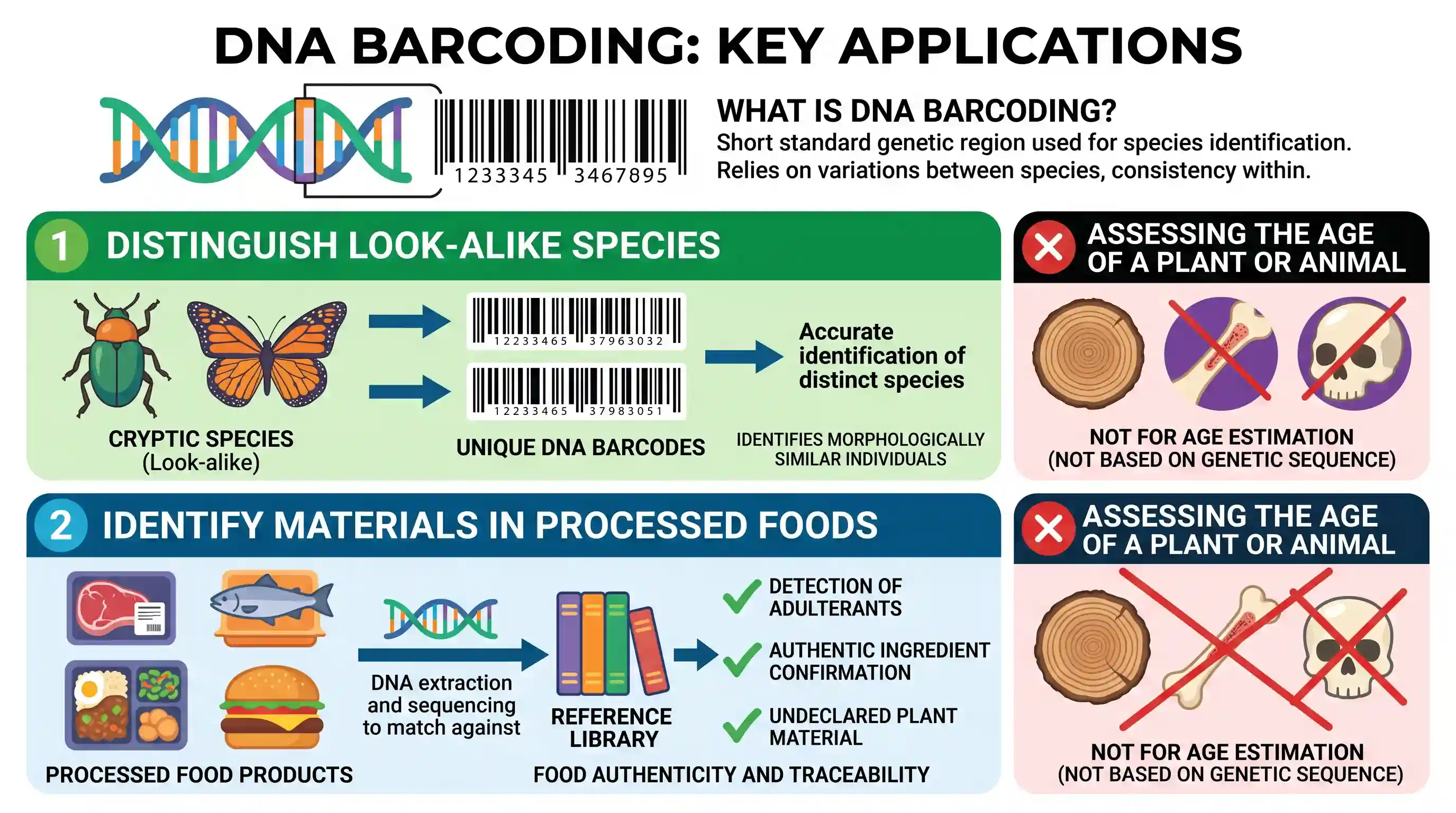
DNA barcoding is a taxonomic method that uses a short genetic marker in an organism's DNA to identify it as belonging to a particular species. It relies on the principle that genetic sequences differ sufficiently between species but are relatively consistent within a species.
-
Assess the age of a plant or animal: DNA barcoding is primarily a tool for species identification and differentiation. It is not used to assess the age of an organism. Age assessment typically relies on methods like tree rings, bone analysis, or carbon dating for very old samples. Therefore, statement 1 is incorrect.
-
Distinguish among species that look alike: This is a core application of DNA barcoding. Even if two species are morphologically very similar and difficult to tell apart visually, their distinct DNA barcodes can accurately differentiate them. Therefore, statement 2 is correct.
-
Identify undesirable animal or plant materials in processed foods: DNA barcoding is widely used in food authenticity testing. It can identify the species of animal or plant origin in processed foods, helping to detect adulteration, mislabeling, or the presence of allergens/undesirable ingredients (e.g., horse meat in beef, specific fish species, or undeclared plant materials). Therefore, statement 3 is correct.
Hence, statements 2 and 3 are correct.
Related questions
More UPSC Prelims practice from the same subject and topic.
- Prelims 2022GS1science-and-technology
Consider the following : 1. Aarogya Setu 2. CoWIN 3. DigiLocker 4. DIKSHA Which of the above are built on top of open-source digital platforms?
- Prelims 2022GS1science-and-technology
With reference to Web 3.0, consider the following statements: 1. Web 3.0 technology enables people to control their own data. 2. In Web 3.0 world, there can be blockchain based social networks. 3. Web…
- Prelims 2022GS1science-and-technology
With reference to "Software as a Service (SaaS)", consider the following statements: 1. SaaS buyers can customise the user interface and can change data fields. 2. SaaS users can access their data thr…
- Prelims 2022GS1science-and-technology
Which one of the following statements best reflects the idea behind the "Fractional Orbital Bombardment System" often talked about in media?
- Prelims 2022GS1science-and-technology
Which one of the following is the context in which the term "qubit" is mentioned ?
- Prelims 2022GS1science-and-technology
Consider the following communication technologies: 1. Closed-circuit Television 2. Radio Frequency Identification 3. Wireless Local Area Network Which of the above are considered Short-Range devices/t…