A principal P becomes Q in 1 year when compounded half-yearly with R% annual rate of interest. If the same principal P becomes Q in 1 year when compounded annually with S% annual rate of interest, then which one of the following is correct?

- AR = S
- BR > S
- CR< SCorrect
- DR≤ S
Explanation
The core concept here is the effective annual rate of interest.
-
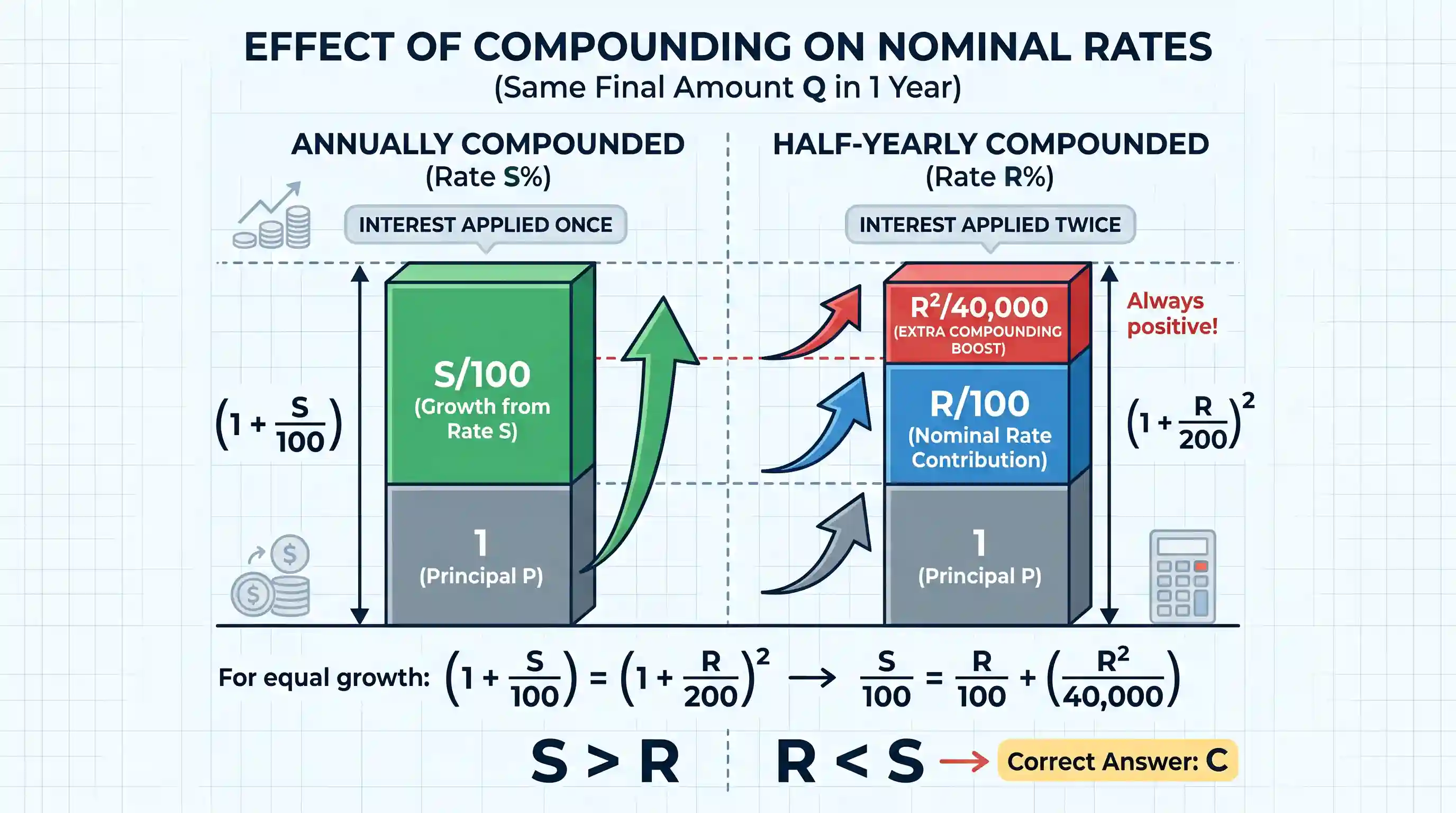
Scenario 1 (Half-yearly compounding with R% annual rate): When interest is compounded half-yearly, the interest is calculated twice a year. For an annual rate of R%, the rate applied per half-year is R/2%. The amount Q after 1 year is given by: Q = P * (1 + (R/2)/100)^2 = P * (1 + R/200)^2
-
Scenario 2 (Annually compounding with S% annual rate): When interest is compounded annually, the interest is calculated once a year. For an annual rate of S%, the rate applied per year is S%. The amount Q after 1 year is given by: Q = P * (1 + S/100)^1 = P * (1 + S/100)
-
Equating the amounts: Since P becomes Q in 1 year in both cases, the final amounts are equal: P * (1 + R/200)^2 = P * (1 + S/100) (1 + R/200)^2 = (1 + S/100)
-
Analysis:
- The term (1 + S/100) represents the growth factor for one year with annual compounding at rate S. This is the effective annual growth factor.
- The term (1 + R/200)^2 represents the growth factor for one year with half-yearly compounding at an annual rate R. This is also the effective annual growth factor.
- For any positive interest rate, compounding more frequently (half-yearly) results in a higher effective annual rate than compounding less frequently (annually) for the same nominal annual rate.
- However, in this problem, the effective annual growth (P becoming Q) is the same for both scenarios.
- To achieve the same effective annual growth with more frequent compounding (half-yearly for R), the nominal annual rate (R) must be lower than the nominal annual rate (S) for less frequent compounding (annually for S).
- Mathematically, expanding (1 + R/200)^2 gives 1 + 2(R/200) + (R/200)^2 = 1 + R/100 + R^2/40000.
- So, 1 + R/100 + R^2/40000 = 1 + S/100
- R/100 + R^2/40000 = S/100
- S = R + R^2/400 (multiplying by 100)
- Since R is a positive interest rate, R^2/400 will be a positive value.
- Therefore, S must be greater than R (S > R), which means R < S.
Conclusion: For the same principal to grow to the same amount in the same time, if one scenario involves more frequent compounding, its nominal annual rate must be lower than the nominal annual rate of the less frequently compounded scenario.
The final answer is C) R < S.
Related questions
More UPSC Prelims practice from the same subject and topic.
- Prelims 2023CSATQuantitative Aptitude
For five children with ages a < b < c < d < e ; any two successive ages differ by 2 years. Question: What is the age of the youngest child? Statement- 1: The age of the eldest is 3 times the youngest.…
- Prelims 2023CSATQuantitative Aptitude
Raj has ten pairs of red, nine pairs of white and eight pairs of black shoes in a box. If he randomly picks shoes one by one (without replacement) from the box to get a red pair of shoes to wear, what…
- Prelims 2023CSATQuantitative Aptitude
In how many ways can a batsman score exactly 25 runs by scoring single runs, fours and sixes only, irrespective of the sequence of scoring shots?
- Prelims 2023CSATQuantitative Aptitude
There are four letters and four envelopes and exactly one letter is to be put in exactly one envelope with the correct address. If the letters are randomly inserted into the envelopes, then consider t…
- Prelims 2023CSATQuantitative Aptitude
What is the remainder when 85 × 87 × 89 × 91 × 95 × 96 is divided by 100?
- Prelims 2023CSATQuantitative Aptitude
What is the unit digit in the expansion of (57242)^(9×7×5×3×1)?