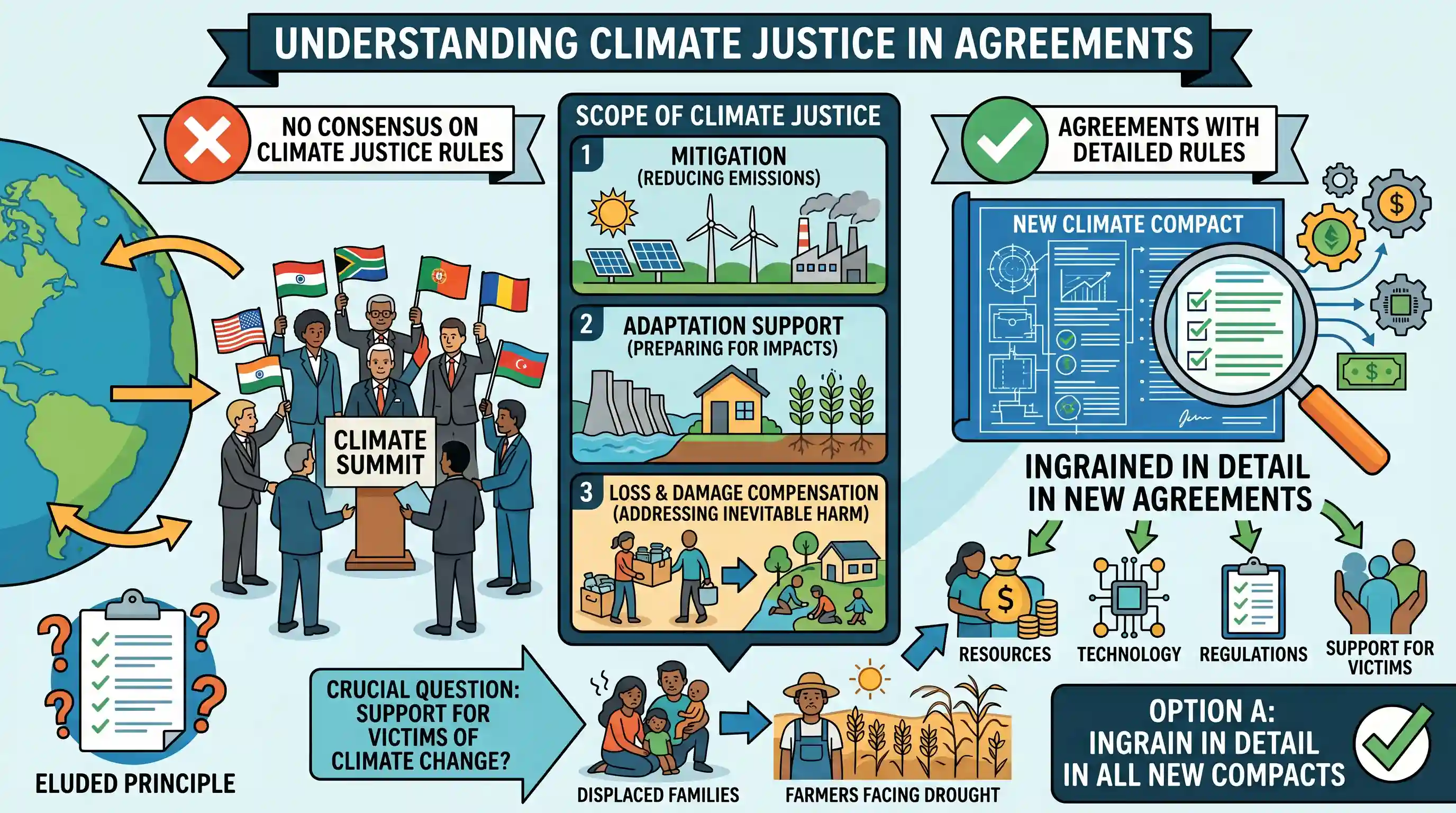
Along with sustainable lifestyles, climate justice is regarded as a significant principle in environmental parlance. Both the principles have bearings on political and economic choices of the nation. So far, in our climate change summits or compacts, both the principles have eluded consensus among nations. Justice, in the judicial sense, is well defined. However, in the context of climate change, it has scientific as well as socio- political connotations. The crucial question in the next few years will be how resources, technologies and regulations are used to support the victims of climate change. Justice in climate is not confined to actions relating to mitigation, but includes the wider notion of support for adaptation to climate change and compensation for loss and damage. Which one of the following statements best reflects the most logical, rational and crucial message conveyed by the passage?

- AClimate justice should be ingrained in detail in the rules of all the new climate compacts/agreements.Correct
- BEnvironmental resources are unevenly distributed and exploited across the globe.
- CThere is an impending issue of dealing with a huge number of climate change victims/climate refugees.
- DClimate change in all its connotations is mostly due to developed countries and therefore their share of burden should be more.
Explanation
The passage highlights that climate justice is a significant principle that has "eluded consensus among nations" in climate change summits. It further states that the "crucial question in the next few years will be how resources, technologies and regulations are used to support the victims of climate change," and that justice includes "support for adaptation to climate change and compensation for loss and damage."
Option A) Climate justice should be ingrained in detail in the rules of all the new climate compacts/agreements. This statement directly addresses the core problem identified in the passage: the lack of consensus on climate justice. If it has eluded consensus, the logical and crucial next step is to ensure it is formally included and detailed in future agreements to provide the necessary support for victims, adaptation, and compensation. This aligns perfectly with the passage's emphasis on the "crucial question" of how support will be provided.
Option B) Environmental resources are unevenly distributed and exploited across the globe. While this is a general truth related to climate change, the passage does not explicitly state or primarily focus on the uneven distribution or exploitation of resources. Its focus is on the principle of climate justice and its implementation.
Option C) There is an impending issue of dealing with a huge number of climate change victims/climate refugees. The passage mentions "victims of climate change" and the need to support them, identifying this as a "crucial question." However, it does not quantify them as "huge" or specifically mention "climate refugees." The central message is about the principle of justice and how to support victims, not just the scale of the problem.
Option D) Climate change in all its connotations is mostly due to developed countries and therefore their share of burden should be more. While climate justice often involves historical responsibility and differentiated burdens, the passage does not explicitly state that climate change is "mostly due to developed countries" or that their "share of burden should be more." It discusses the concept of justice broadly, including mitigation, adaptation, and compensation, without directly attributing blame or specifying the distribution of burden.
Therefore, Option A best reflects the most logical, rational, and crucial message conveyed by the passage, as it directly addresses the identified lack of consensus and the need for practical implementation of climate justice.
Related questions
More UPSC Prelims practice from the same subject and topic.
- Prelims 2023CSATReading Comprehension
We often hear about conflicts among different States in India over river waters. Of the 20 major river systems, 14 are already water- stressed; 75% of the population lives in water- stressed regions, …
- Prelims 2023CSATReading Comprehension
More than half of Indian women and almost a quarter of Indian men of working age suffer from anaemia. According to studies, they are anywhere from 5 - 15% less productive than they could be, as a resu…
- Prelims 2023CSATReading Comprehension
In India, a majority of farmers are marginal and small, less educated and possess low adaptive capabilities to climate change, perhaps because of credit and other constraints. So, one cannot expect au…
- Prelims 2023CSATReading Comprehension
The emissions humans put into the atmosphere now will affect the climate in the middle of the century and onwards. Technological change, meanwhile, could make a future transition away from fossil fuel…
- Prelims 2023CSATReading Comprehension
Environmental problems cause health problems. Substantial changes in lifestyle can reduce environmental or health problems, but this idea appears almost impossible to adopt. With environmental problem…
- Prelims 2023CSATReading Comprehension
Many people are not eating the right food. For some, it is simply a decision to stick with food they enjoy but which is not too healthy. This is leading to an increase in non- communicable diseases. T…