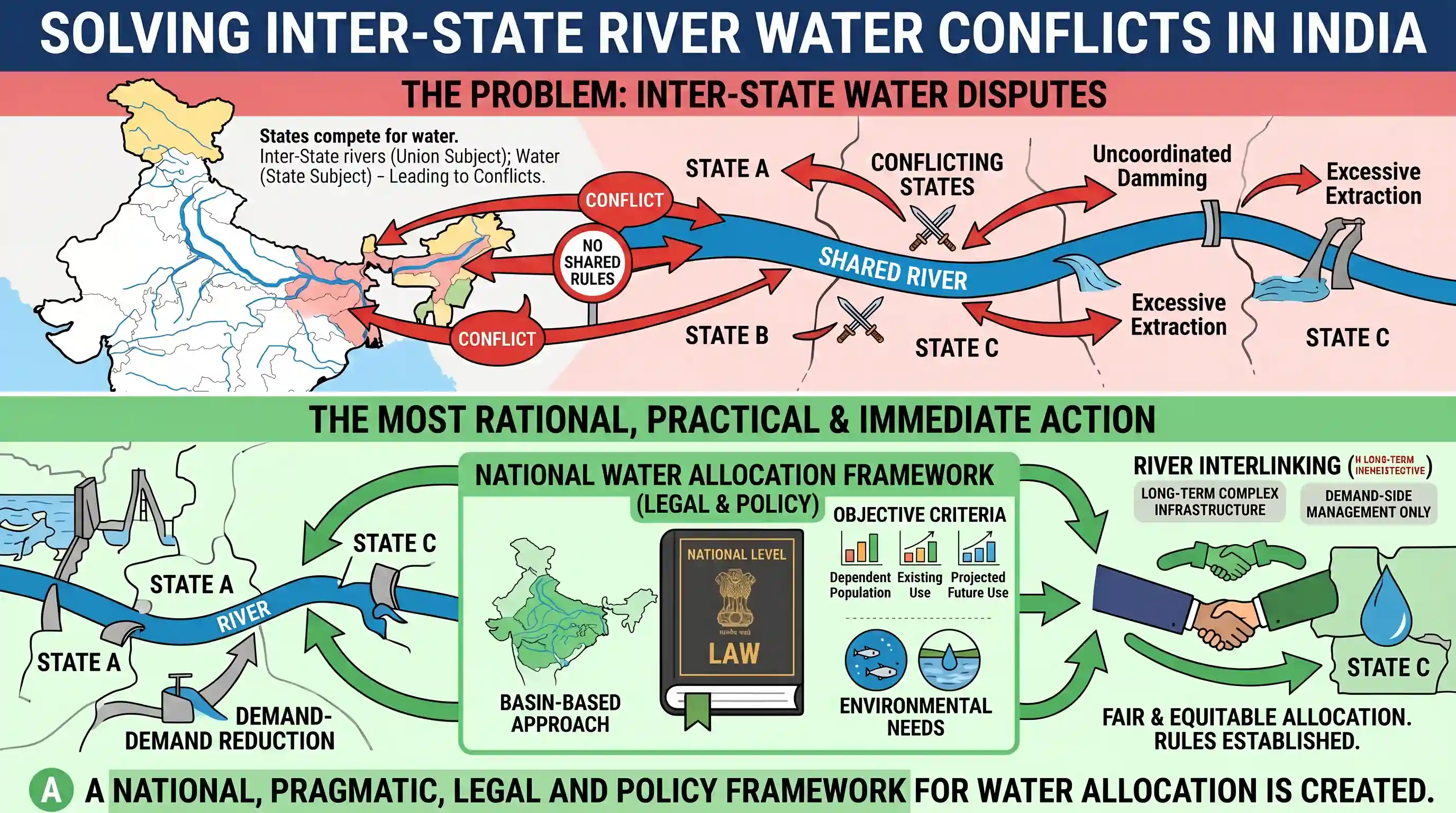
We often hear about conflicts among different States in India over river waters. Of the 20 major river systems, 14 are already water- stressed; 75% of the population lives in water- stressed regions, a third of whom live in water- scarce areas. Climate change, the demands of rising population and the need for agriculture to keep pace, and increased rate of urbanization and industrialization will exacerbate water stress. According to the Constitution of India, water is a State subject and not that of the Union, except for regulation of inter- State rivers. Key to ensuring balance between competing demands of various stakeholders is a basin- based approach to allocate water amongst constituent regions and States. Allocating fair share of water to them requires assessments based on objective criteria, such as specificities of the river basin, size of dependent population, existing water use and demand, efficiency of use, projected future use, etc. while ensuring the environmental needs of the river and aquifers. Which one of the following statements best reflects the most rational, practical and immediate action required to ensure fair and equitable allocation of water to different stakeholders?

- AA national, pragmatic, legal and policy framework for water allocation should be made.Correct
- BAll river systems of the country should be linked and huge aquifers created.
- CWater channels between regions of water surplus and regions of water deficit should be created.
- DTo mitigate water crisis, water demand of sectors such as agriculture and industry should be reduced.
Explanation
The question asks for the most rational, practical, and immediate action to ensure fair and equitable allocation of water. The passage highlights conflicts over inter-State rivers, the need for a basin-based approach, and objective criteria for allocation, acknowledging water as a State subject but with Union regulation for inter-State rivers.
Let's analyze the options:
A) A national, pragmatic, legal and policy framework for water allocation should be made. This option directly addresses the core problem of allocation. Given that conflicts arise between States and the Union has a role in inter-State rivers, a national framework would provide the necessary overarching principles, legal backing, and policy guidelines for fair and equitable distribution. It would facilitate the basin-based approach and the use of objective criteria mentioned in the passage. This is a foundational step for effective allocation.
B) All river systems of the country should be linked and huge aquifers created. This refers to large-scale infrastructure projects like river interlinking. While it aims to address water scarcity, it is a massive, long-term, and highly complex undertaking with significant environmental and social implications. It is not an immediate or practical solution for ensuring fair and equitable allocation in the short term, but rather a supply-side measure that would still require an allocation framework.
C) Water channels between regions of water surplus and regions of water deficit should be created. This is essentially a component of river interlinking (Option B). Similar to B, it's a major infrastructure project, not an immediate or practical action for establishing a system of fair and equitable allocation. It deals with physical transfer, not the rules of distribution.
D) To mitigate water crisis, water demand of sectors such as agriculture and industry should be reduced. Reducing water demand is a crucial long-term strategy for mitigating the water crisis. However, the question specifically asks for action to "ensure fair and equitable allocation of water." Even if demand is reduced, a framework for allocating the remaining water fairly among stakeholders would still be necessary to prevent disputes. This is a demand-side management strategy, not an allocation strategy in itself.
Conclusion: Option A is the most rational, practical, and immediate action because it establishes the necessary legal and policy foundation for implementing fair and equitable water allocation, especially for inter-State rivers, which is the primary focus of the conflict mentioned in the passage. It provides the "rules of the game" for distribution.
The final answer is A
Related questions
More UPSC Prelims practice from the same subject and topic.
- Prelims 2023CSATReading Comprehension
More than half of Indian women and almost a quarter of Indian men of working age suffer from anaemia. According to studies, they are anywhere from 5 - 15% less productive than they could be, as a resu…
- Prelims 2023CSATReading Comprehension
In India, a majority of farmers are marginal and small, less educated and possess low adaptive capabilities to climate change, perhaps because of credit and other constraints. So, one cannot expect au…
- Prelims 2023CSATReading Comprehension
The emissions humans put into the atmosphere now will affect the climate in the middle of the century and onwards. Technological change, meanwhile, could make a future transition away from fossil fuel…
- Prelims 2023CSATReading Comprehension
Environmental problems cause health problems. Substantial changes in lifestyle can reduce environmental or health problems, but this idea appears almost impossible to adopt. With environmental problem…
- Prelims 2023CSATReading Comprehension
Many people are not eating the right food. For some, it is simply a decision to stick with food they enjoy but which is not too healthy. This is leading to an increase in non- communicable diseases. T…
- Prelims 2023CSATReading Comprehension
Read the following three passages and answer the items that follow the passages. Your answers to these items should be based on the passages only. To tackle the problem of pollution in cities, policy …