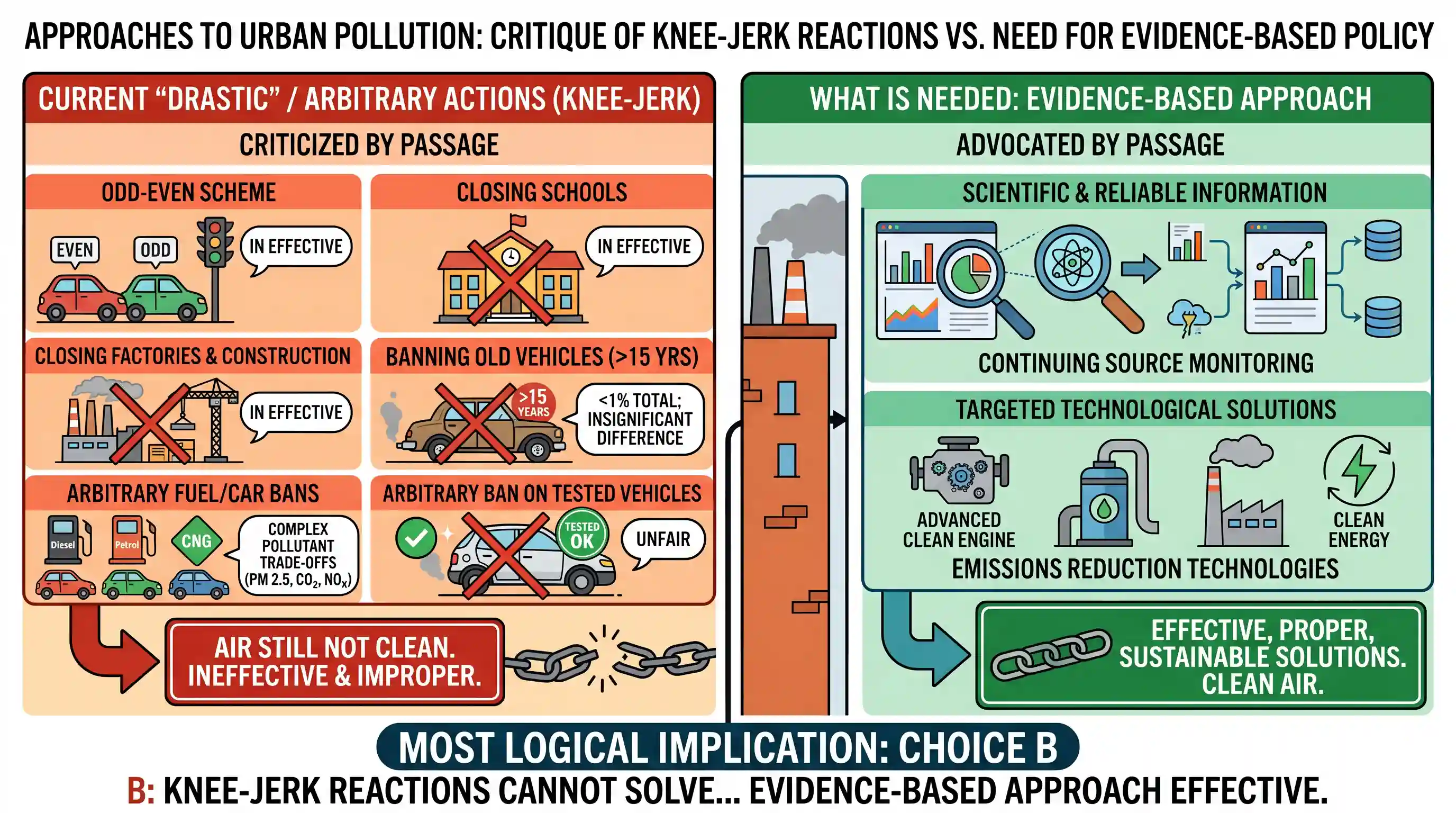
Read the following three passages and answer the items that follow the passages. Your answers to these items should be based on the passages only. To tackle the problem of pollution in cities, policy makers think that drastic actions like temporary use of odd- even number scheme for vehicles, closing schools, factories, construction activities, and banning the use of certain type of vehicles are a way forward. Even then the air is not clean. Vehicles more than 15 years old comprise one percent of the total; and taking them off the road will not make any difference. Banning certain fuels and car types arbitrarily is not proper. Diesel engines produce more PM 2.5 and less CO_2 than petrol or CNG engines. On the other hand, both diesel and CNG engines produce more NO_x than petrol engines. No one has measured the amount of NO_x that CNG engines are emitting. Arbitrary bans on vehicles that have passed mandated fitness tests and periodic pollution tests are unfair. What is needed is the scientific and reliable information about the source of pollutants on a continuing basis and the technologies that will work to reduce pollution from them. Which one of the following statements best reflects the most logical and rational implication conveyed by the passage?

- AArbitrary curbs on vehicles to reduce pollution are difficult to implement.
- BKnee-jerk reactions cannot solve the problem of pollution but an evidence-based approach will be more effective.Correct
- CA heavy penalty should be enforced on those driving without periodic pollution tests.
- DIn the absence of laws to deal with the problems of pollution, the administration tends to make arbitrary decisions.
Explanation
The passage criticizes current "drastic actions" and "arbitrary bans" taken by policymakers to reduce pollution, stating that "Even then the air is not clean" and such actions are "not proper" or "unfair." It then explicitly states what is needed: "scientific and reliable information about the source of pollutants on a continuing basis and the technologies that will work to reduce pollution from them."
Let's analyze the options:
A) Arbitrary curbs on vehicles to reduce pollution are difficult to implement. The passage focuses on the ineffectiveness and improperness of these curbs, not primarily on their difficulty of implementation. While difficulty might be a factor, it's not the main implication conveyed.
B) Knee-jerk reactions cannot solve the problem of pollution but an evidence-based approach will be more effective. "Knee-jerk reactions" aligns with the "drastic actions" and "arbitrary bans" mentioned. The passage clearly states these actions don't clean the air and are improper, implying they "cannot solve the problem." The call for "scientific and reliable information" directly supports the need for an "evidence-based approach" that would be "more effective." This statement perfectly summarizes the passage's core message.
C) A heavy penalty should be enforced on those driving without periodic pollution tests. The passage mentions "Arbitrary bans on vehicles that have passed mandated fitness tests and periodic pollution tests are unfair." This highlights unfairness towards those who have passed tests, not a call for penalties on those who haven't. This option is a misinterpretation and not the main implication.
D) In the absence of laws to deal with the problems of pollution, the administration tends to make arbitrary decisions. The passage doesn't suggest an absence of laws. It criticizes the nature of decisions made by "policy makers," implying a flaw in their approach rather than a legal vacuum.
Therefore, option B best reflects the most logical and rational implication conveyed by the passage, criticizing the current unscientific approach and advocating for an evidence-based one.
The final answer is B
Related questions
More UPSC Prelims practice from the same subject and topic.
- Prelims 2023CSATReading Comprehension
We often hear about conflicts among different States in India over river waters. Of the 20 major river systems, 14 are already water- stressed; 75% of the population lives in water- stressed regions, …
- Prelims 2023CSATReading Comprehension
More than half of Indian women and almost a quarter of Indian men of working age suffer from anaemia. According to studies, they are anywhere from 5 - 15% less productive than they could be, as a resu…
- Prelims 2023CSATReading Comprehension
In India, a majority of farmers are marginal and small, less educated and possess low adaptive capabilities to climate change, perhaps because of credit and other constraints. So, one cannot expect au…
- Prelims 2023CSATReading Comprehension
The emissions humans put into the atmosphere now will affect the climate in the middle of the century and onwards. Technological change, meanwhile, could make a future transition away from fossil fuel…
- Prelims 2023CSATReading Comprehension
Environmental problems cause health problems. Substantial changes in lifestyle can reduce environmental or health problems, but this idea appears almost impossible to adopt. With environmental problem…
- Prelims 2023CSATReading Comprehension
Many people are not eating the right food. For some, it is simply a decision to stick with food they enjoy but which is not too healthy. This is leading to an increase in non- communicable diseases. T…