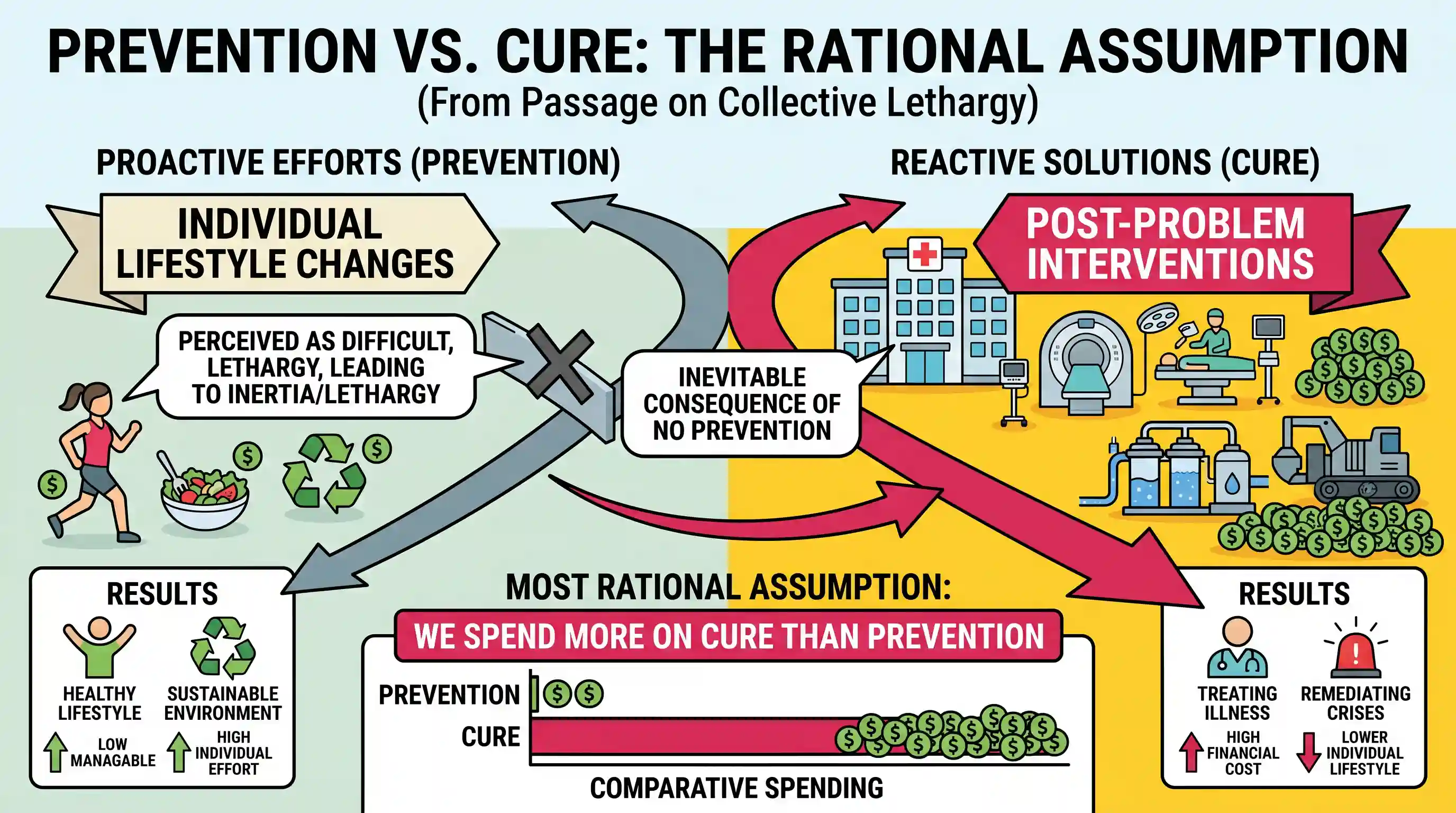
Environmental problems cause health problems. Substantial changes in lifestyle can reduce environmental or health problems, but this idea appears almost impossible to adopt. With environmental problems, individual efforts can be perceived as having a negligible effect and therefore lead to inertia. With health, on the other hand, individual choices can make the difference between life and death, literally. And yet, barring a few, there seems to be the same collective lethargy towards making their choices. Which one of the following statements best implies the most rational assumption that can be made from the passage?

- AWe are likely to spend more money on cure than prevention.Correct
- BIt is the job of the government to solve our environmental and public health problems.
- CHealth can be protected even if environmental problems go on unattended.
- DLoss of traditional lifestyle and the influence of western values led to some unhealthy ways of living.
Explanation
The passage highlights a "collective lethargy" towards making individual choices that could prevent both environmental and health problems, even when health choices can literally mean the difference between life and death.
Let's analyze each option:
A) We are likely to spend more money on cure than prevention. This is the most rational assumption. If there is a collective unwillingness to adopt preventive lifestyle changes (as stated in the passage), then problems will inevitably arise. When problems arise, people will seek solutions, which are typically "cures" for health issues and reactive measures for environmental problems. This implies that more resources (money) will be directed towards fixing problems after they occur, rather than preventing them. The passage describes a human tendency to avoid prevention, making the need for cure more likely and costly.
B) It is the job of the government to solve our environmental and public health problems. The passage focuses on individual efforts and choices, and the inertia towards them. While governments have a role, the passage does not imply that the responsibility solely lies with the government, nor is this the most rational assumption derived from the text's focus on individual behavior.
C) Health can be protected even if environmental problems go on unattended. The first sentence of the passage states, "Environmental problems cause health problems." This directly contradicts the idea that health can be protected if environmental problems are unattended.
D) Loss of traditional lifestyle and the influence of western values led to some unhealthy ways of living. The passage discusses "substantial changes in lifestyle" and "unhealthy ways of living" but does not attribute their cause to the "loss of traditional lifestyle" or "western values." This is an external explanation not supported or implied by the passage itself. The passage focuses on the reluctance to adopt healthy lifestyles, not the historical reasons for unhealthy ones.
Therefore, option A best implies the most rational assumption, as it logically follows from the observed human behavior of neglecting preventive measures described in the passage.
Related questions
More UPSC Prelims practice from the same subject and topic.
- Prelims 2023CSATReading Comprehension
We often hear about conflicts among different States in India over river waters. Of the 20 major river systems, 14 are already water- stressed; 75% of the population lives in water- stressed regions, …
- Prelims 2023CSATReading Comprehension
More than half of Indian women and almost a quarter of Indian men of working age suffer from anaemia. According to studies, they are anywhere from 5 - 15% less productive than they could be, as a resu…
- Prelims 2023CSATReading Comprehension
In India, a majority of farmers are marginal and small, less educated and possess low adaptive capabilities to climate change, perhaps because of credit and other constraints. So, one cannot expect au…
- Prelims 2023CSATReading Comprehension
The emissions humans put into the atmosphere now will affect the climate in the middle of the century and onwards. Technological change, meanwhile, could make a future transition away from fossil fuel…
- Prelims 2023CSATReading Comprehension
Many people are not eating the right food. For some, it is simply a decision to stick with food they enjoy but which is not too healthy. This is leading to an increase in non- communicable diseases. T…
- Prelims 2023CSATReading Comprehension
Read the following three passages and answer the items that follow the passages. Your answers to these items should be based on the passages only. To tackle the problem of pollution in cities, policy …