Many people are not eating the right food. For some, it is simply a decision to stick with food they enjoy but which is not too healthy. This is leading to an increase in non- communicable diseases. This in turn leads to major burden on our health- care systems that have the potential to derail the economic progress which is essential for the poor to improve their lives. For others, it is about limited access to nutritious food or a lack of affordability, leading to monotonous diets that do not provide the daily nutrients for them to develop fully. Part of the reason nutrition is under threat worldwide is that our food systems are not properly responding to nutritional needs. Somewhere along that long road from farm to fork, there are serious detours taking place. Which one of the following statements best reflects the crux of the passage?

- AThe scheme of Universal Basic Income should be implemented worldwide as a way of poverty alleviation.
- BWe must place food-based nutrition at the centre of our policy debate.Correct
- CNutritional status of food should be improved by creating appropriate genetically modified crops.
- DUsing modern food processing technologies, we must fortify food items with required nutrient elements.
Explanation
The passage highlights a multifaceted problem related to nutrition:
- People making unhealthy food choices, leading to non-communicable diseases and burden on healthcare.
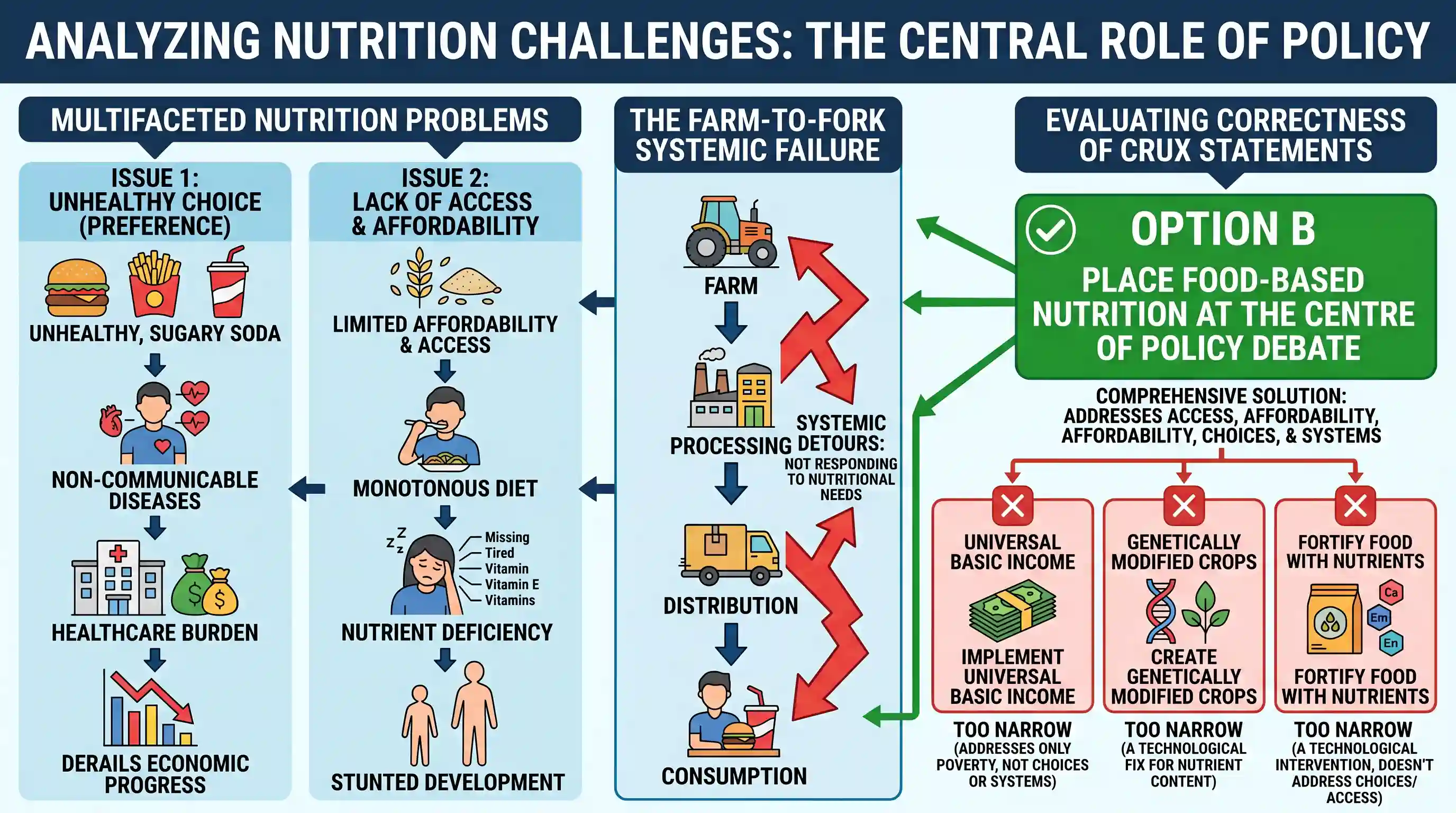
- Limited access or affordability of nutritious food, leading to monotonous diets and nutrient deficiencies. It explicitly states that "our food systems are not properly responding to nutritional needs" and that "serious detours" are taking place "from farm to fork." The core issue is that nutrition is under threat due to systemic failures in how food is produced, distributed, and consumed.
Let's analyze the options:
A) The scheme of Universal Basic Income should be implemented worldwide as a way of poverty alleviation. While the passage mentions "lack of affordability" as a reason for poor nutrition, UBI is a specific economic policy that is not the central theme or the sole solution implied by the passage. The passage's scope is broader, encompassing food choices, food systems, and health impacts.
B) We must place food-based nutrition at the centre of our policy debate. This statement perfectly reflects the crux. The passage details various ways nutrition is failing (unhealthy choices, lack of access/affordability) and attributes this to food systems not responding to nutritional needs. Placing food-based nutrition at the centre of policy debate implies a comprehensive approach to address all these issues, from farm to fork, encompassing choices, access, affordability, and systemic changes.
C) Nutritional status of food should be improved by creating appropriate genetically modified crops. This is a specific technological solution to improve nutrient content. While it could be part of a solution, the passage discusses a much broader problem involving food choices, access, affordability, and overall food system failures, not just the inherent nutritional status of crops. It's too narrow to be the crux.
D) Using modern food processing technologies, we must fortify food items with required nutrient elements. Like option C, this is another specific technological intervention (food fortification). It addresses one aspect of improving nutrition but does not encompass the full range of issues raised in the passage, such as unhealthy food choices, access, affordability, or the systemic failures of food systems. It's also too narrow.
Therefore, option B best captures the overarching message that nutrition, in all its dimensions, needs to be a primary focus of policy to address the systemic failures and their consequences described in the passage.
Related questions
More UPSC Prelims practice from the same subject and topic.
- Prelims 2023CSATReading Comprehension
We often hear about conflicts among different States in India over river waters. Of the 20 major river systems, 14 are already water- stressed; 75% of the population lives in water- stressed regions, …
- Prelims 2023CSATReading Comprehension
More than half of Indian women and almost a quarter of Indian men of working age suffer from anaemia. According to studies, they are anywhere from 5 - 15% less productive than they could be, as a resu…
- Prelims 2023CSATReading Comprehension
In India, a majority of farmers are marginal and small, less educated and possess low adaptive capabilities to climate change, perhaps because of credit and other constraints. So, one cannot expect au…
- Prelims 2023CSATReading Comprehension
The emissions humans put into the atmosphere now will affect the climate in the middle of the century and onwards. Technological change, meanwhile, could make a future transition away from fossil fuel…
- Prelims 2023CSATReading Comprehension
Environmental problems cause health problems. Substantial changes in lifestyle can reduce environmental or health problems, but this idea appears almost impossible to adopt. With environmental problem…
- Prelims 2023CSATReading Comprehension
Read the following three passages and answer the items that follow the passages. Your answers to these items should be based on the passages only. To tackle the problem of pollution in cities, policy …