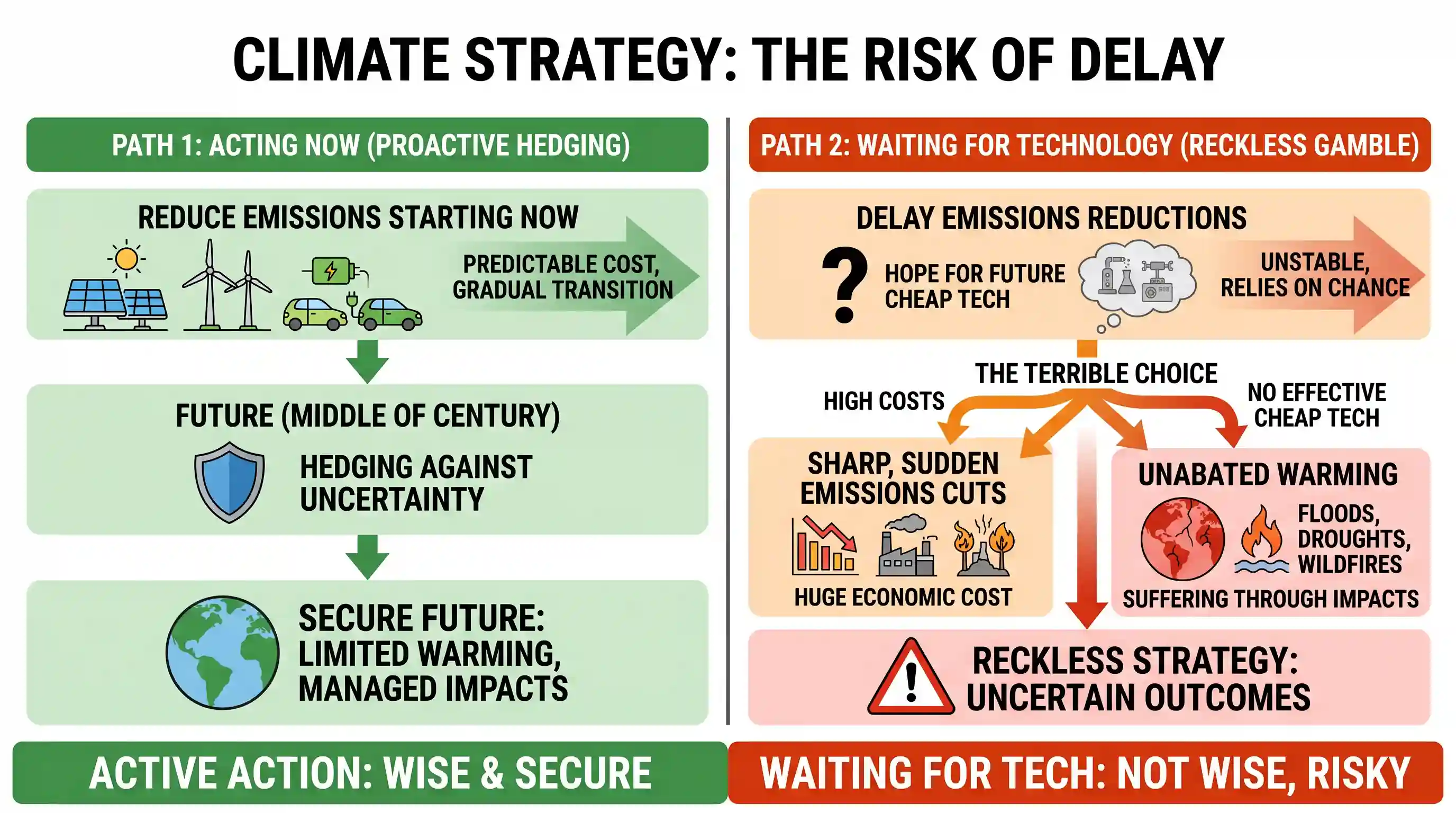
The emissions humans put into the atmosphere now will affect the climate in the middle of the century and onwards. Technological change, meanwhile, could make a future transition away from fossil fuels cheap or it might not, leaving the world with a terrible choice between sharply reducing emissions at huge cost or suffering through the effects of unabated warming. Businesses that do not hedge against the threat of uncertain outcomes fail. The world cannot afford such recklessness on climate change. Which one of the following statements best reflects the crucial message conveyed by the author of the passage?

- ABusinesses that cause emissions may need to close down or pay for pollution in future.
- BThe only solution is technological development related to the issues of climate change.
- CWaiting to deal with carbon emissions until technology improves is not a wise strategy.Correct
- DSince future technological change is uncertain, new industries should be based on renewable energy sources.
Explanation
The crucial message of the passage revolves around the uncertainty of future technological solutions and the severe consequences of delaying action on climate change.
Analysis of options:
A) Businesses that cause emissions may need to close down or pay for pollution in future. This option focuses on the fate of businesses, which is mentioned in the passage as an analogy ("Businesses that do not hedge... fail") to illustrate the need for proactive action. However, it's not the central, crucial message about the world's overall strategy for climate change.
B) The only solution is technological development related to the issues of climate change. This contradicts the passage. The passage explicitly states that technological change "might not" make the transition cheap, leading to a "terrible choice." It highlights the uncertainty of technology, not its certainty as the sole solution.
C) Waiting to deal with carbon emissions until technology improves is not a wise strategy. This statement perfectly reflects the crucial message. The passage warns about the uncertainty of future technology making solutions cheap and the "terrible choice" that would result if we delay. It concludes that the world "cannot afford such recklessness," which implies that waiting is indeed not a wise strategy. The analogy of businesses failing if they don't hedge against uncertainty further supports this.
D) Since future technological change is uncertain, new industries should be based on renewable energy sources. While promoting renewable energy is a relevant solution, the passage doesn't explicitly state this specific industrial policy as its crucial message. The core warning is about the danger of waiting for technology, not a directive for specific new industry types, although that might be an implied action. The message is broader: don't delay action due to uncertain technological promises.
Therefore, C best captures the author's warning against inaction based on uncertain future technological improvements.
Related questions
More UPSC Prelims practice from the same subject and topic.
- Prelims 2023CSATReading Comprehension
We often hear about conflicts among different States in India over river waters. Of the 20 major river systems, 14 are already water- stressed; 75% of the population lives in water- stressed regions, …
- Prelims 2023CSATReading Comprehension
More than half of Indian women and almost a quarter of Indian men of working age suffer from anaemia. According to studies, they are anywhere from 5 - 15% less productive than they could be, as a resu…
- Prelims 2023CSATReading Comprehension
In India, a majority of farmers are marginal and small, less educated and possess low adaptive capabilities to climate change, perhaps because of credit and other constraints. So, one cannot expect au…
- Prelims 2023CSATReading Comprehension
Environmental problems cause health problems. Substantial changes in lifestyle can reduce environmental or health problems, but this idea appears almost impossible to adopt. With environmental problem…
- Prelims 2023CSATReading Comprehension
Many people are not eating the right food. For some, it is simply a decision to stick with food they enjoy but which is not too healthy. This is leading to an increase in non- communicable diseases. T…
- Prelims 2023CSATReading Comprehension
Read the following three passages and answer the items that follow the passages. Your answers to these items should be based on the passages only. To tackle the problem of pollution in cities, policy …