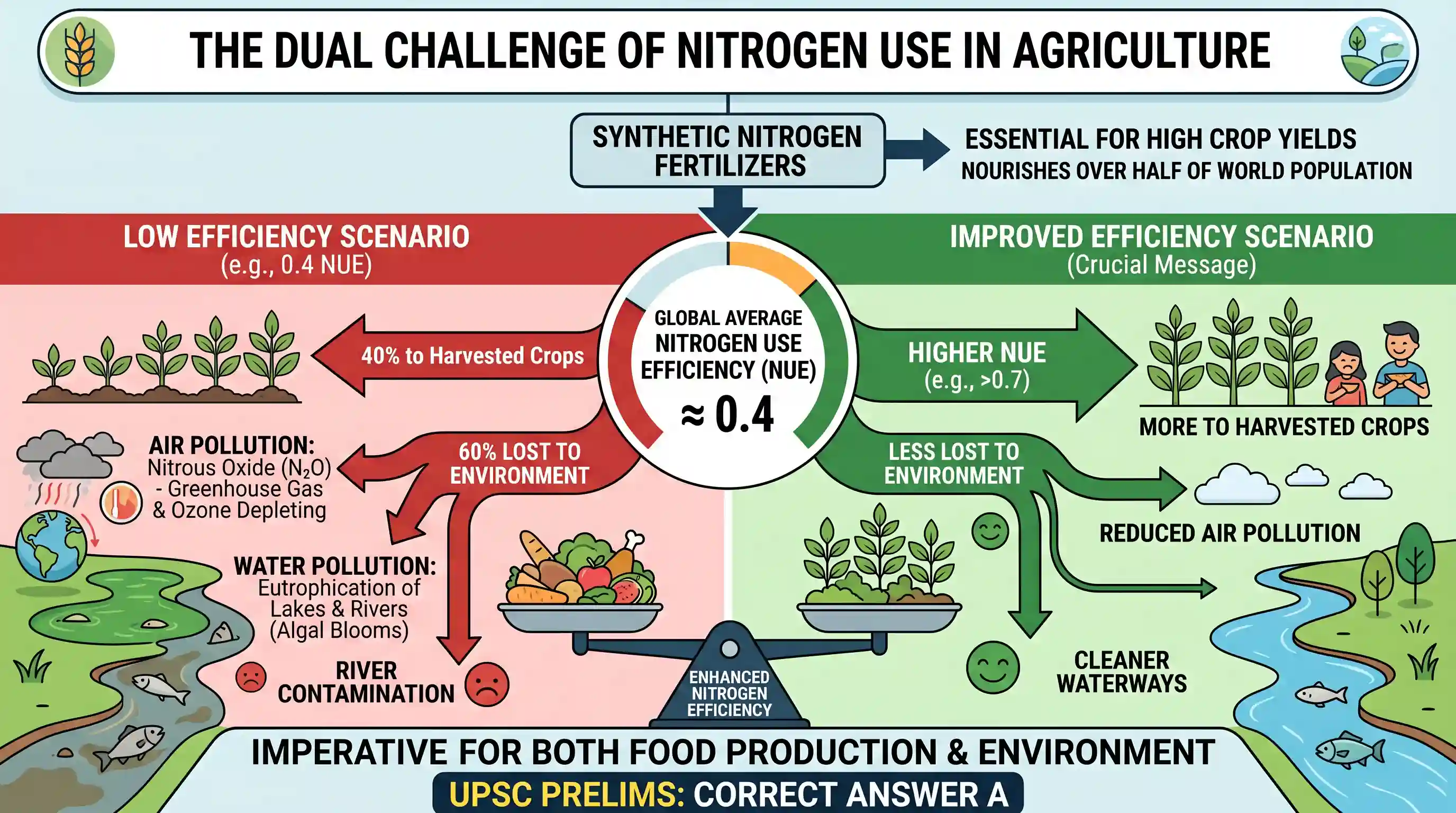
A global analysis of nitrogen use efficiency - a measure of the amount of nitrogen a plant takes in to grow versus what is left behind as pollution - says that using too much fertilizers will lead to increased pollution of waterways and the air. Currently, the global average for nitrogen use efficiency is approximately 0.4, meaning 40 per cent of the total nitrogen added to cropland goes into the harvested crop while 60 per cent is lost to the environment, says a study. More than half of the world's population is nourished by food grown with fertilizers containing synthetic nitrogen, which is needed to produce high crop yields. Plants take the nitrogen they need to grow, and the excess is left in the ground, water and air. This results in significant emissions of nitrous oxide, a potent greenhouse and ozone depleting gas, and other forms of nitrogen pollution, including eutrophication of lakes and rivers and contamination of river water. Which one of the following statements best reflects the most logical, rational and crucial message implied by the passage?

- AAn enhanced efficiency of use of nitrogen is imperative for both food production and environment.Correct
- BProduction of synthetic nitrogen fertilizers cannot be stopped as it will adversely affect global food security.
- CAlternatives to crops that require excess of nitrogen should be identified and cultivated.
- DConventional agriculture using synthetic fertilizers should be replaced with agroforestry, agroecosystems and organic farming.
Explanation
The passage highlights a critical dilemma: synthetic nitrogen fertilizers are essential for global food production, but their inefficient use (only 40% is taken by plants, 60% is lost) leads to significant environmental pollution (nitrous oxide emissions, eutrophication, water contamination).
Let's analyze each option:
A) An enhanced efficiency of use of nitrogen is imperative for both food production and environment. This statement directly addresses the core message. The passage details the low nitrogen use efficiency (0.4) and the resulting environmental pollution. It also states that synthetic nitrogen is "needed to produce high crop yields" and nourishes "more than half of the world's population." Therefore, improving efficiency would mean less pollution (benefiting the environment) while ensuring that enough nitrogen is available for crops to grow (benefiting food production). This is the most logical, rational, and crucial message implied, as it offers a solution to the presented problem that balances both needs.
B) Production of synthetic nitrogen fertilizers cannot be stopped as it will adversely affect global food security. While true and mentioned in the passage ("needed to produce high crop yields," "nourished by food grown with fertilizers containing synthetic nitrogen"), this is a supporting fact explaining why we use these fertilizers. It's not the most crucial message about what needs to be done in light of the pollution problem. The passage's emphasis is on the consequences of current use and the implied need for improvement, not just the indispensability of fertilizers.
C) Alternatives to crops that require excess of nitrogen should be identified and cultivated. The passage discusses the general efficiency of nitrogen use by plants and the excess left behind, not specifically about replacing crops that inherently require a lot of nitrogen. While crop selection could be part of a broader solution, the passage's direct focus is on improving the efficiency of nitrogen use across the board, regardless of the crop type, to minimize waste and pollution. This is a specific solution not directly implied as the most crucial message.
D) Conventional agriculture using synthetic fertilizers should be replaced with agroforestry, agroecosystems and organic farming. The passage describes a problem within the current agricultural system related to nitrogen use. It does not advocate for a complete overhaul or replacement of conventional agriculture with alternative systems. While these alternatives might offer solutions, the passage's direct implication is to address the inefficiency of nitrogen use within the existing framework, which is crucial for current food security. This option goes beyond the scope and direct implication of the passage.
Therefore, option A best reflects the most logical, rational, and crucial message because it synthesizes the dual challenge presented by the passage: the necessity of nitrogen for food and the environmental harm caused by its inefficient use, pointing towards enhanced efficiency as the imperative solution.
The final answer is A
Related questions
More UPSC Prelims practice from the same subject and topic.
- Prelims 2023CSATReading Comprehension
We often hear about conflicts among different States in India over river waters. Of the 20 major river systems, 14 are already water- stressed; 75% of the population lives in water- stressed regions, …
- Prelims 2023CSATReading Comprehension
More than half of Indian women and almost a quarter of Indian men of working age suffer from anaemia. According to studies, they are anywhere from 5 - 15% less productive than they could be, as a resu…
- Prelims 2023CSATReading Comprehension
In India, a majority of farmers are marginal and small, less educated and possess low adaptive capabilities to climate change, perhaps because of credit and other constraints. So, one cannot expect au…
- Prelims 2023CSATReading Comprehension
The emissions humans put into the atmosphere now will affect the climate in the middle of the century and onwards. Technological change, meanwhile, could make a future transition away from fossil fuel…
- Prelims 2023CSATReading Comprehension
Environmental problems cause health problems. Substantial changes in lifestyle can reduce environmental or health problems, but this idea appears almost impossible to adopt. With environmental problem…
- Prelims 2023CSATReading Comprehension
Many people are not eating the right food. For some, it is simply a decision to stick with food they enjoy but which is not too healthy. This is leading to an increase in non- communicable diseases. T…