## Passage - 1 Scientists studied the vernal window transition period from winter to the growing season. They found that warmer winters with less snow resulted in a longer lag time between spring events and a more protracted vernal window. This change in the spring timetable has ecological, social and economic consequences for agriculture, fisheries and tourism. As the ice melts earlier, the birds don't return, causing a delay, or lengthening in springtime ecological events. With reference to the above passage, the following assumptions have been made : 1. Global warming is causing spring to come early and for longer durations. 2. Early spring and longer period of spring is not good for bird populations. Which of the above assumptions is/are correct?

- A1 onlyCorrect
- B2 only
- CBoth 1 and 2
- DNeither 1 nor 2
Explanation
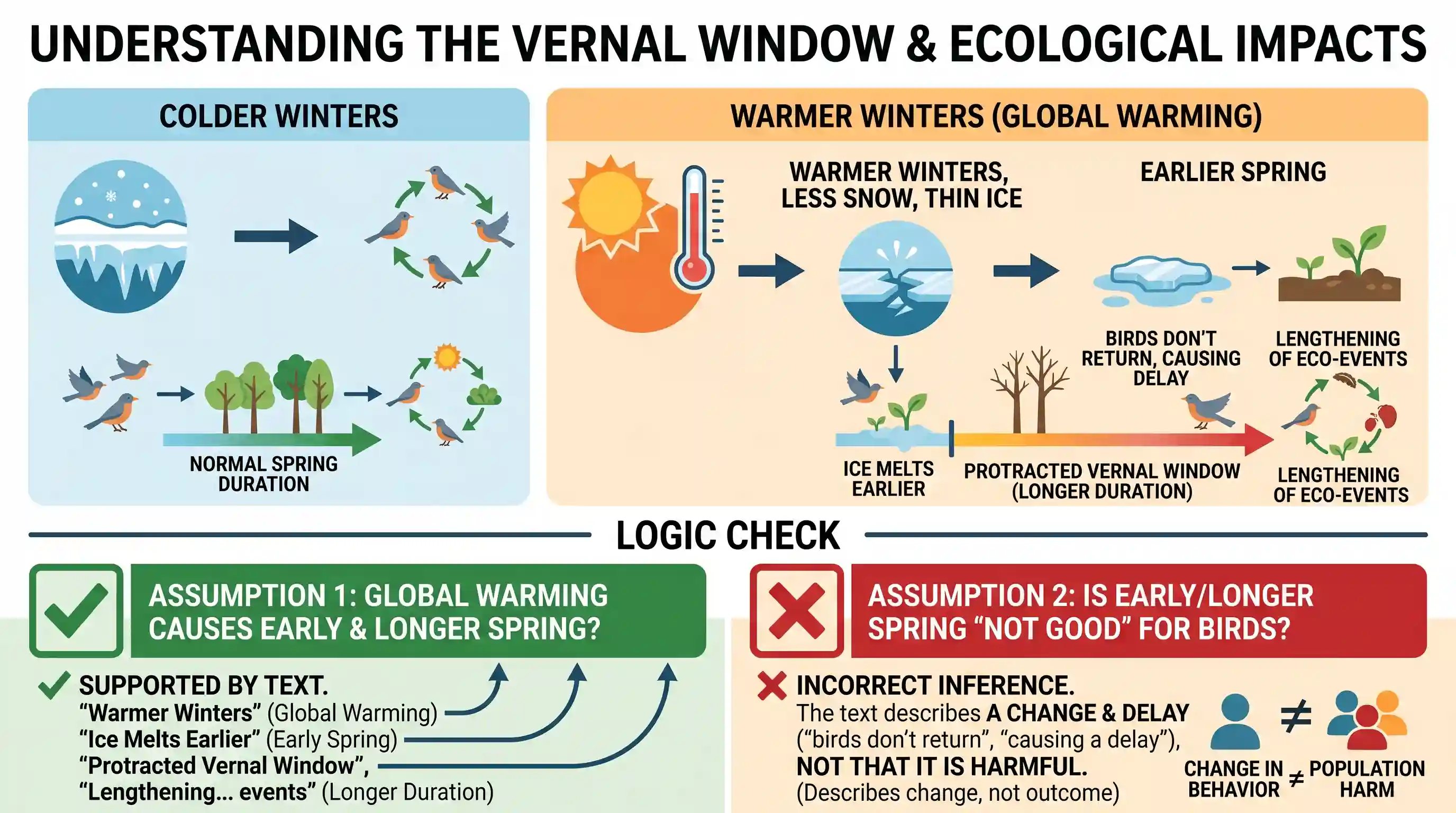
The passage states that "warmer winters with less snow" lead to "a more protracted vernal window" and "As the ice melts earlier, the birds don't return, causing a delay, or lengthening in springtime ecological events."
-
Global warming is causing spring to come early and for longer durations.
- "Warmer winters" implies global warming.
- "As the ice melts earlier" indicates spring coming early.
- "a more protracted vernal window" and "lengthening in springtime ecological events" indicate spring lasting for longer durations.
- This assumption is directly supported by the passage.
-
Early spring and longer period of spring is not good for bird populations.
- The passage states "As the ice melts earlier, the birds don't return, causing a delay, or lengthening in springtime ecological events." This describes a change in bird behavior and its impact on ecological events.
- However, the passage does not explicitly state that this change is "not good for bird populations." It describes a disruption and a delay, but doesn't make a judgment about the overall well-being or survival of the bird populations. It focuses on the timing and consequences for ecological events, agriculture, fisheries, and tourism.
- This assumption goes beyond what is explicitly stated or directly inferable from the passage.
Therefore, only assumption 1 is correct.
Related questions
More UPSC Prelims practice from the same subject and topic.
- Prelims 2023CSATReading Comprehension
We often hear about conflicts among different States in India over river waters. Of the 20 major river systems, 14 are already water- stressed; 75% of the population lives in water- stressed regions, …
- Prelims 2023CSATReading Comprehension
More than half of Indian women and almost a quarter of Indian men of working age suffer from anaemia. According to studies, they are anywhere from 5 - 15% less productive than they could be, as a resu…
- Prelims 2023CSATReading Comprehension
In India, a majority of farmers are marginal and small, less educated and possess low adaptive capabilities to climate change, perhaps because of credit and other constraints. So, one cannot expect au…
- Prelims 2023CSATReading Comprehension
The emissions humans put into the atmosphere now will affect the climate in the middle of the century and onwards. Technological change, meanwhile, could make a future transition away from fossil fuel…
- Prelims 2023CSATReading Comprehension
Environmental problems cause health problems. Substantial changes in lifestyle can reduce environmental or health problems, but this idea appears almost impossible to adopt. With environmental problem…
- Prelims 2023CSATReading Comprehension
Many people are not eating the right food. For some, it is simply a decision to stick with food they enjoy but which is not too healthy. This is leading to an increase in non- communicable diseases. T…