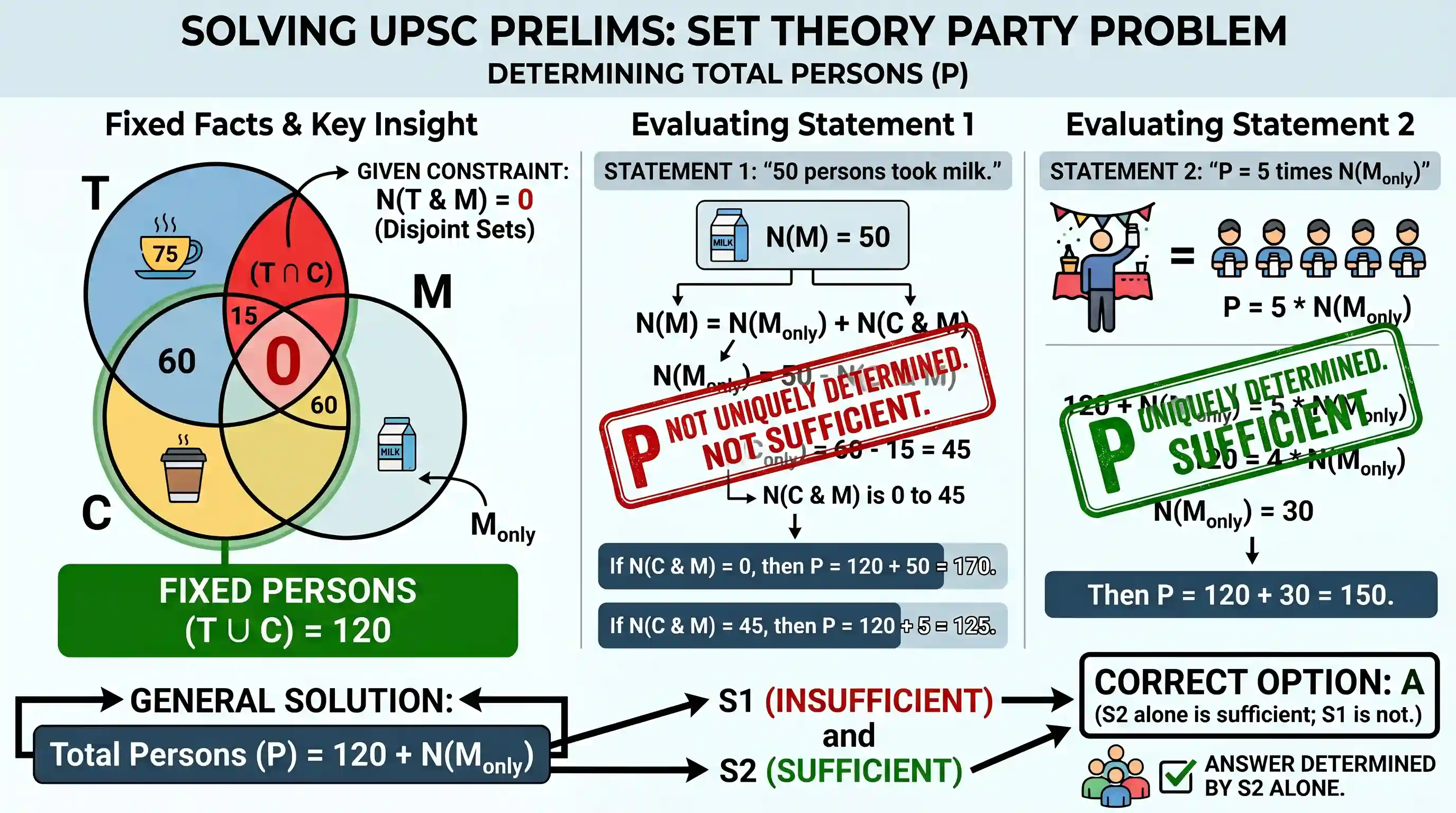
In a party, 75 persons took tea, 60 persons took coffee and 15 persons took both tea and coffee. No one taking milk takes tea. Each person takes at least one drink. Question: How many persons attended the party? Statement- 1: 50 persons took milk. Statement- 2: Number of persons who attended the party is five times the number of persons who took milk only. Which one of the following is correct in respect of the above Question and the Statements?

- AThe Question can be answered by using one of the Statements alone, but cannot be answered using the other Statement alone.Correct
- BThe Question can be answered by using either Statement alone.
- CThe Question can be answered by using both the Statements together, but cannot be answered using either Statement alone.
- DThe Question cannot be answered even by using both the Statements together.
Explanation
Here's a step-by-step analysis:
-
Analyze the given information:
- Tea (T) = 75 persons
- Coffee (C) = 60 persons
- Both Tea and Coffee (T and C) = 15 persons
- No one taking milk (M) takes tea (T). This means the set of people taking milk and the set of people taking tea are disjoint: N(M and T) = 0.
- Each person takes at least one drink. This means the total number of persons (P) is N(T U C U M).
-
Derive a general formula for P: Using the Principle of Inclusion-Exclusion for three sets: P = N(T U C U M) = N(T) + N(C) + N(M) - N(T and C) - N(T and M) - N(C and M) + N(T and C and M)
Substitute the known values and conditions:
- N(T) = 75
- N(C) = 60
- N(T and C) = 15
- N(T and M) = 0 (given)
- Since N(T and M) = 0, it follows that N(T and C and M) must also be 0.
So, the formula simplifies to: P = 75 + 60 + N(M) - 15 - 0 - N(C and M) + 0 P = 120 + N(M) - N(C and M)
Let's also define N(M_only) as the number of people who took only milk. Since no one taking milk takes tea, milk drinkers either took only milk or milk and coffee. So, N(M) = N(M_only) + N(C and M). Substitute N(M) into the formula for P: P = 120 + (N(M_only) + N(C and M)) - N(C and M) P = 120 + N(M_only)
This is a crucial simplified formula: The total number of persons at the party is 120 (those who took tea or coffee or both) plus those who took only milk. To find P, we need to find N(M_only).
-
Evaluate Statement 1: "50 persons took milk." This means N(M) = 50. Using the formula P = 120 + N(M) - N(C and M): P = 120 + 50 - N(C and M) P = 170 - N(C and M)
Now we need to determine N(C and M) (number of people who took coffee and milk).
- The total number of people who took coffee is 60.
- The number of people who took both tea and coffee is 15.
- So, the number of people who took only coffee (not tea) is 60 - 15 = 45.
- Since "No one taking milk takes tea", the people who took milk and coffee (N(C and M)) cannot be among the 15 people who took tea and coffee. They must be from the 45 people who took only coffee.
- Therefore, N(C and M) can be any integer from 0 (no one took both coffee and milk) to 45 (all persons who took only coffee also took milk).
- Since N(C and M) is not uniquely determined, P is not uniquely determined.
- Statement 1 alone is NOT sufficient.
-
Evaluate Statement 2: "Number of persons who attended the party is five times the number of persons who took milk only." This means P = 5 * N(M_only). Using our simplified formula P = 120 + N(M_only): 5 * N(M_only) = 120 + N(M_only) 4 * N(M_only) = 120 N(M_only) = 30
Now that N(M_only) is uniquely determined, we can find P: P = 120 + 30 = 150. (Alternatively, P = 5 * 30 = 150).
- Statement 2 alone IS sufficient.
-
Conclusion: Statement 1 alone is not sufficient, but Statement 2 alone is sufficient. This matches option A.
The final answer is A
Related questions
More UPSC Prelims practice from the same subject and topic.
- Prelims 2023CSATQuantitative Aptitude
What is the remainder when 85 × 87 × 89 × 91 × 95 × 96 is divided by 100?
- Prelims 2023CSATQuantitative Aptitude
What is the unit digit in the expansion of (57242)^(9×7×5×3×1)?
- Prelims 2023CSATQuantitative Aptitude
If ABC and DEF are both 3-digit numbers such that A, B, C, D, E and F are distinct non-zero digits such that ABC + DEF = 1111 , then what is the value of A + B + C + D + E + F ?
- Prelims 2023CSATQuantitative Aptitude
D is a 3-digit number such that the ratio of the number to the sum of its digits is least. What is the difference between the digit at the hundred's place and the digit at the unit's place of D?
- Prelims 2023CSATQuantitative Aptitude
Three of the five positive integers p, q, r, s, t are even and two of them are odd (not necessarily in order). Consider the following: 1. p + q + r - s - t is definitely even. 2. 2p + q + 2r - 2s + t …
- Prelims 2023CSATQuantitative Aptitude
Consider the following in respect of prime number p and composite number c. 1. p + c{p - c} can be even. 2. 2p + c can be odd. 3. pc can be odd. Which of the statements given above are correct?