Consider a 3-digit number. Question: What is the number? Statement- 1: The sum of the digits of the number is equal to the product of the digits. Statement- 2: The number is divisible by the sum of the digits of the number. Which one of the following is correct in respect of the above Question and the Statements?

- AThe Question can be answered by using one of the Statements alone, but cannot be answered using the other Statement alone.
- BThe Question can be answered by using either Statement alone.
- CThe Question can be answered by using both the Statements together, but cannot be answered using either Statement alone.
- DThe Question cannot be answered even by using both the Statements together.Correct
Explanation
Here's a concise explanation:
Let the 3-digit number be 100a + 10b + c.
-
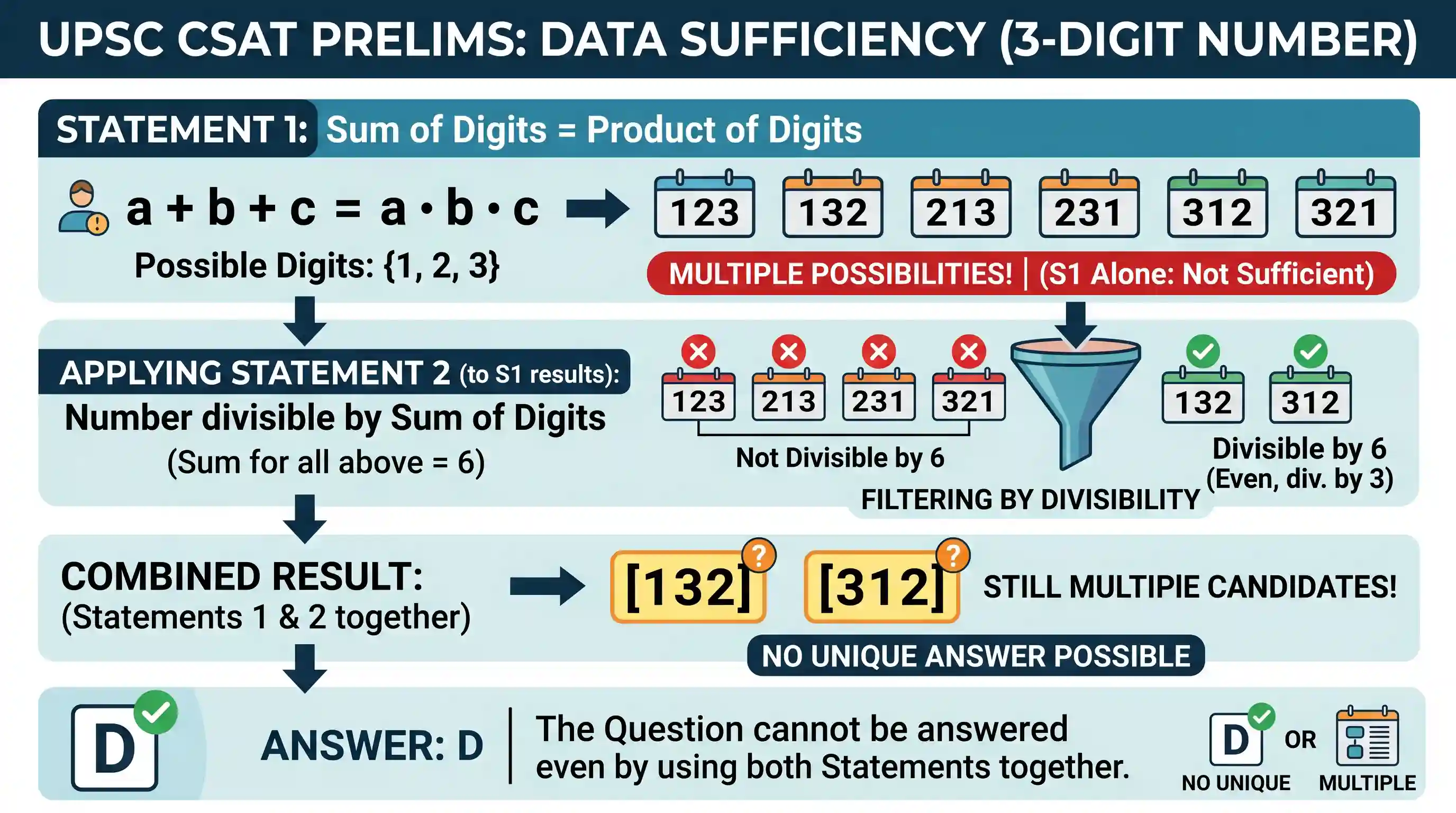
Analyze Statement 1: "The sum of the digits of the number is equal to the product of the digits." This means a + b + c = a * b * c. If any digit is 0, the product is 0, implying a+b+c=0, which is impossible for a 3-digit number (a cannot be 0). So all digits must be non-zero. Through systematic checking (or by proving that if a>=2, the product grows much faster than the sum), it can be shown that the only set of digits satisfying this condition is {1, 2, 3}. These digits can form the following 3-digit numbers: 123, 132, 213, 231, 312, 321. Since there are multiple possible numbers, Statement 1 alone is NOT sufficient to uniquely determine the number.
-
Analyze Statement 2: "The number is divisible by the sum of the digits of the number." Let's test some numbers:
- 111: Sum of digits = 3. 111 is divisible by 3 (111/3 = 37).
- 112: Sum of digits = 4. 112 is divisible by 4 (112/4 = 28).
- 120: Sum of digits = 3. 120 is divisible by 3 (120/3 = 40). There are many such numbers. Thus, Statement 2 alone is NOT sufficient to uniquely determine the number.
-
Analyze both Statements together: From Statement 1, the digits must be {1, 2, 3}. The sum of these digits is 1 + 2 + 3 = 6. From Statement 2, the number must be divisible by the sum of its digits, which is 6. A number is divisible by 6 if it is divisible by both 2 and 3. All numbers formed by digits {1, 2, 3} (like 123, 132, etc.) have a sum of digits equal to 6, so they are all divisible by 3. Now we need to check which of these are also divisible by 2 (i.e., end in an even digit):
- 123 (ends in 3, not divisible by 2)
- 132 (ends in 2, divisible by 2)
- 213 (ends in 3, not divisible by 2)
- 231 (ends in 1, not divisible by 2)
- 312 (ends in 2, divisible by 2)
- 321 (ends in 1, not divisible by 2) The numbers that satisfy both statements are 132 and 312. Since there are still two possible numbers, even using both statements together, we cannot uniquely determine the number.
Conclusion: The Question cannot be answered even by using both the Statements together. Therefore, option D is correct.
Related questions
More UPSC Prelims practice from the same subject and topic.
- Prelims 2023CSATLogical Reasoning
Consider the following statements: 1. A is older than B. 2. C and D are of the same age. 3. E is the youngest. 4. F is younger than D. 5. F is older than A. How many statements given above are require…
- Prelims 2023CSATLogical Reasoning
Consider the following statements in respect of five candidates P, Q, R, S and T. Two statements are true and one statement is false. True Statement: One of P and Q was selected for the job. False Sta…
- Prelims 2023CSATLogical Reasoning
Let P, Q, R, S and T be five statements such that: I. If P is true, then both Q and S are true. II. If R and S are true, then T is false. Which of the following can be concluded? 1. If T is true, then…
- Prelims 2023CSATLogical Reasoning
If 7 ⊕ 9 ⊕ 10 = 8 , 9 ⊕ 11 ⊕ 30 = 5 , 11 ⊕ 17 ⊕ 21 = 13 , what is the value of 23 ⊕ 4 ⊕ 15 ?
- Prelims 2023CSATLogical Reasoning
If 'ZERO' is written as 'CHUR', then how is 'PLAYER' written?
- Prelims 2023CSATLogical Reasoning
Consider the following including the Question and the Statements: There are 5 members A, B, C, D, E in a family. Question: What is the relation of E to B? Statement- 1: A and B are a married couple. S…