Let P, Q, R, S and T be five statements such that: I. If P is true, then both Q and S are true. II. If R and S are true, then T is false. Which of the following can be concluded? 1. If T is true, then at least one of P and R must be false. 2. If Q is true, then P is true. Select the correct answer using the code given below:

- A1 onlyCorrect
- B2 only
- CBoth 1 and 2
- DNeither 1 nor 2
Explanation
Let's analyze the given statements:
I. If P is true, then both Q and S are true. (P -> (Q and S)) II. If R and S are true, then T is false. ((R and S) -> not T)
Now let's evaluate each conclusion:
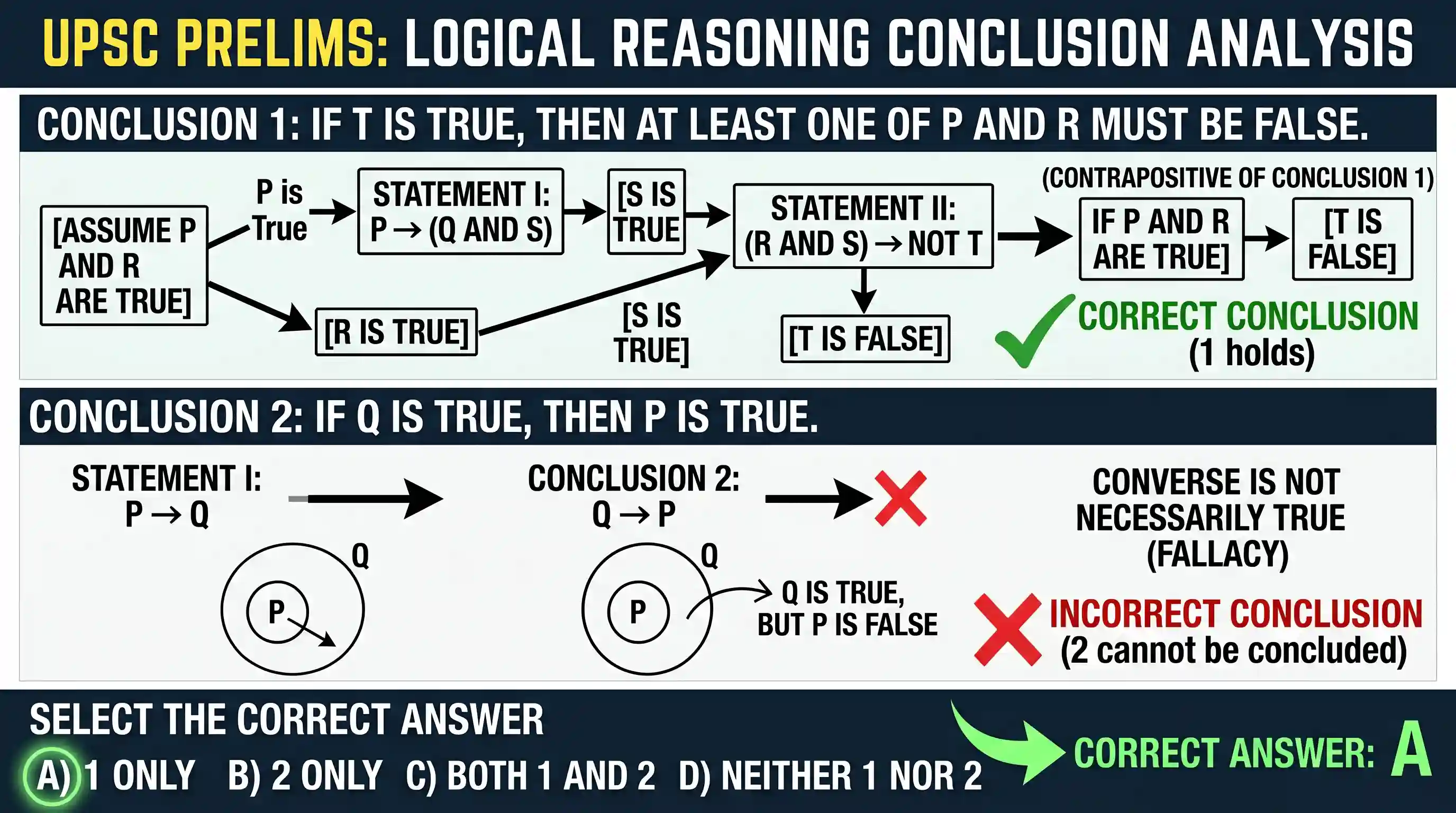
Conclusion 1: If T is true, then at least one of P and R must be false. This can be written as: T -> (not P or not R). Let's try to prove its contrapositive: If (P and R) is true, then T must be false. Assume (P and R) is true. This means P is true AND R is true.
- If P is true, then from Statement I, (Q and S) is true. This implies S is true.
- We now have R is true (from our assumption) and S is true (from step 1).
- Since (R and S) is true, then from Statement II, T must be false. So, if (P and R) is true, then T is false. This is the contrapositive of Conclusion 1. Since the contrapositive is true, Conclusion 1 itself is true.
Alternatively, let's assume T is true and see what follows:
- If T is true, then 'not T' is false.
- From Statement II, ((R and S) -> not T). Since the consequent (not T) is false, the antecedent (R and S) must also be false for the implication to be true.
- So, if T is true, then (R and S) is false. This means (not R or not S) is true.
- Now we need to show that (not P or not R) is true. Case A: Assume P is true. If P is true, then from Statement I, (Q and S) is true, which means S is true. We know from step 3 that (not R or not S) is true. If S is true, then (not R or false) must be true, which implies not R is true. So, if P is true and T is true, then not R is true. This makes (not P or not R) true. Case B: Assume P is false. If P is false, then (not P) is true. This automatically makes (not P or not R) true, regardless of R. In both cases, if T is true, then (not P or not R) is true. Therefore, Conclusion 1 is correct.
Conclusion 2: If Q is true, then P is true. (Q -> P) From Statement I, we have P -> (Q and S). This implies P -> Q. Conclusion 2 (Q -> P) is the converse of P -> Q. The converse of a true statement is not necessarily true. Consider a scenario where P is false, Q is true, and S is true.
- Statement I (P -> (Q and S)) becomes (False -> (True and True)), which is (False -> True), which is True. So Statement I holds.
- Statement II ((R and S) -> not T) can also hold (e.g., if R is true, S is true, T is false). In this scenario, Q is true, but P is false. So, "If Q is true, then P is true" is false. Therefore, Conclusion 2 cannot be concluded.
Based on the analysis, only Conclusion 1 is correct.
The final answer is A) 1 only.
Related questions
More UPSC Prelims practice from the same subject and topic.
- Prelims 2023CSATLogical Reasoning
Consider the following statements: 1. A is older than B. 2. C and D are of the same age. 3. E is the youngest. 4. F is younger than D. 5. F is older than A. How many statements given above are require…
- Prelims 2023CSATLogical Reasoning
Consider a 3-digit number. Question: What is the number? Statement- 1: The sum of the digits of the number is equal to the product of the digits. Statement- 2: The number is divisible by the sum of th…
- Prelims 2023CSATLogical Reasoning
Consider the following statements in respect of five candidates P, Q, R, S and T. Two statements are true and one statement is false. True Statement: One of P and Q was selected for the job. False Sta…
- Prelims 2023CSATLogical Reasoning
If 7 ⊕ 9 ⊕ 10 = 8 , 9 ⊕ 11 ⊕ 30 = 5 , 11 ⊕ 17 ⊕ 21 = 13 , what is the value of 23 ⊕ 4 ⊕ 15 ?
- Prelims 2023CSATLogical Reasoning
If 'ZERO' is written as 'CHUR', then how is 'PLAYER' written?
- Prelims 2023CSATLogical Reasoning
Consider the following including the Question and the Statements: There are 5 members A, B, C, D, E in a family. Question: What is the relation of E to B? Statement- 1: A and B are a married couple. S…