Consider the following statements: 1. A is older than B. 2. C and D are of the same age. 3. E is the youngest. 4. F is younger than D. 5. F is older than A. How many statements given above are required to determine the oldest person/persons?

- AOnly two
- BOnly three
- COnly four
- DAll fiveCorrect
Explanation
To determine the oldest person, we must analyze the relationships provided in the statements:
- Statement 1 tells us A is older than B.
- Statement 2 tells us C and D are the same age.
- Statement 3 tells us E is the youngest, so E cannot be the oldest.
- Statement 4 tells us D is older than F.
- Statement 5 tells us F is older than A.
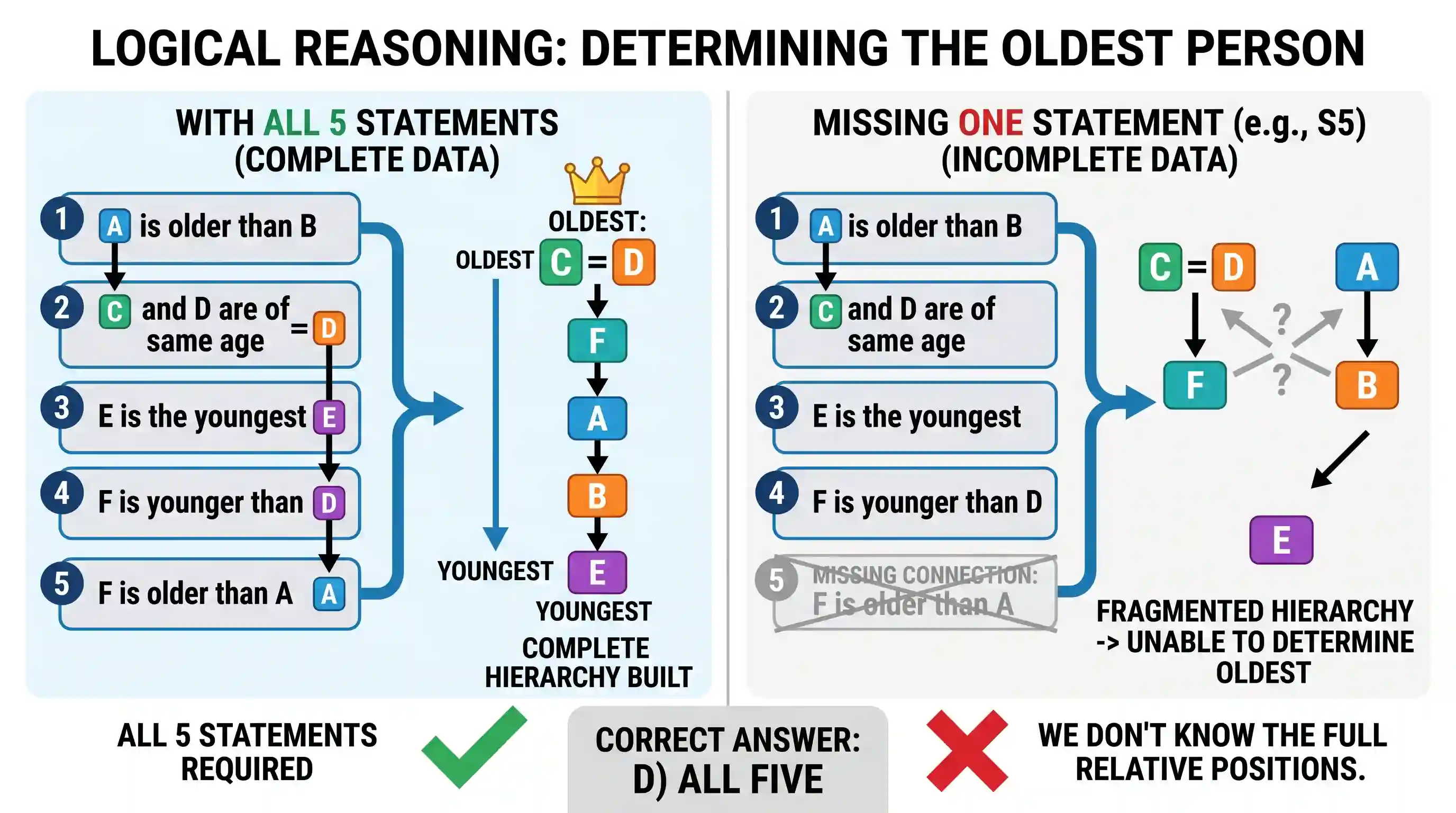
By combining these, we establish a hierarchy: C and D are equal and older than F. F is older than A. A is older than B. E is the youngest.
This creates the sequence: (C = D) > F > A > B > E.
To reach this conclusion, we need every piece of information:
- We need 4 and 5 to know D is older than A.
- We need 1 to know A is older than B.
- We need 2 to include C in the top position with D.
- We need 3 to ensure E is not the oldest.
Without any one of these statements, we cannot definitively rank all individuals to confirm that C and D are the oldest. Therefore, all five statements are required.
Related questions
More UPSC Prelims practice from the same subject and topic.
- Prelims 2023CSATLogical Reasoning
Consider a 3-digit number. Question: What is the number? Statement- 1: The sum of the digits of the number is equal to the product of the digits. Statement- 2: The number is divisible by the sum of th…
- Prelims 2023CSATLogical Reasoning
Consider the following statements in respect of five candidates P, Q, R, S and T. Two statements are true and one statement is false. True Statement: One of P and Q was selected for the job. False Sta…
- Prelims 2023CSATLogical Reasoning
Let P, Q, R, S and T be five statements such that: I. If P is true, then both Q and S are true. II. If R and S are true, then T is false. Which of the following can be concluded? 1. If T is true, then…
- Prelims 2023CSATLogical Reasoning
If 7 ⊕ 9 ⊕ 10 = 8 , 9 ⊕ 11 ⊕ 30 = 5 , 11 ⊕ 17 ⊕ 21 = 13 , what is the value of 23 ⊕ 4 ⊕ 15 ?
- Prelims 2023CSATLogical Reasoning
If 'ZERO' is written as 'CHUR', then how is 'PLAYER' written?
- Prelims 2023CSATLogical Reasoning
Consider the following including the Question and the Statements: There are 5 members A, B, C, D, E in a family. Question: What is the relation of E to B? Statement- 1: A and B are a married couple. S…