A rectangular floor measures 4 m in length and 2 · 2 m in breadth. Tiles of size 140 cm by 60 cm have to be laid such that the tiles do not overlap. A tile can be placed in any orientation so long as its edges are parallel to the edges of the floor. What is the maximum number of tiles that can be accommodated on the floor?

- A6
- B7
- C8Correct
- D9
Explanation
The problem asks for the maximum number of tiles that can be accommodated on a rectangular floor.
-
Convert all dimensions to the same unit (centimeters): Floor length = 4 m = 400 cm Floor breadth = 2.2 m = 220 cm Tile dimensions = 140 cm by 60 cm
-
A tile can be placed in two orientations: 140 cm x 60 cm or 60 cm x 140 cm.
-
Let's try to fit the tiles systematically. Consider placing tiles predominantly in one orientation first, then filling the remaining space with the other orientation if possible.
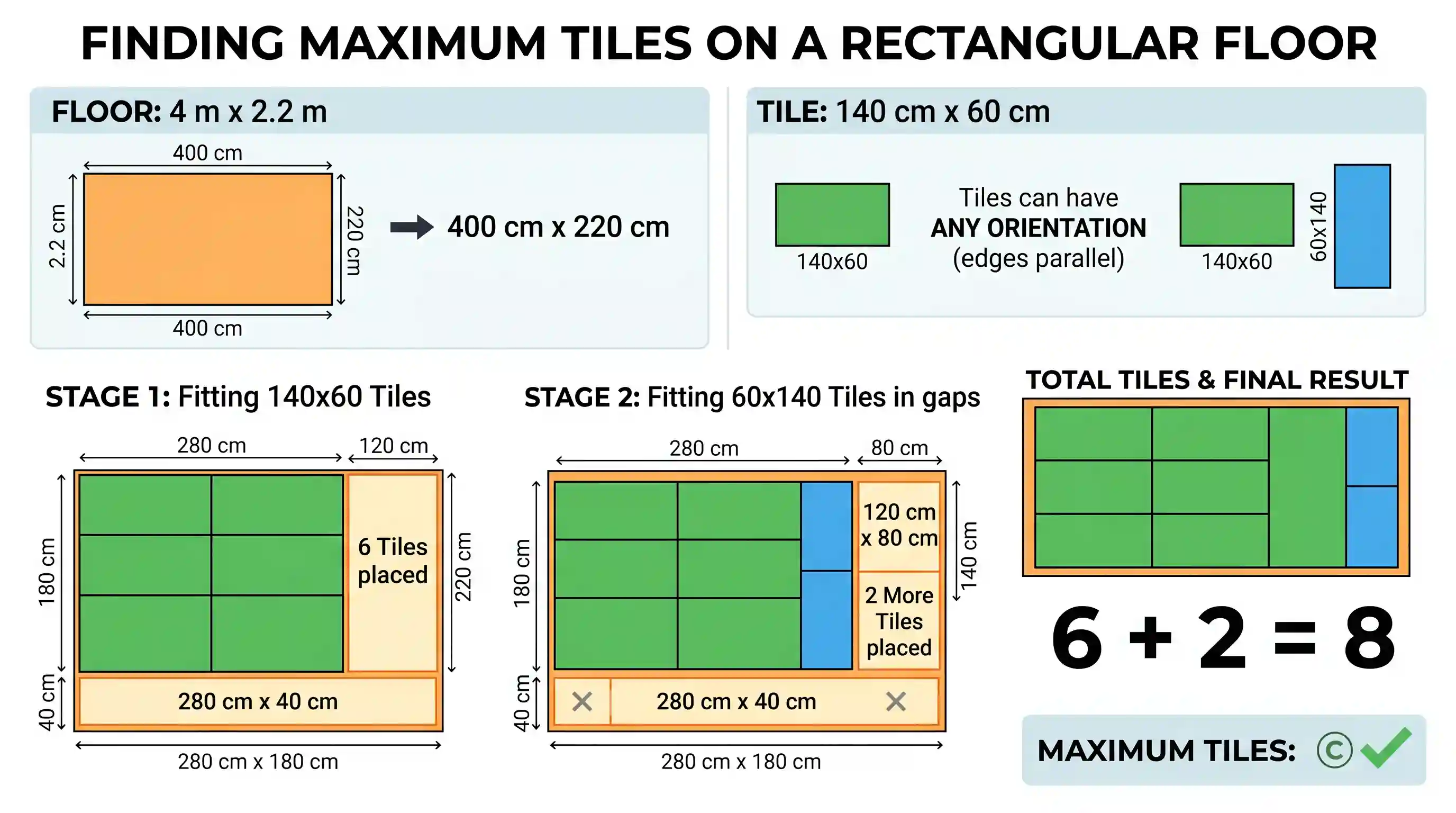
Strategy 1: Place tiles with their 140 cm side along the floor's 400 cm length and 60 cm side along the floor's 220 cm breadth.
- Number of tiles along 400 cm length = 400 cm / 140 cm = 2 tiles (2 * 140 = 280 cm used). Remaining length = 400 - 280 = 120 cm.
- Number of tiles along 220 cm breadth = 220 cm / 60 cm = 3 tiles (3 * 60 = 180 cm used). Remaining breadth = 220 - 180 = 40 cm.
- This arrangement fits 2 rows * 3 columns = 6 tiles (in 140x60 orientation). These 6 tiles cover an area of 280 cm x 180 cm.
-
Now, consider the remaining floor area. This L-shaped area can be broken down into two rectangles:
- Rectangle 1: (400 - 280) cm x 220 cm = 120 cm x 220 cm (the strip along the remaining length).
- Rectangle 2: 280 cm x (220 - 180) cm = 280 cm x 40 cm (the strip along the remaining breadth, below the first 180 cm height).
-
Try to fit more tiles in Rectangle 1 (120 cm x 220 cm) using the other tile orientation (60 cm x 140 cm):
- Number of tiles along 120 cm = 120 cm / 60 cm = 2 tiles.
- Number of tiles along 220 cm = 220 cm / 140 cm = 1 tile.
- This fits 2 * 1 = 2 tiles (in 60x140 orientation). These 2 tiles cover an area of 120 cm x 140 cm within Rectangle 1.
-
Total tiles so far = 6 tiles + 2 tiles = 8 tiles.
-
Check if any more tiles can be fitted:
- In Rectangle 2 (280 cm x 40 cm): Neither 140x60 nor 60x140 tiles can fit, as 40 cm is smaller than both 60 cm and 140 cm.
- The remaining portion of Rectangle 1 after placing 2 tiles is 120 cm x (220 - 140) cm = 120 cm x 80 cm. Neither 140x60 nor 60x140 tiles can fit here (120 cm is less than 140 cm, and 80 cm is less than 140 cm).
-
Therefore, the maximum number of tiles that can be accommodated is 8.
Alternative Strategy (starting with 60 cm side along 400 cm length):
- Number of tiles along 400 cm length = 400 cm / 60 cm = 6 tiles (360 cm used). Remaining length = 40 cm.
- Number of tiles along 220 cm breadth = 220 cm / 140 cm = 1 tile (140 cm used). Remaining breadth = 80 cm.
- This fits 6 * 1 = 6 tiles (in 60x140 orientation), covering 360 cm x 140 cm.
- Remaining area: 40 cm x 220 cm and 360 cm x 80 cm.
- In 360 cm x 80 cm (using 140x60 orientation): 360/140 = 2 tiles, 80/60 = 1 tile. So, 2 * 1 = 2 tiles can fit.
- Total = 6 + 2 = 8 tiles. No more tiles fit in the remaining spaces.
Both primary strategies yield 8 tiles, confirming it as the maximum.
The final answer is C) 8.
Related questions
More UPSC Prelims practice from the same subject and topic.
- Prelims 2023CSATQuantitative Aptitude
125 identical cubes are arranged in the form of a cubical block. How many cubes are surrounded by other cubes from each side?
- Prelims 2023CSATQuantitative Aptitude
A cuboid of dimensions 7 cm × 5 cm × 3 cm is painted red, green and blue colour on each pair of opposite faces of dimensions 7 cm × 5 cm , 5 cm × 3 cm , 7 cm × 3 cm respectively. Then the cuboid is cu…
- Prelims 2023CSATQuantitative Aptitude
Raj has ten pairs of red, nine pairs of white and eight pairs of black shoes in a box. If he randomly picks shoes one by one (without replacement) from the box to get a red pair of shoes to wear, what…
- Prelims 2023CSATQuantitative Aptitude
In how many ways can a batsman score exactly 25 runs by scoring single runs, fours and sixes only, irrespective of the sequence of scoring shots?
- Prelims 2023CSATQuantitative Aptitude
There are four letters and four envelopes and exactly one letter is to be put in exactly one envelope with the correct address. If the letters are randomly inserted into the envelopes, then consider t…
- Prelims 2023CSATQuantitative Aptitude
What is the remainder when 85 × 87 × 89 × 91 × 95 × 96 is divided by 100?