There are five persons P, Q, R, S and T each one of whom has to be assigned one task. Neither P nor Q can be assigned Task-1. Task-2 must be assigned to either R or S. In how many ways can the assignment be done?

- A6
- B12
- C18
- D24Correct
Explanation
This is a problem of permutations with constraints. Let's break down the assignment process step-by-step based on the given conditions:
-
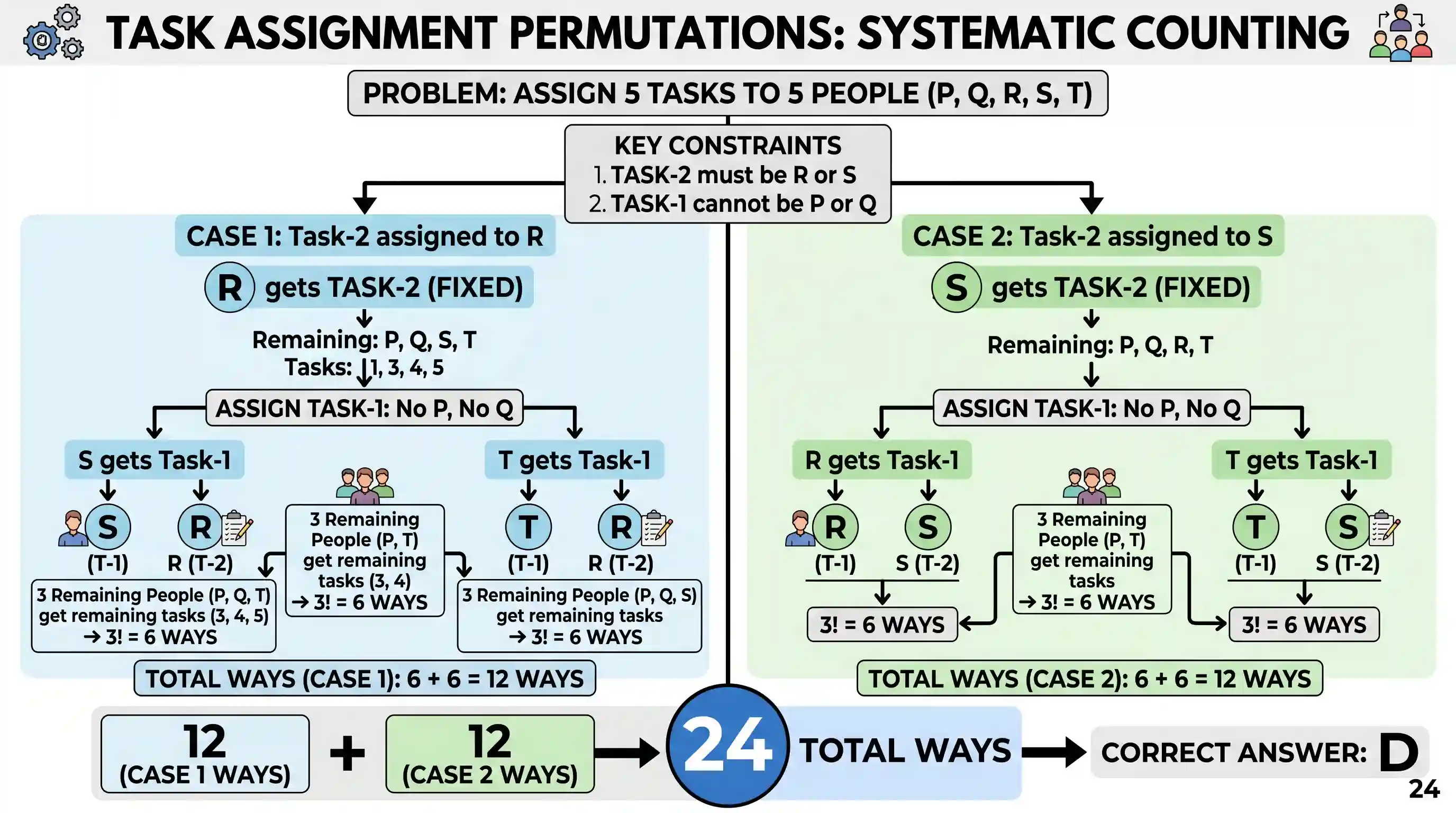
Constraint on Task-2: Task-2 must be assigned to either R or S. This gives us two main cases:
-
Case 1: R is assigned Task-2. If R gets Task-2, then R and Task-2 are fixed. Remaining persons: P, Q, S, T Remaining tasks: Task-1, Task-3, Task-4, Task-5
Now, consider the constraint on Task-1: Neither P nor Q can be assigned Task-1. Since R is already assigned Task-2, Task-1 must be assigned to either S or T. (2 choices)
-
Subcase 1.1: S is assigned Task-1. If S gets Task-1 (and R gets Task-2), then S, R, Task-1, Task-2 are fixed. Remaining persons: P, Q, T Remaining tasks: Task-3, Task-4, Task-5 These 3 persons can be assigned to the 3 remaining tasks in 3! = 3 x 2 x 1 = 6 ways.
-
Subcase 1.2: T is assigned Task-1. If T gets Task-1 (and R gets Task-2), then T, R, Task-1, Task-2 are fixed. Remaining persons: P, Q, S Remaining tasks: Task-3, Task-4, Task-5 These 3 persons can be assigned to the 3 remaining tasks in 3! = 3 x 2 x 1 = 6 ways.
Total ways for Case 1 (R assigned Task-2) = 6 + 6 = 12 ways.
-
-
Case 2: S is assigned Task-2. If S gets Task-2, then S and Task-2 are fixed. Remaining persons: P, Q, R, T Remaining tasks: Task-1, Task-3, Task-4, Task-5
Again, consider the constraint on Task-1: Neither P nor Q can be assigned Task-1. Since S is already assigned Task-2, Task-1 must be assigned to either R or T. (2 choices)
-
Subcase 2.1: R is assigned Task-1. If R gets Task-1 (and S gets Task-2), then R, S, Task-1, Task-2 are fixed. Remaining persons: P, Q, T Remaining tasks: Task-3, Task-4, Task-5 These 3 persons can be assigned to the 3 remaining tasks in 3! = 3 x 2 x 1 = 6 ways.
-
Subcase 2.2: T is assigned Task-1. If T gets Task-1 (and S gets Task-2), then T, S, Task-1, Task-2 are fixed. Remaining persons: P, Q, R Remaining tasks: Task-3, Task-4, Task-5 These 3 persons can be assigned to the 3 remaining tasks in 3! = 3 x 2 x 1 = 6 ways.
Total ways for Case 2 (S assigned Task-2) = 6 + 6 = 12 ways.
-
-
-
Total Ways: Sum the ways from both main cases. Total ways = 12 (from Case 1) + 12 (from Case 2) = 24 ways.
The final answer is D.
Related questions
More UPSC Prelims practice from the same subject and topic.
- Prelims 2023CSATQuantitative Aptitude
Raj has ten pairs of red, nine pairs of white and eight pairs of black shoes in a box. If he randomly picks shoes one by one (without replacement) from the box to get a red pair of shoes to wear, what…
- Prelims 2023CSATQuantitative Aptitude
In how many ways can a batsman score exactly 25 runs by scoring single runs, fours and sixes only, irrespective of the sequence of scoring shots?
- Prelims 2023CSATQuantitative Aptitude
There are four letters and four envelopes and exactly one letter is to be put in exactly one envelope with the correct address. If the letters are randomly inserted into the envelopes, then consider t…
- Prelims 2023CSATQuantitative Aptitude
How many distinct 8-digit numbers can be formed by rearranging the digits of the number 11223344 such that odd digits occupy odd positions and even digits occupy even positions?
- Prelims 2023CSATQuantitative Aptitude
If p , q , r and s are distinct single digit positive numbers, then what is the greatest value of (p + q)(r + s) ?
- Prelims 2023CSATQuantitative Aptitude
ABCD is a square. One point on each of AB and CD; and two distinct points on each of BC and DA are chosen. How many distinct triangles can be drawn using any three points as vertices out of these six …