What is the remainder if 2¹⁹² is divided by 6?

- A0
- B1
- C2
- D4Correct
Explanation
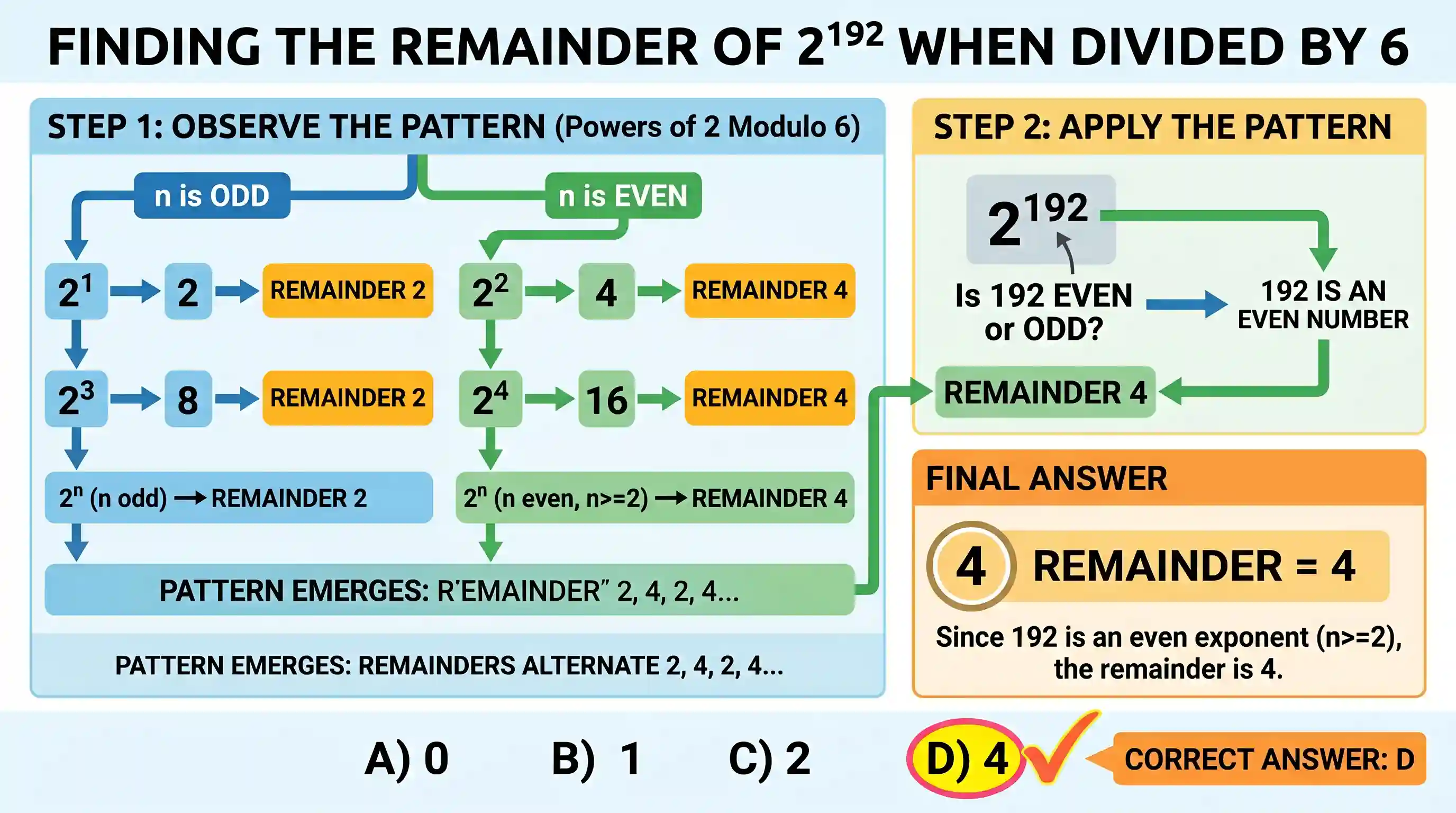
To find the remainder when 2^192 is divided by 6, let's look at the pattern of powers of 2 modulo 6:
2^1 = 2 2^2 = 4 2^3 = 8, which is 2 (mod 6) 2^4 = 16, which is 4 (mod 6) 2^5 = 32, which is 2 (mod 6)
We observe a pattern:
- For n = 1, 2^n mod 6 = 2.
- For even n >= 2, 2^n mod 6 = 4.
- For odd n >= 3, 2^n mod 6 = 2.
The exponent in our question is 192, which is an even number and 192 >= 2. According to the pattern, when the exponent is an even number greater than or equal to 2, the remainder is 4.
Therefore, 2^192 divided by 6 leaves a remainder of 4.
Analysis of options: A) 0: Incorrect. 2^192 is a power of 2, so it only has prime factors of 2. For it to be divisible by 6, it would need a prime factor of 3, which it does not have. B) 1: Incorrect. Any power of 2 (for n>=1) is an even number. An even number cannot leave a remainder of 1 when divided by an even number like 6. C) 2: Incorrect. This would be the remainder if the exponent were an odd number greater than or equal to 3 (e.g., 2^3 = 8, 8 mod 6 = 2). However, 192 is an even exponent. D) 4: Correct. As per the pattern observed, for an even exponent n >= 2, 2^n mod 6 is 4.
The final answer is D.
Related questions
More UPSC Prelims practice from the same subject and topic.
- Prelims 2023CSATQuantitative Aptitude
What is the remainder when 85 × 87 × 89 × 91 × 95 × 96 is divided by 100?
- Prelims 2023CSATQuantitative Aptitude
What is the unit digit in the expansion of (57242)^(9×7×5×3×1)?
- Prelims 2023CSATQuantitative Aptitude
If ABC and DEF are both 3-digit numbers such that A, B, C, D, E and F are distinct non-zero digits such that ABC + DEF = 1111 , then what is the value of A + B + C + D + E + F ?
- Prelims 2023CSATQuantitative Aptitude
D is a 3-digit number such that the ratio of the number to the sum of its digits is least. What is the difference between the digit at the hundred's place and the digit at the unit's place of D?
- Prelims 2023CSATQuantitative Aptitude
Three of the five positive integers p, q, r, s, t are even and two of them are odd (not necessarily in order). Consider the following: 1. p + q + r - s - t is definitely even. 2. 2p + q + 2r - 2s + t …
- Prelims 2023CSATQuantitative Aptitude
Consider the following in respect of prime number p and composite number c. 1. p + c{p - c} can be even. 2. 2p + c can be odd. 3. pc can be odd. Which of the statements given above are correct?