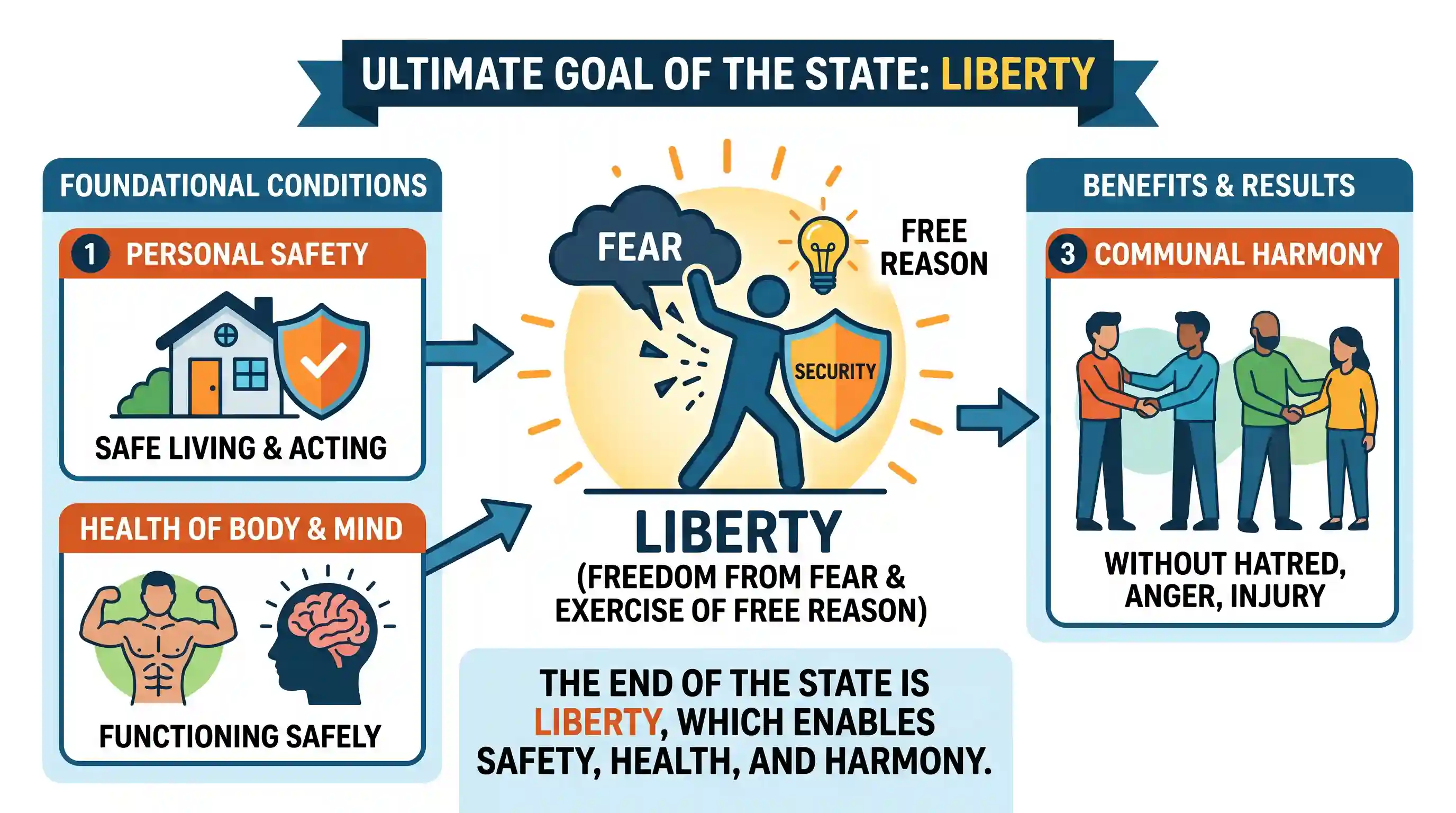
"The last end of the state is not to dominate men, nor to restrain them by fear; rather it is so to free each man from fear that he may live and act with full security and without injury to himself or his neighbour. The end of the state, I repeat, is not to make rational beings into brute beasts and machines. It is to enable their bodies and their minds to function safely. It is to lead men to live by, and to exercise, a free reason; that they may not waste their strength in hatred, anger and guile, nor act unfairly toward one another." Based on the above passage, which one of the following terms best expresses the ultimate goal of the state?

- APersonal safety
- BHealth of body and mind
- CCommunal harmony
- DLibertyCorrect
Explanation
The passage describes the state's ultimate goal as freeing individuals from fear so they can live and act with full security, enable their bodies and minds to function safely, and most importantly, "to lead men to live by, and to exercise, a free reason."
Let's analyze the options:
A) Personal safety: The passage mentions "free each man from fear that he may live and act with full security." While personal safety is a crucial aspect, it is presented as a means or a condition for a larger goal – to live and act freely. It's a component, not the ultimate end.
B) Health of body and mind: The passage states, "It is to enable their bodies and their minds to function safely." Similar to personal safety, this is a necessary condition or an immediate objective, but not the overarching ultimate goal. The passage goes further to discuss how men should live and exercise their reason.
C) Communal harmony: The passage mentions "without injury to himself or his neighbour" and "nor act unfairly toward one another," which points to communal harmony. However, this harmony is described as a result of men living by and exercising "free reason." The ultimate goal is enabling that "free reason," which then leads to harmonious living.
D) Liberty: This term best encapsulates the core message. The passage emphasizes "to free each man from fear," "live and act with full security," and crucially, "to lead men to live by, and to exercise, a free reason." The ability to live and act freely, guided by reason, without domination or fear, is the essence of liberty. Personal safety, health, and communal harmony are all components or consequences that flow from this fundamental liberty. The freedom to exercise "free reason" is the ultimate aim described.
Related questions
More UPSC Prelims practice from the same subject and topic.
- Prelims 2023CSATReading Comprehension
We often hear about conflicts among different States in India over river waters. Of the 20 major river systems, 14 are already water- stressed; 75% of the population lives in water- stressed regions, …
- Prelims 2023CSATReading Comprehension
More than half of Indian women and almost a quarter of Indian men of working age suffer from anaemia. According to studies, they are anywhere from 5 - 15% less productive than they could be, as a resu…
- Prelims 2023CSATReading Comprehension
In India, a majority of farmers are marginal and small, less educated and possess low adaptive capabilities to climate change, perhaps because of credit and other constraints. So, one cannot expect au…
- Prelims 2023CSATReading Comprehension
The emissions humans put into the atmosphere now will affect the climate in the middle of the century and onwards. Technological change, meanwhile, could make a future transition away from fossil fuel…
- Prelims 2023CSATReading Comprehension
Environmental problems cause health problems. Substantial changes in lifestyle can reduce environmental or health problems, but this idea appears almost impossible to adopt. With environmental problem…
- Prelims 2023CSATReading Comprehension
Many people are not eating the right food. For some, it is simply a decision to stick with food they enjoy but which is not too healthy. This is leading to an increase in non- communicable diseases. T…