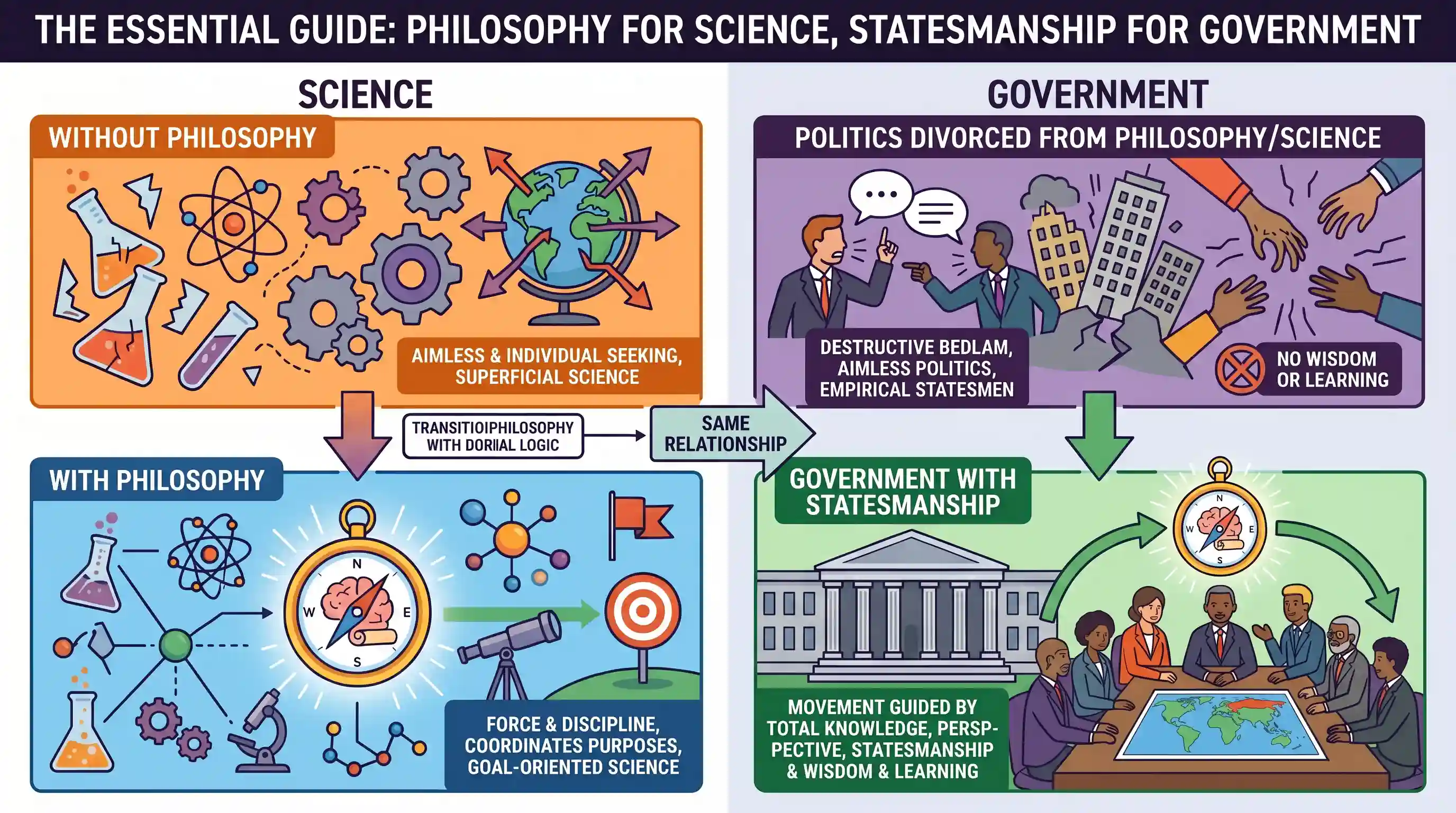
"Science by itself is not enough, there must be a force and discipline outside the sciences to coordinate them and point to a goal. It is not possible to run a course aright when the goal itself has not been rightly placed. What science needs is philosophy - the analysis of scientific method and the coordination of scientific purposes and results; without this, any science must be superficial. Government suffers, precisely like science, for lack of philosophy. Philosophy bears to science the same relationship which statesmanship bears to politics : movement guided by total knowledge and perspective, as against aimless and individual seeking. Just as the pursuit of knowledge becomes scholasticism when divorced from the actual needs of men and life, so the pursuit of politics becomes a destructive bedlam when divorced from science and philosophy." Which one of the following statements best reflects the most rational, logical and practical message conveyed by the passage?

- AModern statesmen need to be well trained in scientific methods and philosophical thinking to enable them to have a better perspective of their roles, responsibilities and goals.
- BIt is not desirable to have Governments managed by empirical statesmen unless well mixed with others who are grounded in learning and reflect wisdom.Correct
- CAs the statesmen/bureaucrats are the products of a society, it is desirable to have a system of education in a society that focuses on training its citizens in scientific method and philosophical thinking from a very early age.
- DIt is desirable that all scientists need to be philosophers as well to make their work goal-oriented and thus purposeful and useful to the society.
Explanation
The passage argues that both science and government suffer from a lack of "philosophy" or a guiding "statesmanship" that provides total knowledge, perspective, and a clear goal. It contrasts this with aimless, individual seeking or purely empirical approaches, which lead to superficiality or destructive outcomes.
Let's analyze each option:
A) Modern statesmen need to be well trained in scientific methods and philosophical thinking... While the passage draws parallels, its primary emphasis for statesmen is on "statesmanship" (total knowledge and perspective), which is analogous to philosophy for science. It doesn't explicitly state that statesmen themselves need to be "well trained in scientific methods." The core message is about the guidance and perspective that philosophy/statesmanship provides, not the specific training of individual leaders in scientific methods.
B) It is not desirable to have Governments managed by empirical statesmen unless well mixed with others who are grounded in learning and reflect wisdom. This option perfectly captures the essence of the passage regarding government. "Empirical statesmen" can be equated to those engaging in "aimless and individual seeking" or "politics... divorced from science and philosophy." The phrase "grounded in learning and reflect wisdom" directly corresponds to "philosophy," "total knowledge and perspective," and "statesmanship." The passage explicitly states that "Government suffers, precisely like science, for lack of philosophy," and this option reflects that deficiency and the necessary remedy.
C) As the statesmen/bureaucrats are the products of a society, it is desirable to have a system of education in a society that focuses on training its citizens in scientific method and philosophical thinking from a very early age. This is a possible practical implication, but it's a step removed from the direct message of the passage. The passage focuses on the need for philosophy/statesmanship in science and government, not primarily on a societal education system for all citizens from an early age, though such a system might contribute to the solution.
D) It is desirable that all scientists need to be philosophers as well to make their work goal-oriented and thus purposeful and useful to the society. The passage states "What science needs is philosophy," implying a guiding discipline or perspective. It doesn't necessarily mean that every single scientist must also be a philosopher. More importantly, this option only addresses science, whereas the passage explicitly extends the problem and solution to government and politics, making it an incomplete reflection of the passage's broader message.
Therefore, option B best reflects the most rational, logical, and practical message conveyed by the passage, directly addressing the problem identified in government and the necessary solution as described.
Related questions
More UPSC Prelims practice from the same subject and topic.
- Prelims 2023CSATReading Comprehension
We often hear about conflicts among different States in India over river waters. Of the 20 major river systems, 14 are already water- stressed; 75% of the population lives in water- stressed regions, …
- Prelims 2023CSATReading Comprehension
More than half of Indian women and almost a quarter of Indian men of working age suffer from anaemia. According to studies, they are anywhere from 5 - 15% less productive than they could be, as a resu…
- Prelims 2023CSATReading Comprehension
In India, a majority of farmers are marginal and small, less educated and possess low adaptive capabilities to climate change, perhaps because of credit and other constraints. So, one cannot expect au…
- Prelims 2023CSATReading Comprehension
The emissions humans put into the atmosphere now will affect the climate in the middle of the century and onwards. Technological change, meanwhile, could make a future transition away from fossil fuel…
- Prelims 2023CSATReading Comprehension
Environmental problems cause health problems. Substantial changes in lifestyle can reduce environmental or health problems, but this idea appears almost impossible to adopt. With environmental problem…
- Prelims 2023CSATReading Comprehension
Many people are not eating the right food. For some, it is simply a decision to stick with food they enjoy but which is not too healthy. This is leading to an increase in non- communicable diseases. T…