Which one of the following activities of the Reserve Bank of India is considered to be part of 'sterilization'?

- AConducting 'Open Market Operations'Correct
- BOversight of settlement and payment systems
- CDebt and cash management for the Central and State Governments
- DRegulating the functions of Non-banking Financial Institutions
Explanation
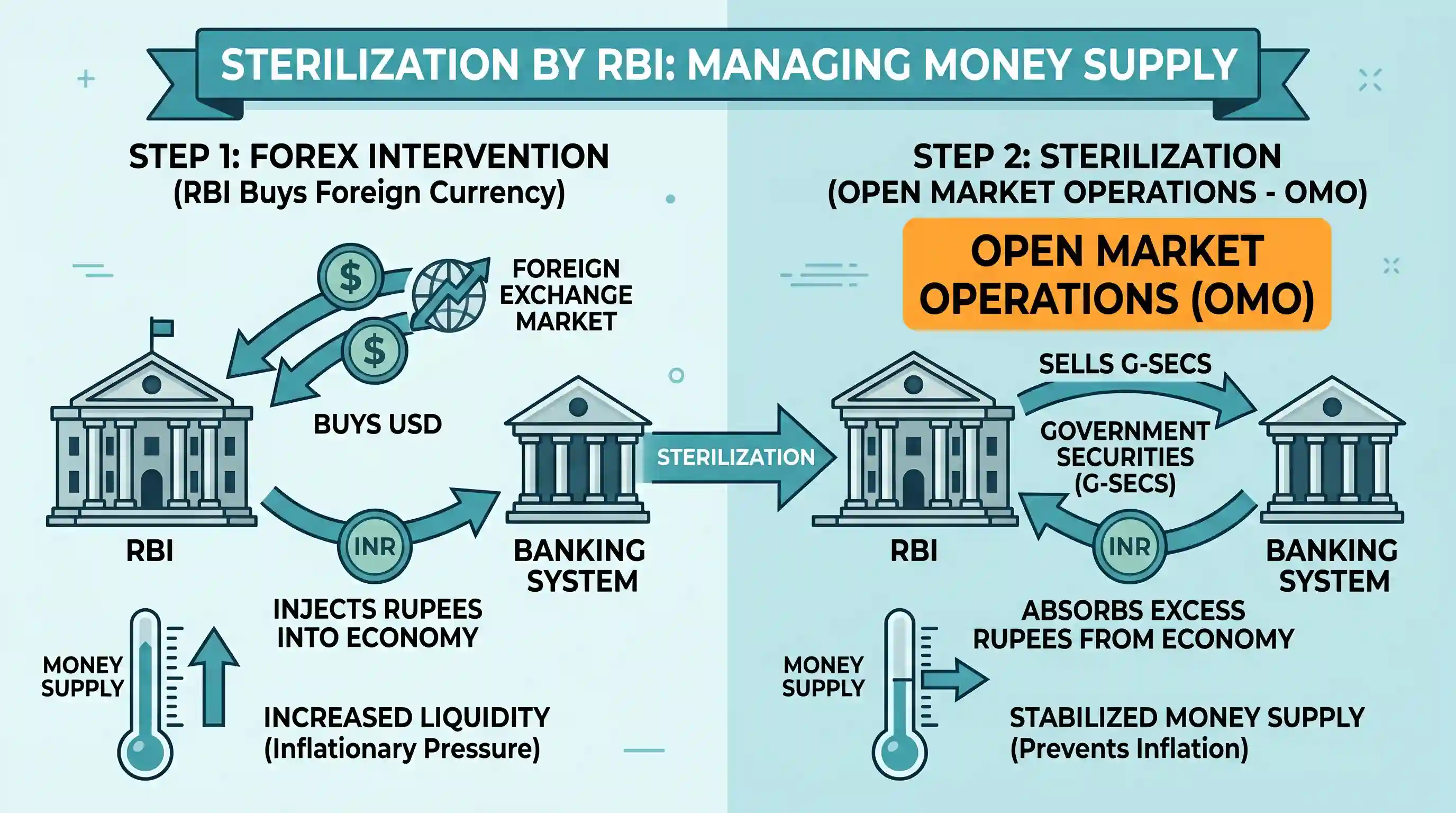
Sterilization, in the context of central banking, refers to the actions undertaken by a central bank to offset the monetary impact of its interventions in the foreign exchange market. For example, if the Reserve Bank of India (RBI) buys foreign currency to prevent the appreciation of the rupee, it injects an equivalent amount of Indian rupees into the domestic economy, thereby increasing the money supply. To 'sterilize' or neutralize this increase in money supply, the RBI would typically sell government securities in the open market (Open Market Operations or OMOs). This action absorbs the excess liquidity from the banking system, preventing it from fueling inflation.
The other options describe different functions of the RBI:
Oversight of settlement and payment systems: This is part of the RBI's role in maintaining financial stability and efficiency. Debt and cash management for the Central and State Governments: This is a banking function of the RBI for the government. Regulating the functions of Non-banking Financial Institutions: This is part of the RBI's regulatory and supervisory role in the financial sector. Therefore, conducting 'Open Market Operations' is the activity considered part of sterilization.
Related questions
More UPSC Prelims practice from the same subject and topic.
- Prelims 2023GS1economy
Consider the following statements: Statement-I: Interest income from the deposits in Infrastructure Investment Trusts (InvITs) distributed to their investors is exempted from tax, but the dividend is …
- Prelims 2023GS1economy
Consider the following statements: Statement-I: In the post-pandemic recent past, many Central Banks worldwide had carried out interest rate hikes. Statement-II: Central Banks generally assume that th…
- Prelims 2023GS1economy
Consider the following markets: 1. Government Bond Market 2. Call Money Market 3. Treasury Bill Market 4. Stock Market How many of the above are included in capital markets?
- Prelims 2023GS1economy
With reference to Central Bank digital currencies, consider the following statements: 1. It is possible to make payments in a digital currency without using US dollar or SWIFT system. 2. A digital cur…
- Prelims 2023GS1economy
Consider the following statements: 1. The Self-Help Group (SHG) programme was originally initiated by the State Bank of India by providing microcredit to the financially deprived. 2. In an SHG, all me…
- Prelims 2023GS1economy
About three-fourths of world's cobalt, a metal required for the manufacture of batteries for electric motor vehicles, is produced by