Consider the following statements: Statement-I: Carbon markets are likely to be one of the most widespread tools in the fight against climate change. Statement-II: Carbon markets transfer resources from the private sector to the State. Which one of the following is correct in respect of the above statements?

- ABoth Statement-I and Statement-II are correct and Statement-II is the correct explanation for Statement-ICorrect
- BBoth Statement-I and Statement-II are correct and Statement-II is not the correct explanation for Statement-I
- CStatement-I is correct but Statement-II is incorrect
- DStatement-I is incorrect but Statement-II is correct
Explanation
Let's analyze the statements:
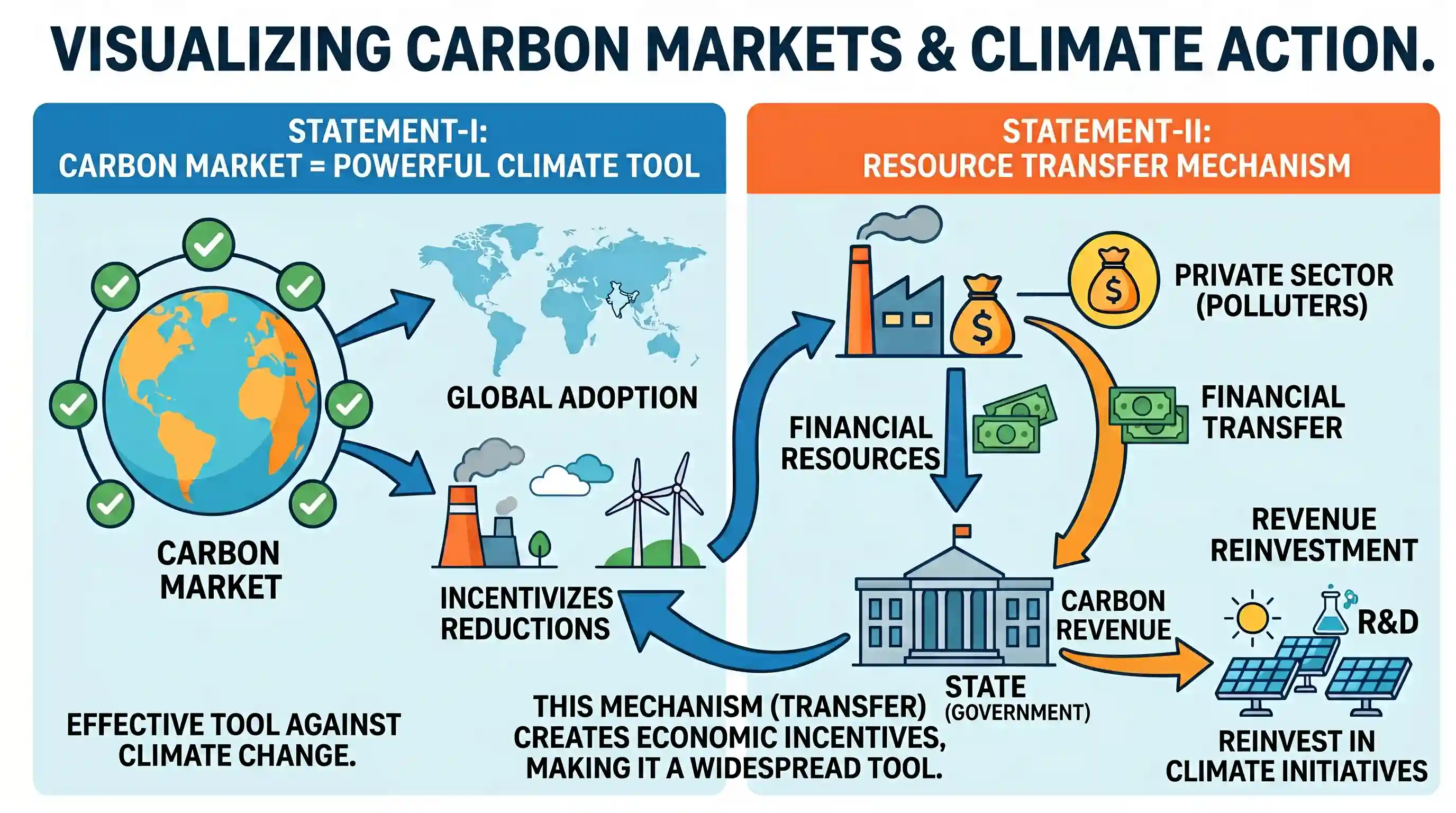
Statement-I: Carbon markets are likely to be one of the most widespread tools in the fight against climate change. This statement is correct. Carbon markets, including cap-and-trade systems and carbon taxes, are market-based mechanisms that put a price on carbon emissions. This incentivizes industries and entities to reduce their greenhouse gas emissions, making them a powerful and increasingly adopted tool globally for climate action.
Statement-II: Carbon markets transfer resources from the private sector to the State. This statement is correct. In carbon market mechanisms like carbon taxation, industries (private sector) pay a tax to the government (State) for their emissions. In a cap-and-trade system, polluters may have to purchase emission allowances from the government or from other entities that have reduced emissions, effectively transferring financial resources. This transfer provides incentives (or disincentives) for emission reduction and can generate revenue for the state, which can then be reinvested in climate initiatives.
Relationship between Statement-I and Statement-II: Statement-II is a correct explanation for Statement-I. The transfer of resources from the private sector to the state (or other entities within the market) is the fundamental mechanism through which carbon markets create economic incentives and disincentives for emissions. This financial mechanism is precisely what makes them an effective and widespread tool for driving emission reductions and combating climate change, as it internalizes the cost of pollution and drives behavioral change across the economy.
Related questions
More UPSC Prelims practice from the same subject and topic.
- Prelims 2023GS1geography
Consider the following trees: 1. Jackfruit (Artocarpus heterophyllus) 2. Mahua (Madhuca indica) 3. Teak (Tectona grandis) How many of the above are deciduous trees?
- Prelims 2023GS1geography
Consider the following statements: Statement-I: Marsupials are not naturally found in India. Statement-II: Marsupials can thrive only in montane grasslands with no predators. Which one of the followin…
- Prelims 2023GS1geography
'Invasive Species Specialist Group' (that develops Global Invasive Species Database) belongs to which one of the following organizations?
- Prelims 2023GS1geography
Consider the following fauna: 1. Lion-tailed Macaque 2. Malabar Civet 3. Sambar Deer How many of the above are generally nocturnal or most active after sunset?
- Prelims 2023GS1geography
Which of the following organisms perform waggle dance for others of their kin to indicate the direction and the distance to a source of their food?
- Prelims 2023GS1geography
Consider the following statements regarding the Indian squirrels: 1. They build nests by making burrows in the ground. 2. They store their food materials like nuts and seeds in the ground. 3. They are…