With reference to ancient India, consider the following statements: 1. The concept of Stupa is Buddhist in origin. 2. Stupa was generally a repository of relics. 3. Stupa was a votive and commemorative structure in Buddhist tradition. How many of the statements given above are correct?

- AOnly one
- BOnly twoCorrect
- CAll three
- DNone
Explanation
Let's analyze each statement regarding Stupas:
-
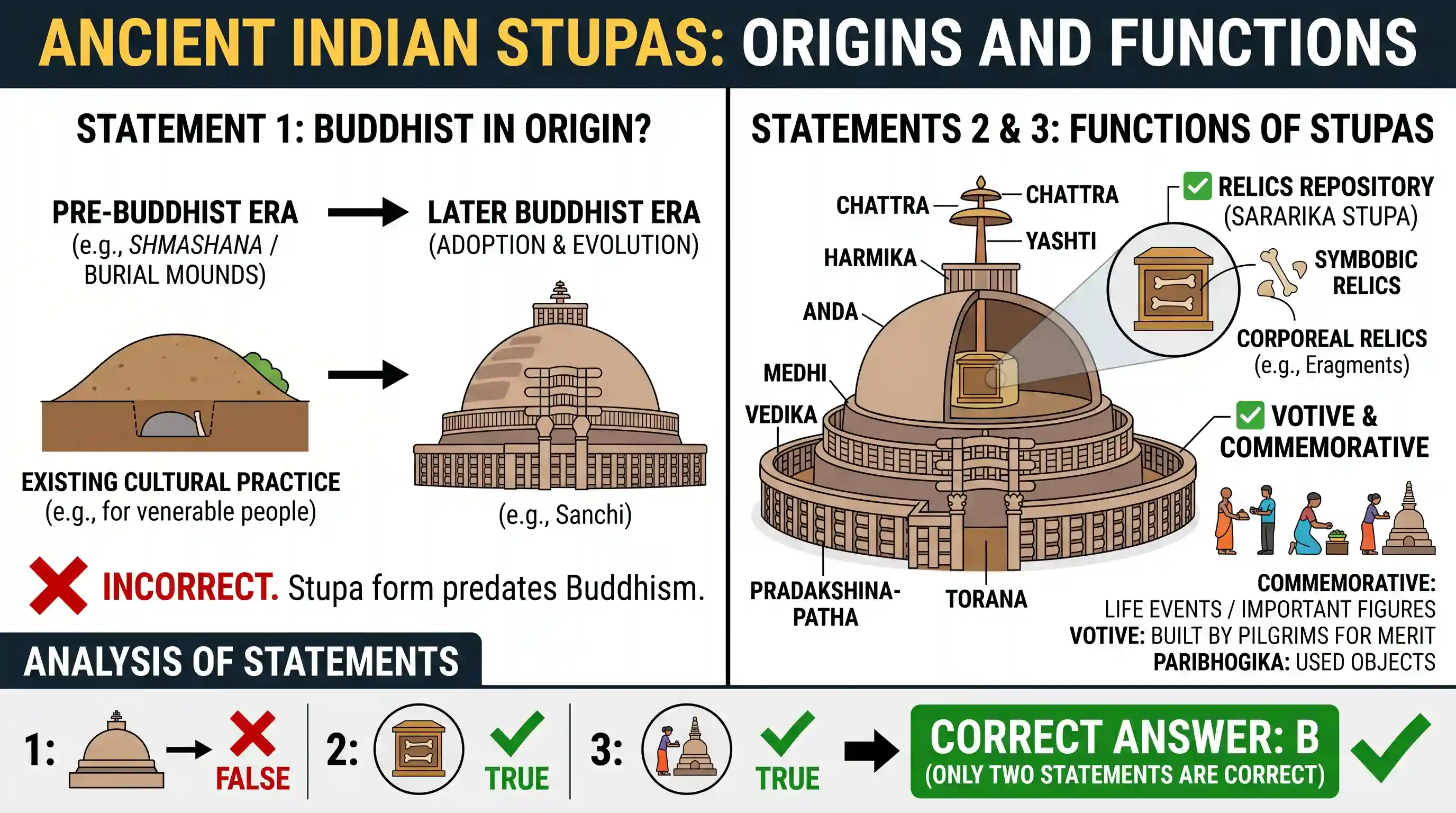
The concept of Stupa is Buddhist in origin. This statement is incorrect. While stupas became intrinsically linked with Buddhism and served as its primary architectural manifestation, their origins predate Buddhism. Early stupa-like mounds served as pre-Buddhist burial or funerary mounds in India, possibly for venerated individuals or as part of a funerary cult. Buddhism later adopted and transformed this existing tradition into a central element of its architectural and spiritual practice.
-
Stupa was generally a repository of relics. This statement is correct. A primary function of stupas in Buddhism was to house the corporeal relics of the Buddha (e.g., bones, hair, teeth) or those of important Buddhist monks and saints, as well as their belongings or sacred texts. These are known as 'sararika stupas'.
-
Stupa was a votive and commemorative structure in Buddhist tradition. This statement is correct. Stupas were often built to commemorate significant events in the Buddha's life or important figures ('paribhogika stupas') or as objects of devotion and merit-making ('votive stupas' built by pilgrims). Buddhists would circumambulate them as a form of worship and to accumulate merit.
Therefore, only statements 2 and 3 are correct.
Related questions
More UPSC Prelims practice from the same subject and topic.
- Prelims 2023GS1art-and-culture
"Souls are not only the property of animal and plant life, but also of rocks, running water and many other natural objects not looked on as living by other religious sects." The above statement reflec…
- Prelims 2023GS1art-and-culture
Consider the following pairs: Site Well known for 1. Besnagar : Shaivite cave shrine 2. Bhaja : Buddhist cave shrine 3. Sittanavasal : Jain cave shrine How many of the above pairs are correctly matche…
- Prelims 2023GS1art-and-culture
Consider the following statements in respect of the 44th Chess Olympiad, 2022: 1. It was the first time that Chess Olympiad was held in India. 2. The official mascot was named 'Thambi'. 3. The trophy …
- Prelims 2025GS1art-and-culture
The first Gandharva Mahavidyalaya, a music training school, was set up in 1901 by Vishnu Digambar Paluskar in
- Prelims 2025GS1art-and-culture
Consider the following statements in respect of the first Kho Kho World Cup : I. The event was held in Delhi, India. II. Indian men beat Nepal with a score of 78-40 in the final to become the World Ch…
- Prelims 2025GS1art-and-culture
Consider the following statements : I. In the finals of the 45th Chess Olympiad held in 2024, Gukesh Dommaraju became the world's youngest winner after defeating the Russian player Ian Nepomniachtchi.…