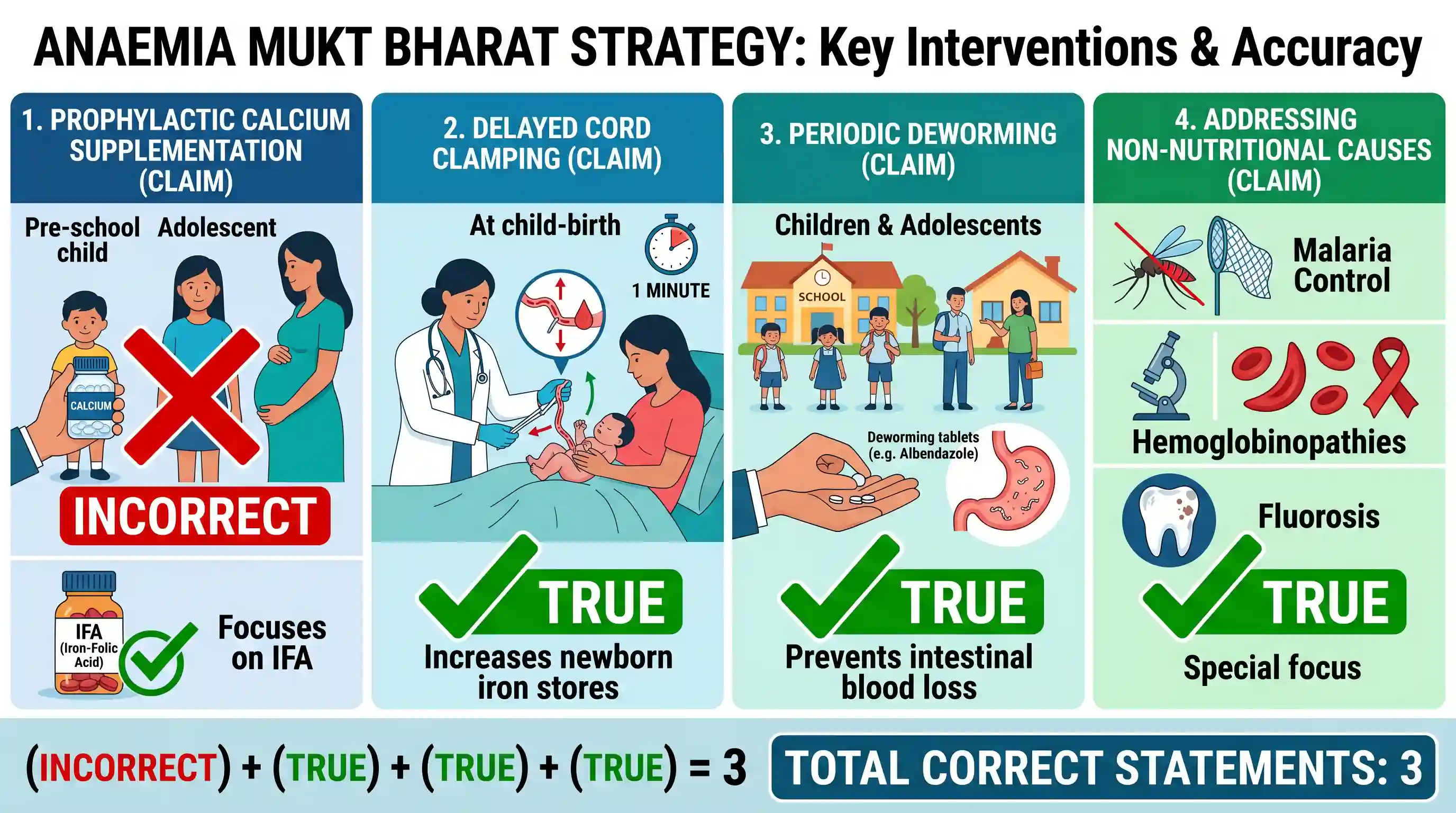
Consider the following statements in the context of interventions being undertaken under Anaemia Mukt Bharat Strategy: 1. It provides prophylactic calcium supplementation for pre-school children, adolescents and pregnant women. 2. It runs a campaign for delayed cord clamping at the time of child-birth. 3. It provides for periodic deworming to children and adolescents. 4. It addresses non-nutritional causes of anaemia in endemic pockets with special focus on malaria, hemoglobinopathies and fluorosis. How many of the statements given above are correct?

- AOnly one
- BOnly two
- COnly threeCorrect
- DAll four
Explanation
Let's evaluate the statements in the context of interventions under the Anaemia Mukt Bharat (AMB) Strategy:
-
It provides prophylactic calcium supplementation for pre-school children, adolescents and pregnant women. This statement is incorrect. The Anaemia Mukt Bharat strategy primarily focuses on iron-folic acid (IFA) supplementation for these target groups to combat anaemia, not calcium supplementation.
-
It runs a campaign for delayed cord clamping at the time of child-birth. This statement is correct. Delayed cord clamping (DCC) is indeed a key intervention under AMB, as it helps in transferring more iron-rich blood from the placenta to the baby, thereby improving the newborn's iron stores and reducing the risk of anaemia.
-
It provides for periodic deworming to children and adolescents. This statement is correct. Deworming is a crucial component of AMB. Intestinal worm infestations contribute significantly to anaemia by causing blood loss, so periodic deworming is recommended, especially for children and adolescents.
-
It addresses non-nutritional causes of anaemia in endemic pockets with special focus on malaria, hemoglobinopathies and fluorosis. This statement is correct. AMB adopts a comprehensive approach, recognizing that anaemia is not solely due to nutritional deficiencies. It includes measures to address other contributing factors like malaria control, screening and management of hemoglobinopathies (e.g., thalassemia, sickle cell anaemia), and addressing fluorosis, particularly in areas where these are endemic.
Based on the analysis, statements 2, 3, and 4 are correct. Therefore, only three statements are correct.
Related questions
More UPSC Prelims practice from the same subject and topic.
- Prelims 2023GS1polity-and-governance
Consider the following: 1. Demographic performance 2. Forest and ecology 3. Governance reforms 4. Stable government 5. Tax and fiscal efforts For the horizontal tax devolution, the Fifteenth Finance C…
- Prelims 2023GS1polity-and-governance
Consider the following statements: Statement-I: In India, prisons are managed by State Governments with their own rules and regulations for the day-to-day administration of prisons. Statement-II: In I…
- Prelims 2023GS1polity-and-governance
Consider the following organizations/bodies in India: 1. The National Commission for Backward Classes 2. The National Human Rights Commission 3. The National Law Commission 4. The National Consumer Di…
- Prelims 2023GS1polity-and-governance
Consider the following statements: Once the Central Government notifies an area as a 'Community Reserve' 1. the Chief Wildlife Warden of the State becomes the governing authority of such forest 2. hun…
- Prelims 2023GS1polity-and-governance
With reference to 'Scheduled Areas' in India, consider the following statements: 1. Within a State, the notification of an area as Scheduled Area takes place through an Order of the President. 2. The …
- Prelims 2023GS1polity-and-governance
Consider the following statements: Statement-I: The Supreme Court of India has held in some judgements that the reservation policies made under Article 16(4) of the Constitution of India would be limi…