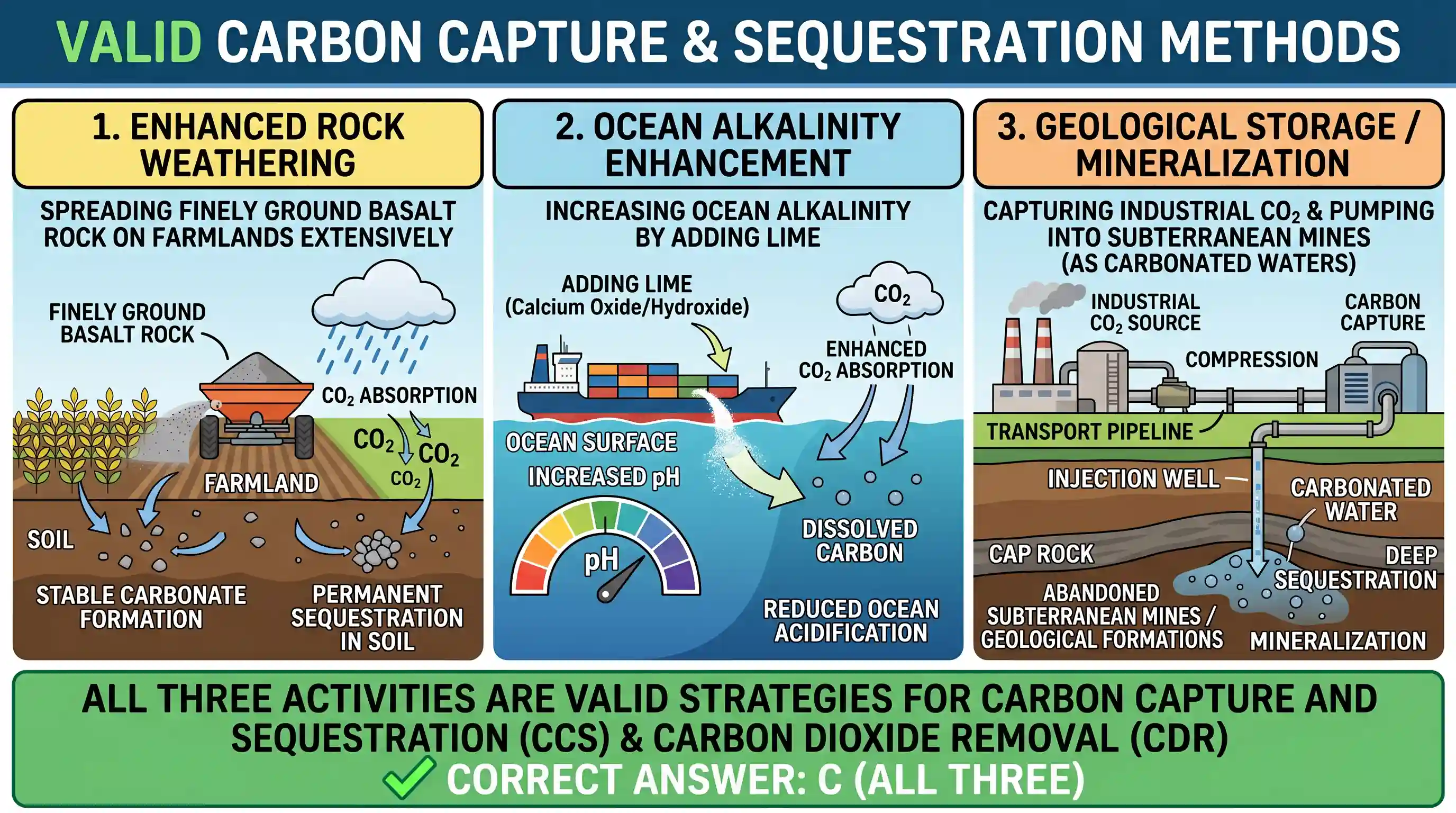
Consider the following activities: 1. Spreading finely ground basalt rock on farmlands extensively 2. Increasing the alkalinity of oceans by adding lime 3. Capturing carbon dioxide released by various industries and pumping it into abandoned subterranean mines in the form of carbonated waters How many of the above activities are often considered and discussed for carbon capture and sequestration?

- AOnly one
- BOnly two
- CAll threeCorrect
- DNone
Explanation
Let's assess each activity in the context of carbon capture and sequestration (CCS):
-
Spreading finely ground basalt rock on farmlands extensively. This is a recognized method of carbon dioxide removal (CDR) known as Enhanced Rock Weathering. Basalt is a silicate rock rich in minerals that react naturally with atmospheric CO2, converting it into stable carbonate minerals, thus permanently sequestering carbon. Spreading it on farmlands accelerates this natural process.
-
Increasing the alkalinity of oceans by adding lime. This is a method of Ocean Alkalinity Enhancement, another form of CDR. Adding alkaline substances like lime (calcium oxide) or crushed silicate rocks to the ocean increases its pH and alkalinity, enhancing the ocean's capacity to absorb CO2 from the atmosphere and reducing ocean acidification.
-
Capturing carbon dioxide released by various industries and pumping it into abandoned subterranean mines in the form of carbonated waters. This describes Carbon Capture and Storage (CCS) or Carbon Capture, Utilization, and Storage (CCUS). CO2 is captured from large industrial point sources (like power plants or factories) and then compressed and injected into deep geological formations for long-term storage. Abandoned subterranean mines, saline aquifers, and depleted oil/gas reservoirs are potential sites. Injecting it as 'carbonated waters' refers to CO2 dissolved in water (mineralization), which can enhance storage safety and permanence.
All three activities are considered and discussed as strategies for carbon capture and sequestration or carbon dioxide removal.
Related questions
More UPSC Prelims practice from the same subject and topic.
- Prelims 2023GS1geography
Consider the following trees: 1. Jackfruit (Artocarpus heterophyllus) 2. Mahua (Madhuca indica) 3. Teak (Tectona grandis) How many of the above are deciduous trees?
- Prelims 2023GS1geography
Consider the following statements: Statement-I: Marsupials are not naturally found in India. Statement-II: Marsupials can thrive only in montane grasslands with no predators. Which one of the followin…
- Prelims 2023GS1geography
'Invasive Species Specialist Group' (that develops Global Invasive Species Database) belongs to which one of the following organizations?
- Prelims 2023GS1geography
Consider the following fauna: 1. Lion-tailed Macaque 2. Malabar Civet 3. Sambar Deer How many of the above are generally nocturnal or most active after sunset?
- Prelims 2023GS1geography
Which of the following organisms perform waggle dance for others of their kin to indicate the direction and the distance to a source of their food?
- Prelims 2023GS1geography
Consider the following statements regarding the Indian squirrels: 1. They build nests by making burrows in the ground. 2. They store their food materials like nuts and seeds in the ground. 3. They are…