'Microsatellite DNA' is used in the case of which one of the following?

- AStudying the evolutionary relationships among various species of faunaCorrect
- BStimulating 'stem cells' to transform into diverse functional tissues
- CPromoting clonal propagation of horticultural plants
- DAssessing the efficacy of drugs by conducting series of drug trials in a population
Explanation
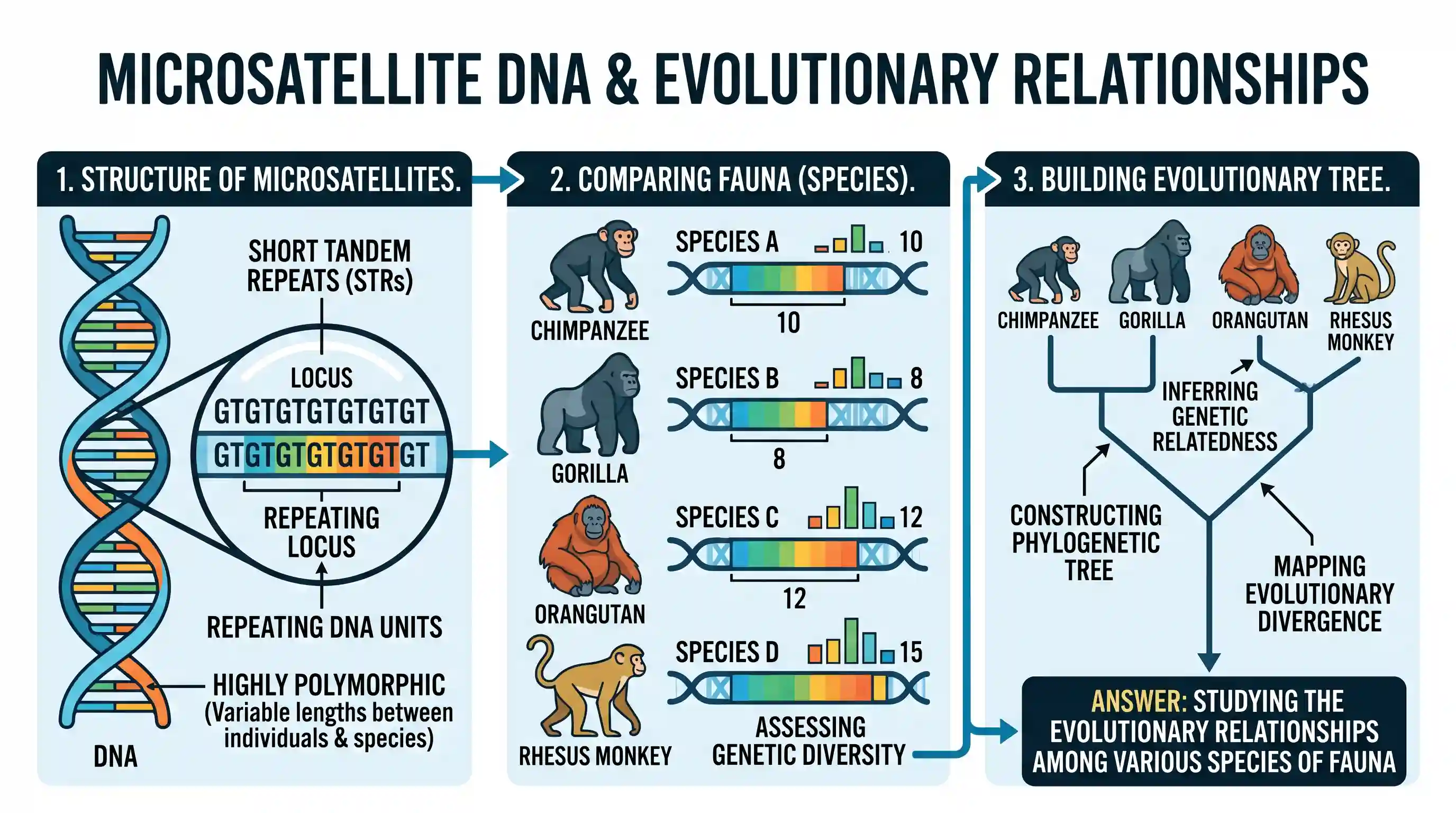
'Microsatellite DNA' is used in the case of: Studying the evolutionary relationships among various species of fauna.
Microsatellites, also known as Short Tandem Repeats (STRs), are short sequences of DNA (typically 2-6 base pairs long) that are repeated many times in a row at a particular location in the genome. They are highly polymorphic, meaning the number of repeats varies significantly among individuals within a population and across species. This high variability makes them extremely useful as genetic markers in various fields of study:
Population Genetics: Assessing genetic diversity, gene flow, and population structure. Forensics: DNA profiling and identification. Paternity Testing: Determining biological relationships. Phylogenetics/Evolutionary Biology: Due to their high mutation rate and variability, microsatellites are excellent tools for studying genetic relatedness, evolutionary divergence, and phylogenetic relationships among closely related species, populations, and even individuals. The other options describe different biological or scientific processes where microsatellite DNA is not the primary tool or is irrelevant.
Related questions
More UPSC Prelims practice from the same subject and topic.
- Prelims 2023GS1science-and-technology
Consider the following statements: Statement-I: India, despite having uranium deposits, depends on coal for most of its electricity production. Statement-II: Uranium, enriched to the extent of at leas…
- Prelims 2023GS1science-and-technology
Consider the following statements: 1. Some mushrooms have medicinal properties. 2. Some mushrooms have psycho-active properties. 3. Some mushrooms have insecticidal properties. 4. Some mushrooms have …
- Prelims 2023GS1science-and-technology
Consider the following statements: 1. Some microorganisms can grow in environments with temperature above the boiling point of water. 2. Some microorganisms can grow in environments with temperature b…
- Prelims 2023GS1science-and-technology
Consider the following: 1. Aerosols 2. Foam agents 3. Fire retardants 4. Lubricants In the making of how many of the above are hydrofluorocarbons used?
- Prelims 2023GS1science-and-technology
Consider the following statements: 1. Carbon fibres are used in the manufacture of components used in automobiles and aircrafts. 2. Carbon fibres once used cannot be recycled. Which of the statements …
- Prelims 2023GS1science-and-technology
Consider the following actions: 1. Detection of car crash/collision which results in the deployment of airbags almost instantaneously 2. Detection of accidental free fall of a laptop towards the groun…