In the context of finance, the term 'beta' refers to

- Athe process of simultaneous buying and selling of an asset from different platforms
- Ban investment strategy of a portfolio manager to balance risk versus reward
- Ca type of systemic risk that arises where perfect hedging is not possible
- Da numeric value that measures the fluctuations of a stock to changes in the overall stock marketCorrect
Explanation
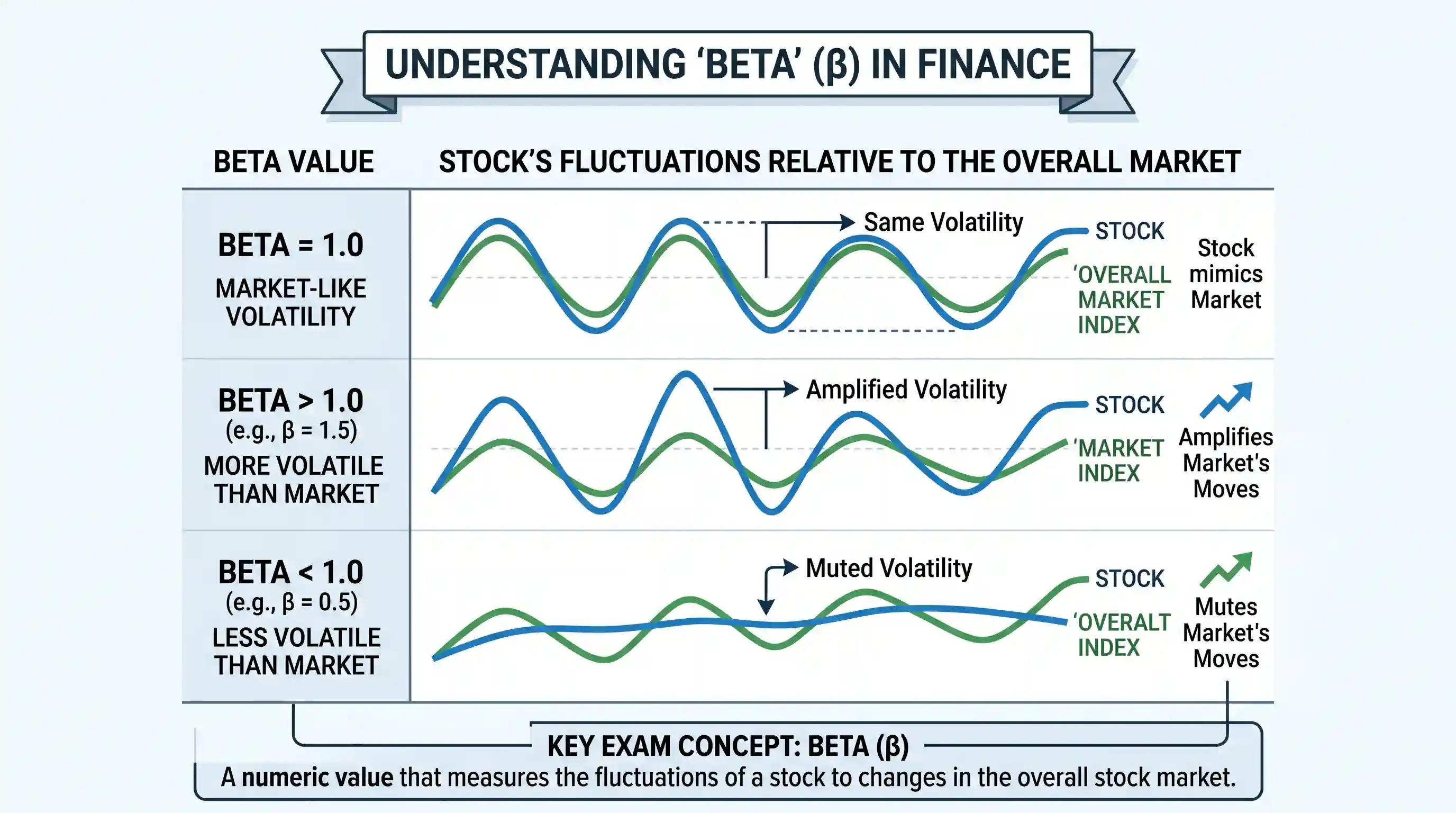
In the context of finance, the term 'beta' refers to: a numeric value that measures the fluctuations of a stock to changes in the overall stock market.
Beta (often denoted by the Greek letter β) is a measure of the volatility or systematic risk of a security or portfolio compared to the market as a whole. It is used in the Capital Asset Pricing Model (CAPM) to calculate the expected return of an asset.
A beta of 1.0 means the stock's price activity is strongly correlated with the market. A beta greater than 1.0 indicates that the stock is more volatile than the market (e.g., a beta of 1.5 means the stock's price tends to change by 1.5% for every 1% change in the market). A beta less than 1.0 indicates that the stock is less volatile than the market. The other options describe different financial concepts:
A) The process of simultaneous buying and selling of an asset from different platforms is arbitrage. B) An investment strategy of a portfolio manager to balance risk versus reward is a general description of portfolio management, not a specific term 'beta'. C) A type of systemic risk where perfect hedging is not possible is a broader concept of market risk or basis risk, not specifically 'beta'.
Related questions
More UPSC Prelims practice from the same subject and topic.
- Prelims 2023GS1economy
Consider the investments in the following assets: 1. Brand recognition 2. Inventory 3. Intellectual property 4. Mailing list of clients How many of the above are considered intangible investments?
- Prelims 2023GS1economy
About three-fourths of world's cobalt, a metal required for the manufacture of batteries for electric motor vehicles, is produced by
- Prelims 2023GS1economy
Consider the following statements: Statement-I: Interest income from the deposits in Infrastructure Investment Trusts (InvITs) distributed to their investors is exempted from tax, but the dividend is …
- Prelims 2023GS1economy
Consider the following statements: Statement-I: In the post-pandemic recent past, many Central Banks worldwide had carried out interest rate hikes. Statement-II: Central Banks generally assume that th…
- Prelims 2023GS1economy
Which one of the following activities of the Reserve Bank of India is considered to be part of 'sterilization'?
- Prelims 2023GS1economy
Consider the following markets: 1. Government Bond Market 2. Call Money Market 3. Treasury Bill Market 4. Stock Market How many of the above are included in capital markets?