Consider the following statements: Statement-I: India's public sector health care system largely focuses on curative care with limited preventive, promotive and rehabilitative care. Statement-II: Under India's decentralized approach to health care delivery, the States are primarily responsible for organizing health services. Which one of the following is correct in respect of the above statements?

- ABoth Statement-I and Statement-II are correct and Statement-II is the correct explanation for Statement-ICorrect
- BBoth Statement-I and Statement-II are correct and Statement-II is not the correct explanation for Statement-I
- CStatement-I is correct but Statement-II is incorrect
- DStatement-I is incorrect but Statement-II is correct
Explanation
Let's evaluate the given statements:
Statement-I: India's public sector health care system largely focuses on curative care with limited preventive, promotive and rehabilitative care. This statement is correct. Historically, and to a significant extent even in recent times, the emphasis in India's public health expenditure and infrastructure has been on providing curative services (treating illnesses) through hospitals and clinics. While there is a growing recognition and initiatives (like Ayushman Bharat Health and Wellness Centres) to strengthen primary and preventive care, the existing system has largely been skewed towards curative aspects, with less robust focus on health promotion, disease prevention, and rehabilitation.
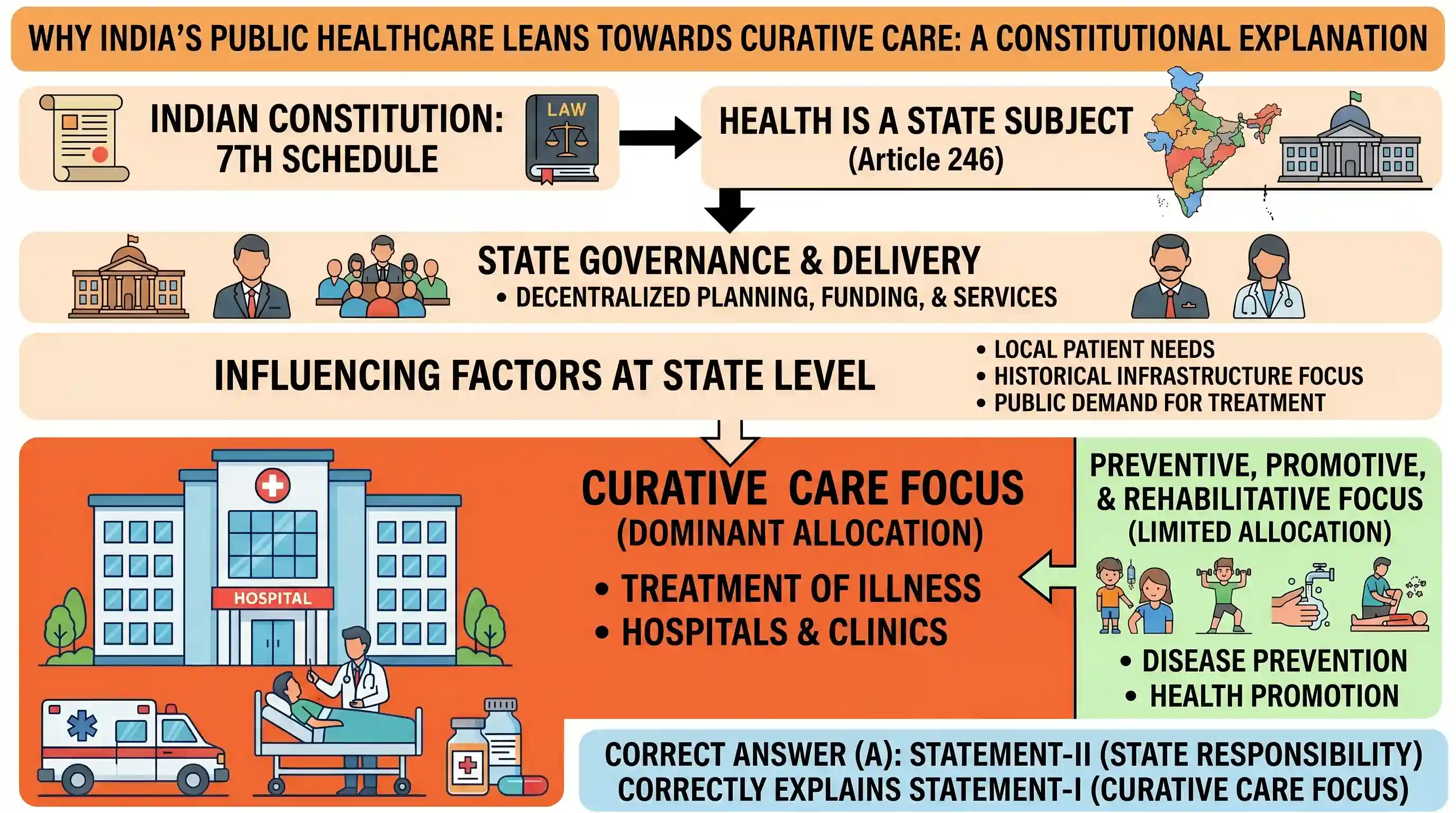
Statement-II: Under India's decentralized approach to health care delivery, the States are primarily responsible for organizing health services. This statement is correct. 'Health' is a State subject under the Seventh Schedule of the Indian Constitution. This constitutional provision grants state governments the primary responsibility for planning, financing, and delivering healthcare services within their respective jurisdictions. This decentralized approach results in significant variations in health infrastructure, funding, and service delivery standards across different states.
Relationship between Statement-I and Statement-II: Statement-II is the correct explanation for Statement-I. Because health is primarily a state subject (Statement II), individual states have significant autonomy and responsibility in shaping their healthcare systems. This decentralized structure allows for varied priorities and resource allocation. Historically, many states, possibly driven by immediate public demand for treatment or existing infrastructure, have focused more heavily on curative care. The lack of a uniform, strong national mandate or sufficient central funding for a comprehensive primary health approach, combined with states' autonomy, has contributed to the system's overall leaning towards curative services (Statement I) over a more balanced preventive and promotive approach. The decentralized nature means that the emphasis of the public healthcare system is largely determined at the state level, which has often prioritized curative services.
Related questions
More UPSC Prelims practice from the same subject and topic.
- Prelims 2023GS1polity-and-governance
Consider the following: 1. Demographic performance 2. Forest and ecology 3. Governance reforms 4. Stable government 5. Tax and fiscal efforts For the horizontal tax devolution, the Fifteenth Finance C…
- Prelims 2023GS1polity-and-governance
Consider the following statements: Statement-I: In India, prisons are managed by State Governments with their own rules and regulations for the day-to-day administration of prisons. Statement-II: In I…
- Prelims 2023GS1polity-and-governance
Consider the following organizations/bodies in India: 1. The National Commission for Backward Classes 2. The National Human Rights Commission 3. The National Law Commission 4. The National Consumer Di…
- Prelims 2023GS1polity-and-governance
Consider the following statements: Once the Central Government notifies an area as a 'Community Reserve' 1. the Chief Wildlife Warden of the State becomes the governing authority of such forest 2. hun…
- Prelims 2023GS1polity-and-governance
With reference to 'Scheduled Areas' in India, consider the following statements: 1. Within a State, the notification of an area as Scheduled Area takes place through an Order of the President. 2. The …
- Prelims 2023GS1polity-and-governance
Consider the following statements: Statement-I: The Supreme Court of India has held in some judgements that the reservation policies made under Article 16(4) of the Constitution of India would be limi…