There are 9 cups placed on a table arranged in equal number of rows and columns out of which 6 cups contain coffee and 3 cups contain tea. In how many ways can they be arranged so that each row should contain at least one cup of coffee?

- A18
- B27
- C54
- D81Correct
Explanation
The problem asks for the number of ways to arrange 6 coffee (C) and 3 tea (T) cups in a 3x3 grid such that each row contains at least one coffee cup.
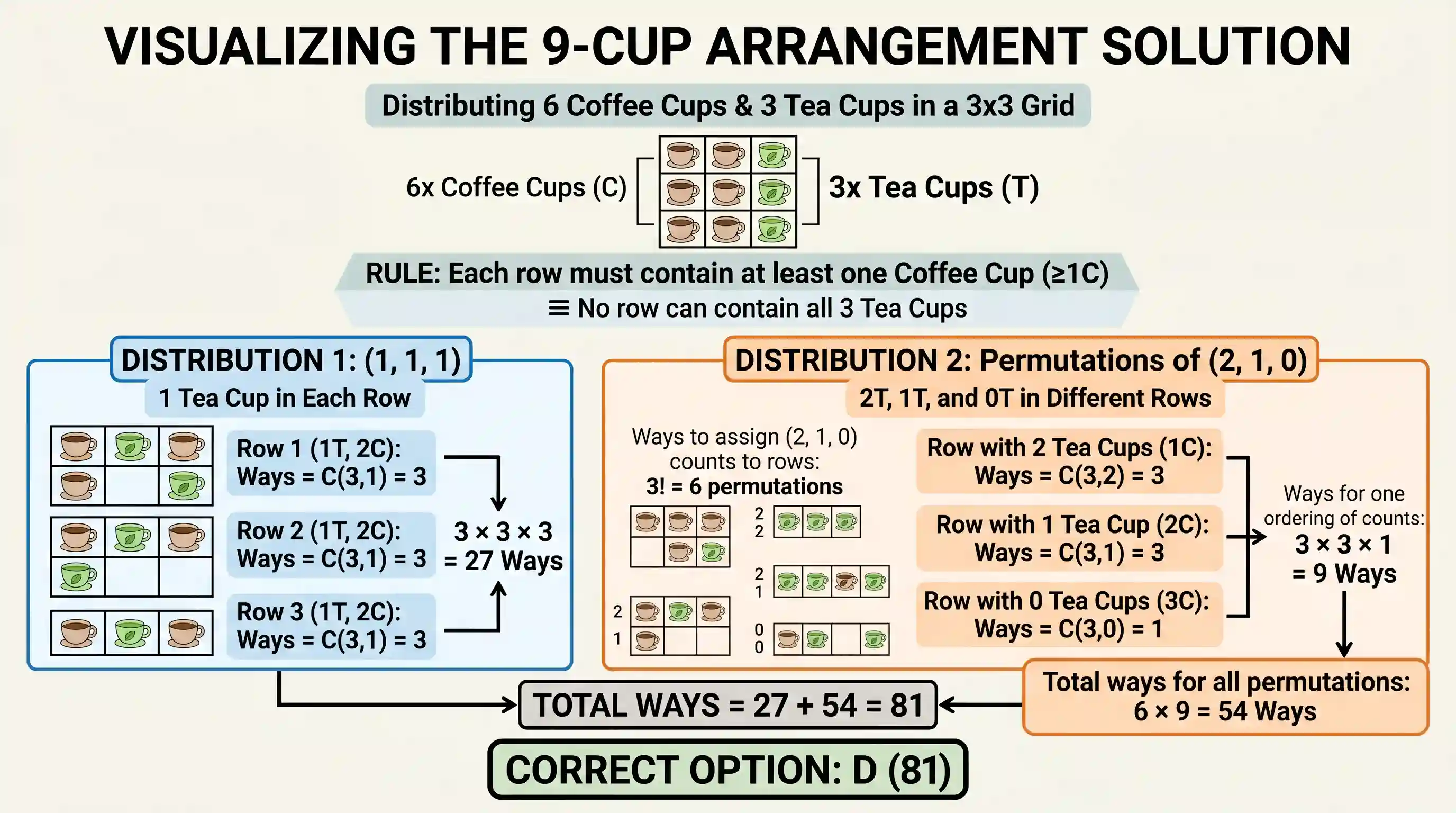
A 3x3 grid has 3 rows, and each row has 3 positions. The condition "each row should contain at least one cup of coffee" means that no row can have 0 coffee cups. Since each row has 3 positions, if a row has 0 coffee cups, it must contain 3 tea cups. Therefore, the condition simplifies to: no row can contain all 3 tea cups.
We have 3 tea cups in total. Let's consider how these 3 tea cups can be distributed among the 3 rows, ensuring no row gets all 3 tea cups. Let t1, t2, t3 be the number of tea cups in Row 1, Row 2, and Row 3, respectively. We must have t1 + t2 + t3 = 3, and t_i cannot be 3.
There are two possible distributions for the tea cups (t1, t2, t3) satisfying this condition:
-
One tea cup in each row (1, 1, 1):
- Row 1: 1 tea cup (and 2 coffee cups). The number of ways to place 1 tea cup in 3 positions is C(3,1) = 3.
- Row 2: 1 tea cup (and 2 coffee cups). The number of ways to place 1 tea cup in 3 positions is C(3,1) = 3.
- Row 3: 1 tea cup (and 2 coffee cups). The number of ways to place 1 tea cup in 3 positions is C(3,1) = 3.
- Total ways for this distribution = 3 * 3 * 3 = 27 ways. (Each row will have 2C, 1T, satisfying the condition).
-
Two tea cups in one row, one tea cup in another row, and zero tea cups in the third row (2, 1, 0):
- First, we need to decide which row gets 2 tea cups, which gets 1, and which gets 0. There are 3! = 6 permutations for distributing these counts across the rows (e.g., Row1=2T, Row2=1T, Row3=0T; or Row1=1T, Row2=2T, Row3=0T, etc.).
- Let's consider one specific permutation, for example:
- Row with 2 tea cups (and 1 coffee cup): The number of ways to place 2 tea cups in 3 positions is C(3,2) = 3.
- Row with 1 tea cup (and 2 coffee cups): The number of ways to place 1 tea cup in 3 positions is C(3,1) = 3.
- Row with 0 tea cups (and 3 coffee cups): The number of ways to place 0 tea cups in 3 positions is C(3,0) = 1.
- For this specific ordered distribution (e.g., (2T, 1T, 0T) across Row1, Row2, Row3), the number of ways is 3 * 3 * 1 = 9 ways.
- Since there are 6 such permutations (ways to assign (2,1,0) to the three rows), the total ways for this distribution = 6 * 9 = 54 ways. (Each row will have (1C,2T), (2C,1T), or (3C,0T), all satisfying the condition).
Total number of ways = Ways from distribution 1 + Ways from distribution 2 Total ways = 27 + 54 = 81 ways.
The final answer is D.
Related questions
More UPSC Prelims practice from the same subject and topic.
- Prelims 2024CSATQuantitative Aptitude
One non-zero digit, one vowel and one consonant from English alphabet (in capital) are to be used in forming passwords, such that each password has to start with a vowel and end with a consonant. How …
- Prelims 2024CSATQuantitative Aptitude
There are two containers X and Y. X contains 100 ml of milk and Y contains 100 ml of water. 20 ml of milk from X is transferred to Y. After mixing well, 20 ml of the mixture in Y is transferred back t…
- Prelims 2024CSATQuantitative Aptitude
There is a numeric lock which has a 3-digit PIN. The PIN contains digits 1 to 7. There is no repetition of digits. The digits in the PIN from left to right are in decreasing order. Any two digits in t…
- Prelims 2024CSATQuantitative Aptitude
There are four letters and four envelopes and exactly one letter is to be put in exactly one envelope with the correct address. If the letters are randomly inserted into the envelopes, then consider t…
- Prelims 2024CSATQuantitative Aptitude
In how many ways can a batsman score exactly 25 runs by scoring single runs, fours and sixes only, irrespective of the sequence of scoring shots?
- Prelims 2024CSATQuantitative Aptitude
Raj has ten pairs of red, nine pairs of white and eight pairs of black shoes in a box. If he randomly picks shoes one by one (without replacement) from the box to get a red pair of shoes to wear, what…