The sum of three consecutive integers is equal to their product. How many such possibilities are there?

- AOnly one
- BOnly two
- COnly threeCorrect
- DNo such possibility is there
Explanation
Let the three consecutive integers be n-1, n, and n+1.
-
Calculate their sum: Sum = (n-1) + n + (n+1) = 3n
-
Calculate their product: Product = (n-1) * n * (n+1) = n(n^2 - 1)
-
Set the sum equal to the product: 3n = n(n^2 - 1)
-
Solve the equation: Rearrange the equation: n(n^2 - 1) - 3n = 0 n( (n^2 - 1) - 3 ) = 0 n(n^2 - 4) = 0
This equation gives us three possible values for n: a) n = 0 b) n^2 - 4 = 0 => n^2 = 4 => n = +2 or n = -2
-
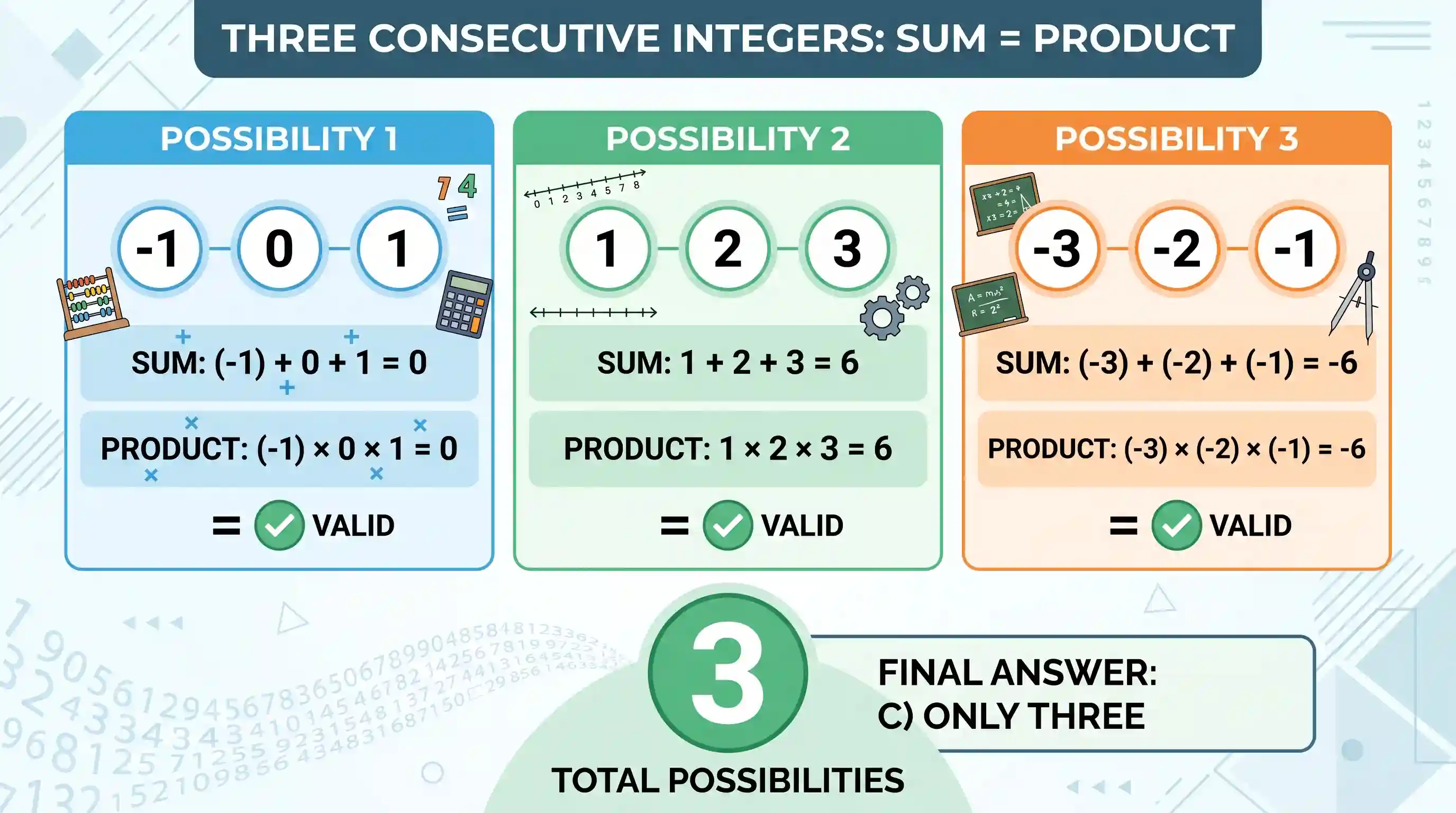
Determine the sets of integers for each value of n: a) If n = 0: The integers are (0-1), 0, (0+1) = -1, 0, 1. Check: Sum = -1 + 0 + 1 = 0. Product = (-1) * 0 * 1 = 0. (Possibility 1)
b) If n = 2: The integers are (2-1), 2, (2+1) = 1, 2, 3. Check: Sum = 1 + 2 + 3 = 6. Product = 1 * 2 * 3 = 6. (Possibility 2)
c) If n = -2: The integers are (-2-1), -2, (-2+1) = -3, -2, -1. Check: Sum = -3 + (-2) + (-1) = -6. Product = (-3) * (-2) * (-1) = -6. (Possibility 3)
There are three distinct sets of consecutive integers that satisfy the condition.
The final answer is C) Only three.
Related questions
More UPSC Prelims practice from the same subject and topic.
- Prelims 2024CSATQuantitative Aptitude
What is the number of numbers of the form 0.xy, where x and y are distinct non-zero digits?
- Prelims 2024CSATQuantitative Aptitude
15 × 14 × 13 × … × 3 × 2 × 1 = 3 m × n 12. 15 × 14 × 13 × … × 3 × 2 × 1 = 3 m × n Where m and n are positive integers, then what is the maximum value of m?
- Prelims 2024CSATQuantitative Aptitude
Consider the following statements in respect of two natural numbers p and q such that p is a prime number and q is a composite number: 1. p x q can be an odd number. 2. q / p can be a prime number. 3.…
- Prelims 2024CSATQuantitative Aptitude
Let p be a two-digit number and q be the number consisting of same digits written in reverse order. If p x q = 2430, then what is the difference between p and q?
- Prelims 2024CSATQuantitative Aptitude
What is the smallest number greater than 1000 that when divided by any one of the numbers 6, 9, 12, 15, 18 leaves a remainder of 3?
- Prelims 2024CSATQuantitative Aptitude
What is the remainder when 91x92x93x94x95x96x97x98x99 is divided by 1261?