15 × 14 × 13 × … × 3 × 2 × 1 = 3 m × n 12. 15 × 14 × 13 × … × 3 × 2 × 1 = 3 m × n Where m and n are positive integers, then what is the maximum value of m?

- A7
- B6Correct
- C5
- D4
Explanation
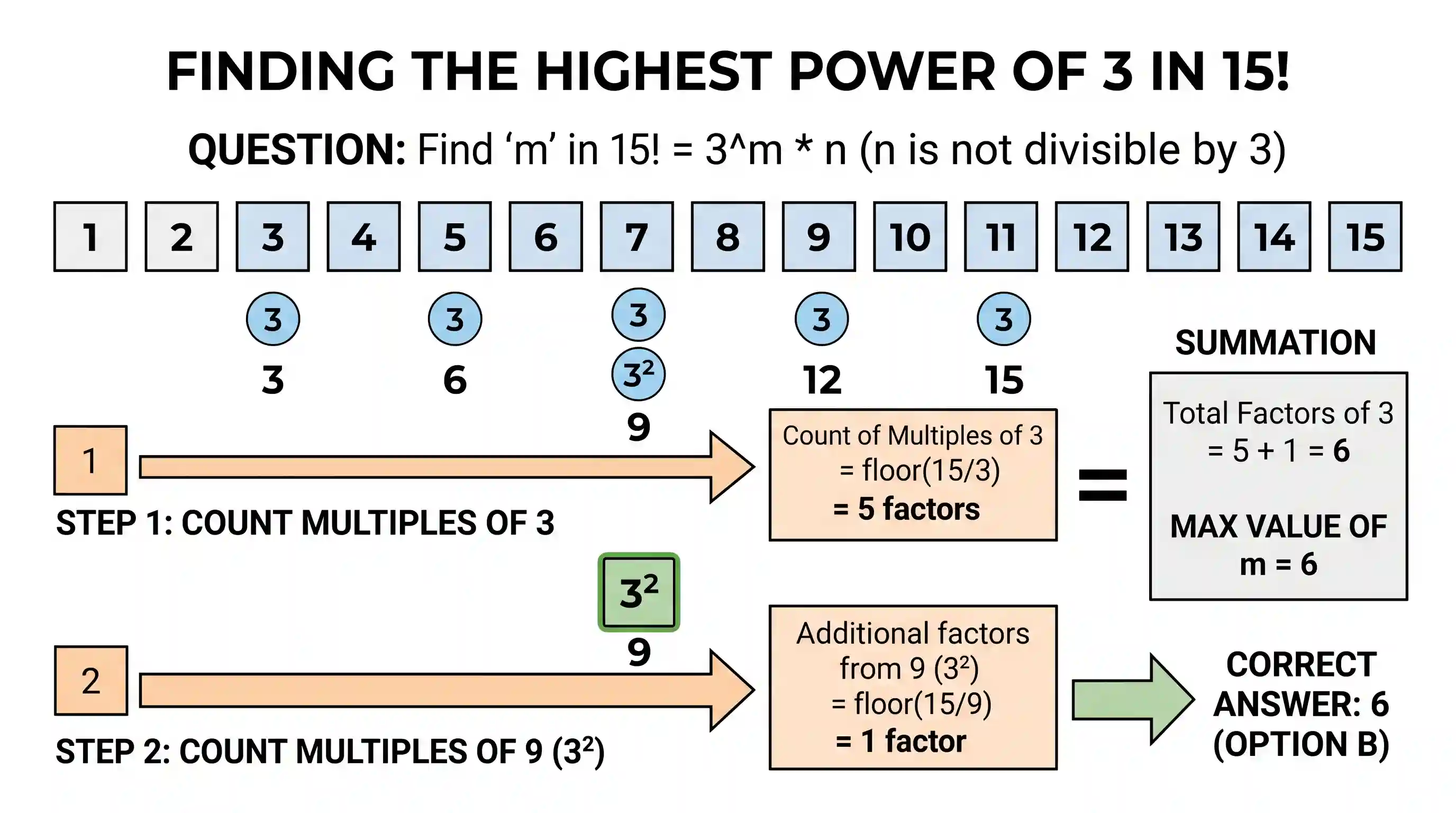
The problem asks for the maximum value of 'm' in the equation 15! = 3^m * n, where 15! represents 15 × 14 × 13 × … × 3 × 2 × 1, and 'n' is a positive integer not divisible by 3. This means 'm' is the highest power of 3 that divides 15!.
To find the highest power of a prime number 'p' that divides n!, we use Legendre's formula: m = floor(n/p) + floor(n/p^2) + floor(n/p^3) + ...
In this case, n = 15 and p = 3.
-
Calculate the first term: floor(15/3) = floor(5) = 5. (This counts numbers like 3, 6, 9, 12, 15, each contributing at least one factor of 3).
-
Calculate the second term: floor(15/3^2) = floor(15/9) = floor(1.66...) = 1. (This counts numbers like 9, which contribute an additional factor of 3 because 9 = 3*3. The first term already counted one 3 from 9, this term counts the second 3 from 9).
-
Calculate the third term: floor(15/3^3) = floor(15/27) = floor(0.55...) = 0. (We stop here as subsequent terms will also be 0).
Now, sum the terms: m = 5 + 1 = 6.
Alternatively, we can directly count the factors of 3 in the numbers from 1 to 15:
- Multiples of 3: 3, 6, 9, 12, 15.
- Each of these contributes at least one factor of 3: (3=3^1), (6=23^1), (9=3^2), (12=43^1), (15=5*3^1).
- Count the factors of 3:
- From 3: one 3
- From 6: one 3
- From 9: two 3s (since 9 = 3 * 3)
- From 12: one 3
- From 15: one 3
- Total number of factors of 3 = 1 + 1 + 2 + 1 + 1 = 6.
Thus, the maximum value of m is 6.
The final answer is B
Related questions
More UPSC Prelims practice from the same subject and topic.
- Prelims 2024CSATQuantitative Aptitude
What is the number of numbers of the form 0.xy, where x and y are distinct non-zero digits?
- Prelims 2024CSATQuantitative Aptitude
The sum of three consecutive integers is equal to their product. How many such possibilities are there?
- Prelims 2024CSATQuantitative Aptitude
Consider the following statements in respect of two natural numbers p and q such that p is a prime number and q is a composite number: 1. p x q can be an odd number. 2. q / p can be a prime number. 3.…
- Prelims 2024CSATQuantitative Aptitude
Let p be a two-digit number and q be the number consisting of same digits written in reverse order. If p x q = 2430, then what is the difference between p and q?
- Prelims 2024CSATQuantitative Aptitude
What is the smallest number greater than 1000 that when divided by any one of the numbers 6, 9, 12, 15, 18 leaves a remainder of 3?
- Prelims 2024CSATQuantitative Aptitude
What is the remainder when 91x92x93x94x95x96x97x98x99 is divided by 1261?