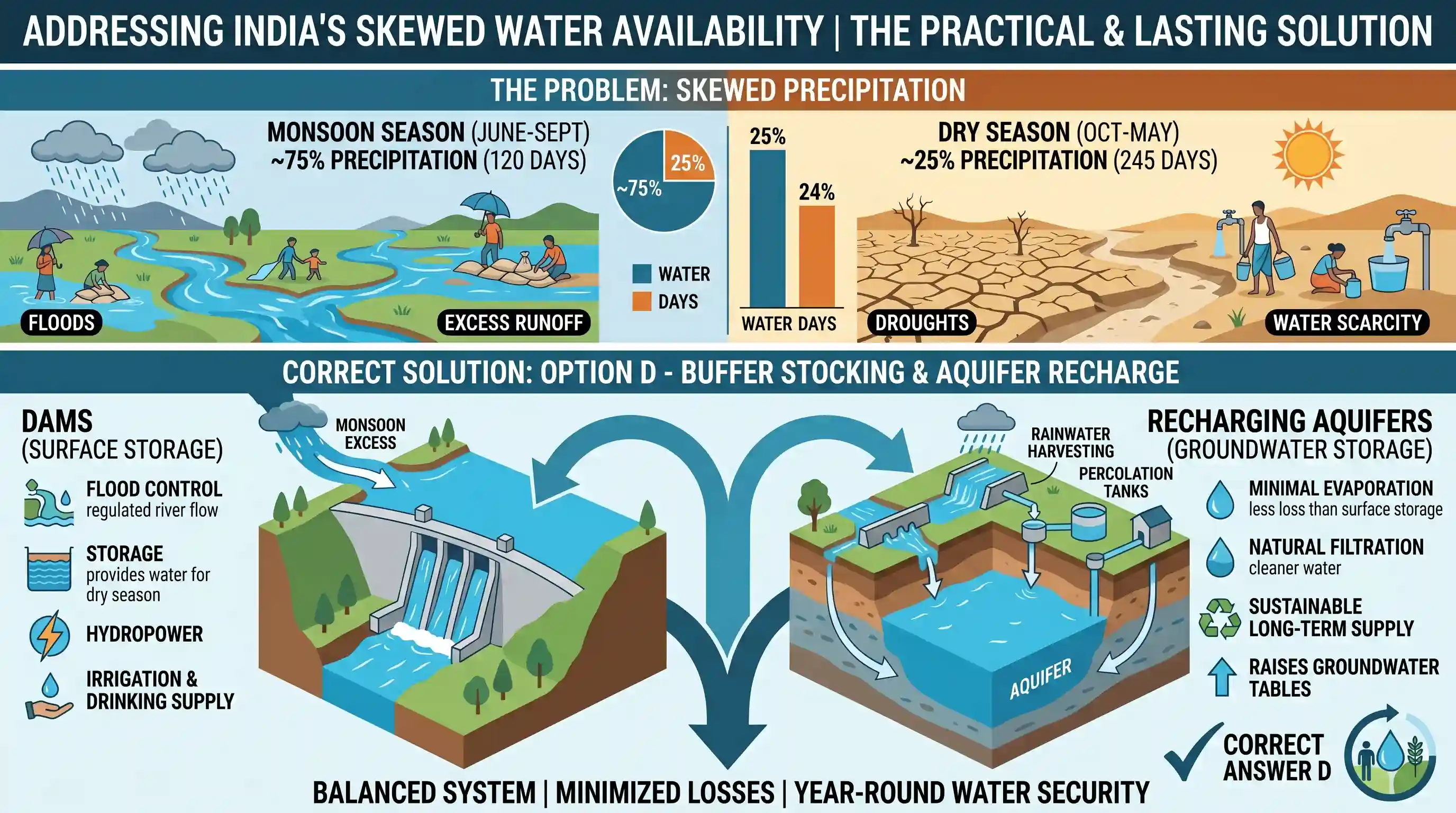
How best can the problems of floods and droughts be addressed so that the losses are minimal and the system becomes resilient? In this context, one important point that needs to be noted is that India gets "too much' water (about 75%) of annual precipitation) during 120 days (June to September) and "too little' for the remaining 245 days. This skewed water availability has to be managed and regulated for its consumption throughout the year. Which one of the following best reflects the practical, rational and lasting solutions?

- AConstructing huge concrete storage tanks and canals across the country
- BChanging the cropping patterns and farming practices
- CInterlinking of rivers across the country
- DBuffer stocking of water through dams and recharging aquifersCorrect
Explanation
The problem highlights India's skewed water availability: too much during the monsoon, too little for the rest of the year. The solution must manage this imbalance for year-round consumption, minimize losses, and build resilience.
Let's analyze each option:
A) Constructing huge concrete storage tanks and canals across the country: While storage and distribution are needed, "huge concrete storage tanks" are prone to high evaporation losses, require vast land acquisition, and are extremely expensive and environmentally impactful. Canals are for distribution, not primary storage of excess monsoon water. This option is less efficient and sustainable than other methods.
B) Changing the cropping patterns and farming practices: This is a crucial aspect of water demand management and efficiency. It helps reduce water consumption and adapt to water scarcity. However, it does not directly address the fundamental problem of storing the excess water from the monsoon to mitigate floods and provide for dry periods. It's a complementary measure, not the primary solution for managing the skewed availability.
C) Interlinking of rivers across the country: This ambitious project aims to transfer water from surplus river basins to deficit ones. While it could address regional imbalances, it faces immense challenges: huge environmental impact (deforestation, displacement), massive costs, long gestation periods, and significant political disputes between states. It is not necessarily the most practical, rational, or easily implemented lasting solution for managing seasonal water availability within a basin or across the nation as a whole, especially considering the scale of the problem.
D) Buffer stocking of water through dams and recharging aquifers: This option provides the most comprehensive and balanced approach. * Dams (surface storage) are essential for "buffer stocking" large volumes of monsoon water. They help mitigate floods by holding excess water and provide water for irrigation, drinking, and power generation during dry periods, directly addressing the "too much" and "too little" problem. * Recharging aquifers (subsurface storage) is a highly sustainable and effective method. Storing water underground minimizes evaporation losses, naturally filters water, and raises groundwater tables, which are vital for long-term water security. It also helps in flood absorption by allowing water to percolate. This combination directly tackles both flood control and drought mitigation by efficiently storing and regulating water for year-round consumption, making the system resilient.
Therefore, buffer stocking of water through dams and recharging aquifers is the most practical, rational, and lasting solution to manage India's skewed water availability.
Related questions
More UPSC Prelims practice from the same subject and topic.
- Prelims 2024CSATReading Comprehension
According to the Food and Agriculture Organization, one-third of food produced for human consumption is lost or wasted globally. Food is lost or wasted throughout the supply chain, from initial agricu…
- Prelims 2024CSATReading Comprehension
As inflation rises, even governments previously committed to budget discipline are spending freely to help households. Higher interest rates announced by central banks are supposed to help produce mod…
- Prelims 2024CSATReading Comprehension
As inflation rises, even governments previously committed to budget discipline are spending freely to help households. Higher interest rates announced by central banks are supposed to help produce mod…
- Prelims 2024CSATReading Comprehension
"The social order is a sacred right which is the basis of all other rights. Nevertheless, this right does not come from nature, and must therefore be founded on conventions." With reference to the abo…
- Prelims 2024CSATReading Comprehension
In an economic organization, allowing mankind to benefit by the productivity of machines should lead to a very good life of leisure, and much leisure is apt to be tedious except to those who have inte…
- Prelims 2024CSATReading Comprehension
In India, a majority of farmers are marginal and small, less educated and possess low adaptive capabilities to climate change, perhaps because of credit and other constraints. So, one cannot expect au…