As inflation rises, even governments previously committed to budget discipline are spending freely to help households. Higher interest rates announced by central banks are supposed to help produce modest fiscal austerity, because to maintain stable debts while paying more to borrow, governments must cut spending or raise taxes. Without the fiscal backup, monetary policy eventually loses traction. Higher interest rates become inflationary, not disinflationary, because they simply lead governments to borrow more to pay rising debt-service costs. The risk of monetary unmooring is greater when public debt rises, because interest rates become more important to budget deficits. Based on the above passage, the following assumptions have been made: 1. Fiscal policies of governments are solely responsible for higher prices. 2. Higher prices do not affect the long-term government bonds. Which of the assumptions given above is/are valid?

- A1 only
- B2 only
- CBoth 1 and 2
- DNeither 1 nor 2Correct
Explanation
The passage does not support either of the assumptions.
-
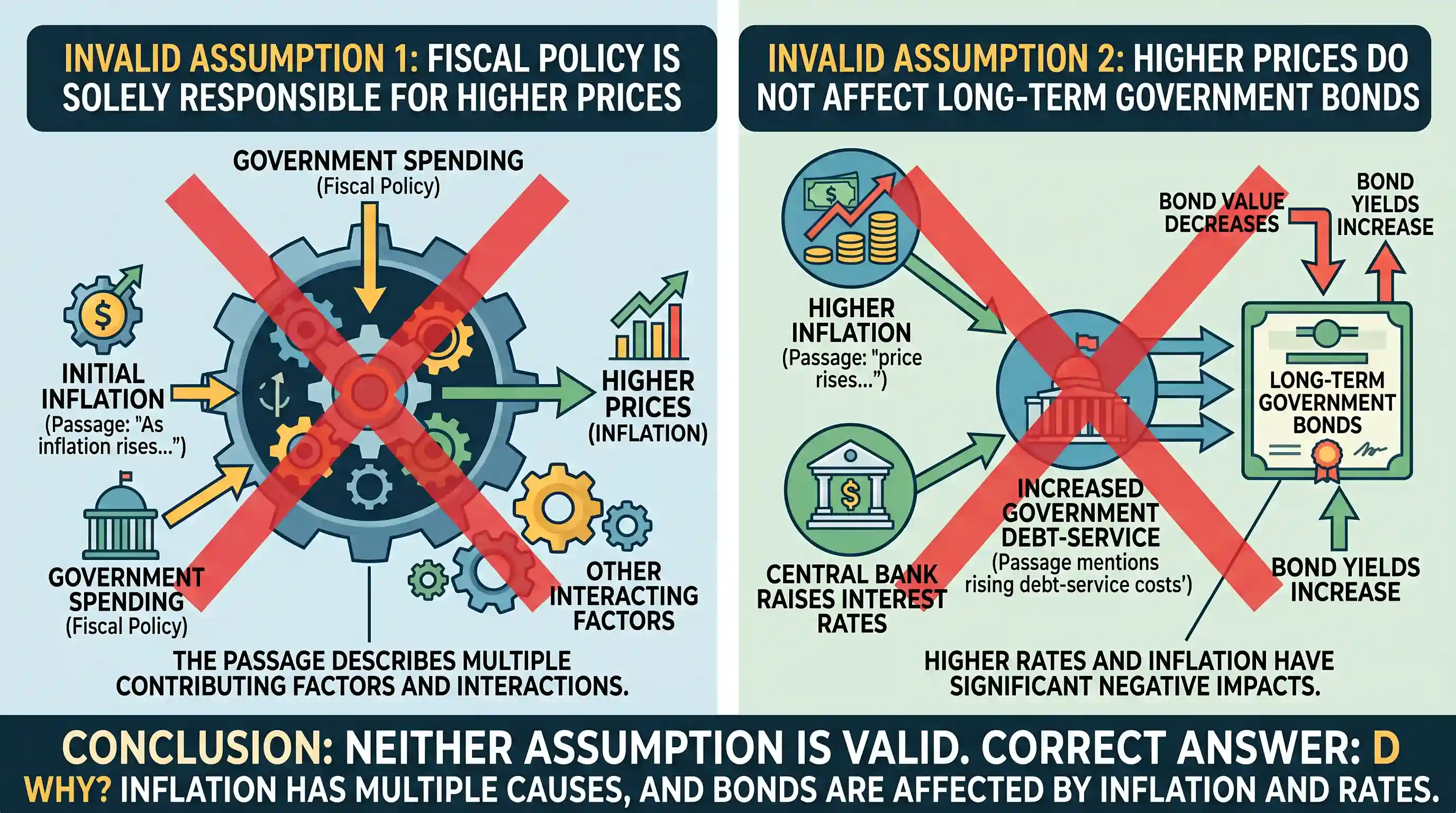
Fiscal policies of governments are solely responsible for higher prices. The passage states, "As inflation rises, even governments... are spending freely." This implies inflation is already a factor, and then government spending occurs. It also mentions central bank actions. The passage describes how government spending can contribute to or exacerbate inflation, especially when interest rates rise, but it does not claim that fiscal policies are solely responsible for higher prices. The word "solely" makes this assumption invalid.
-
Higher prices do not affect the long-term government bonds. The passage discusses "higher interest rates" and "rising debt-service costs" for governments, indicating that the cost of borrowing (which is reflected in bond yields) is affected. While it doesn't explicitly detail the impact on long-term government bonds, the general economic principle is that higher inflation and rising interest rates negatively affect bond prices (and increase their yields) to compensate investors for the loss of purchasing power. The passage provides no basis to assume that higher prices do not affect these bonds; in fact, the context of rising interest rates and debt costs suggests they would be affected.
Therefore, neither assumption is valid based on the provided text.
Related questions
More UPSC Prelims practice from the same subject and topic.
- Prelims 2024CSATReading Comprehension
According to the Food and Agriculture Organization, one-third of food produced for human consumption is lost or wasted globally. Food is lost or wasted throughout the supply chain, from initial agricu…
- Prelims 2024CSATReading Comprehension
As inflation rises, even governments previously committed to budget discipline are spending freely to help households. Higher interest rates announced by central banks are supposed to help produce mod…
- Prelims 2024CSATReading Comprehension
How best can the problems of floods and droughts be addressed so that the losses are minimal and the system becomes resilient? In this context, one important point that needs to be noted is that India…
- Prelims 2024CSATReading Comprehension
"The social order is a sacred right which is the basis of all other rights. Nevertheless, this right does not come from nature, and must therefore be founded on conventions." With reference to the abo…
- Prelims 2024CSATReading Comprehension
In an economic organization, allowing mankind to benefit by the productivity of machines should lead to a very good life of leisure, and much leisure is apt to be tedious except to those who have inte…
- Prelims 2024CSATReading Comprehension
In India, a majority of farmers are marginal and small, less educated and possess low adaptive capabilities to climate change, perhaps because of credit and other constraints. So, one cannot expect au…