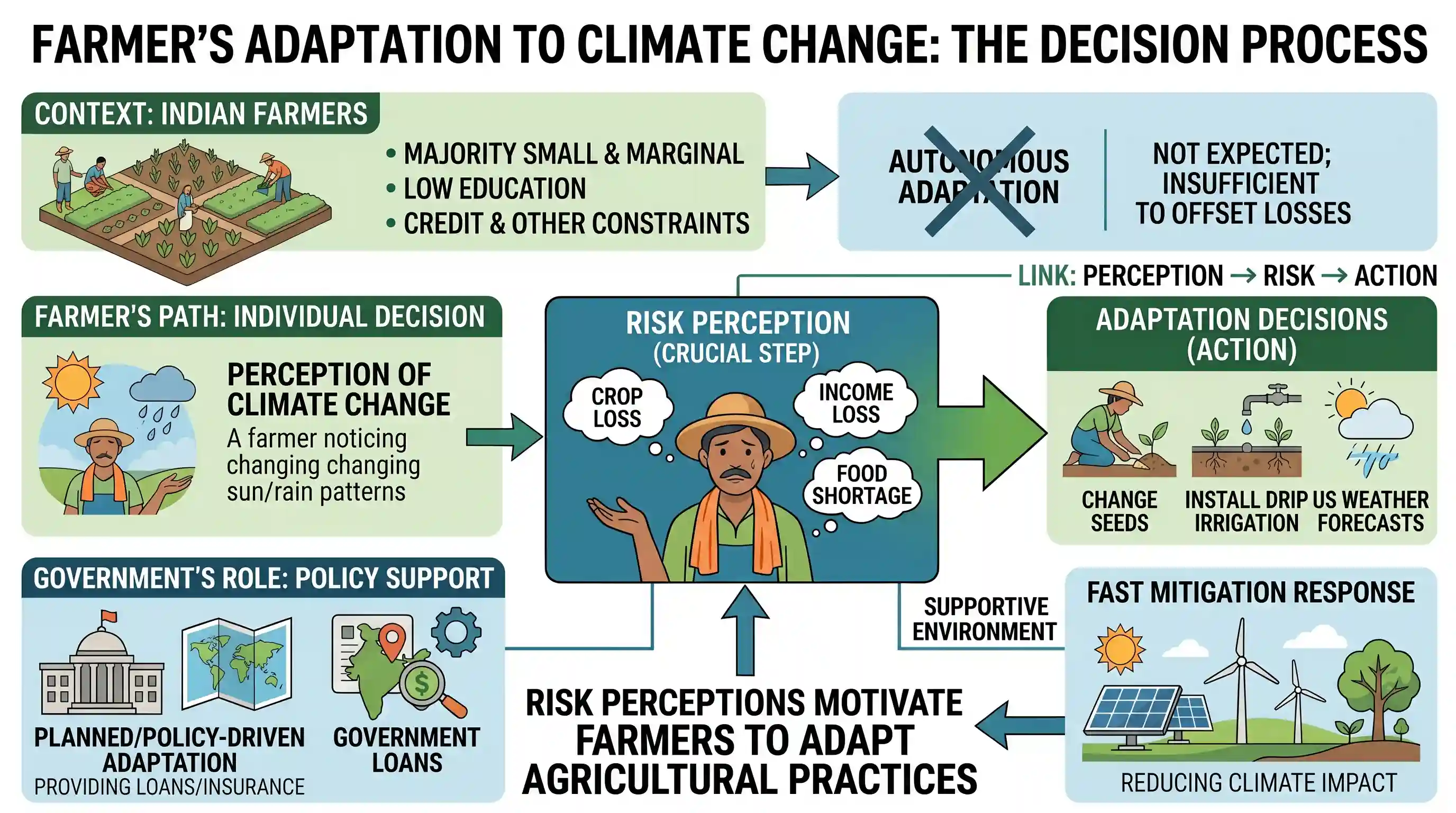
In India, a majority of farmers are marginal and small, less educated and possess low adaptive capabilities to climate change, perhaps because of credit and other constraints. So, one cannot expect autonomous adaptation to climate change. Even if it was possible, it would not be sufficient to offset losses from climate change. To deal with this, adaptation to climate change is paramount, alongside a fast mitigation response. Another solution is to have a planned or policy-driven adaptation, which would require the government to come up with policy recommendations. Perception is a necessary pre-requisite for adaptation. Whether farmers are adapting agricultural practices to climate change depends on whether they perceive it or not. However, this is not always enough for adaptation. It is important how a farmer perceives the risks associated with climate change. Which one of the following statements best reflects the most logical and rational message conveyed by the author of the passage?

- AAdaptation to climate change and mitigation response are basically the responsibilities of the government
- BClimate change causes a change in government policies regarding land use patters in the country
- CRisk perceptions of farmers are important for motivating them for taking adaptation decisionsCorrect
- DSince mitigation is not possible, governments should come up with policies for quick response to climate change.
Explanation
The passage highlights several points:
- Most Indian farmers face constraints (credit, education, low adaptive capabilities) preventing autonomous adaptation to climate change.
- Therefore, planned or policy-driven adaptation by the government is needed, alongside mitigation.
- A crucial prerequisite for farmers to adapt is their perception of climate change.
- More specifically, how a farmer perceives the risks associated with climate change is important for their adaptation.
Let's analyze the options:
A) Adaptation to climate change and mitigation response are basically the responsibilities of the government. While the passage states that government policies are needed for planned adaptation, it doesn't explicitly state that all adaptation and mitigation are basically the government's responsibility. It also discusses farmers' perceptions and their role. This statement is an overgeneralization and not the most logical and rational message conveyed, as the passage emphasizes other factors too.
B) Climate change causes a change in government policies regarding land use patters in the country. The passage mentions the government coming up with "policy recommendations" for adaptation. While land use patterns might be part of this, the passage refers to "agricultural practices" more broadly and does not specifically focus on land use patterns. This is too specific and not the central message.
C) Risk perceptions of farmers are important for motivating them for taking adaptation decisions. The passage explicitly states: "Perception is a necessary pre-requisite for adaptation." It further clarifies, "Whether farmers are adapting agricultural practices to climate change depends on whether they perceive it or not. However, this is not always enough for adaptation. It is important how a farmer perceives the risks associated with climate change." This option directly and accurately reflects this emphasized point, linking risk perception to farmers' adaptation decisions.
D) Since mitigation is not possible, governments should come up with policies for quick response to climate change. The passage states that "adaptation to climate change is paramount, alongside a fast mitigation response." This implies that mitigation is possible and desirable, not that it's impossible. Therefore, the premise of this statement ("Since mitigation is not possible") is incorrect according to the passage.
Conclusion: Option C directly captures a key and strongly emphasized message from the latter part of the passage regarding the crucial role of farmers' risk perceptions in their adaptation decisions.
Related questions
More UPSC Prelims practice from the same subject and topic.
- Prelims 2024CSATReading Comprehension
According to the Food and Agriculture Organization, one-third of food produced for human consumption is lost or wasted globally. Food is lost or wasted throughout the supply chain, from initial agricu…
- Prelims 2024CSATReading Comprehension
As inflation rises, even governments previously committed to budget discipline are spending freely to help households. Higher interest rates announced by central banks are supposed to help produce mod…
- Prelims 2024CSATReading Comprehension
As inflation rises, even governments previously committed to budget discipline are spending freely to help households. Higher interest rates announced by central banks are supposed to help produce mod…
- Prelims 2024CSATReading Comprehension
How best can the problems of floods and droughts be addressed so that the losses are minimal and the system becomes resilient? In this context, one important point that needs to be noted is that India…
- Prelims 2024CSATReading Comprehension
"The social order is a sacred right which is the basis of all other rights. Nevertheless, this right does not come from nature, and must therefore be founded on conventions." With reference to the abo…
- Prelims 2024CSATReading Comprehension
In an economic organization, allowing mankind to benefit by the productivity of machines should lead to a very good life of leisure, and much leisure is apt to be tedious except to those who have inte…