Six Persons A, B, C, D, E and F are sitting equidistant form each other around a circular table (facing the centre of the table). Consider the Question and two statements given below: Question: Who is sitting on the immediate left of A? Statement- 1: B is sitting opposite to C and D is sitting opposite to E. Statement- 2: F is sitting on the immediate left of B. Which one of the following is correct in respect of the Question and the Statements?

- AStatement-1 alone is sufficient to answer the question
- BStatement-2 alone is sufficient to answer the question
- CBoth Statement-1 and Statement-2 are sufficient to answer the Question
- DBoth Statement-1 and Statement-2 are not sufficient to answer the QuestionCorrect
Explanation
Here's a brief explanation:
-
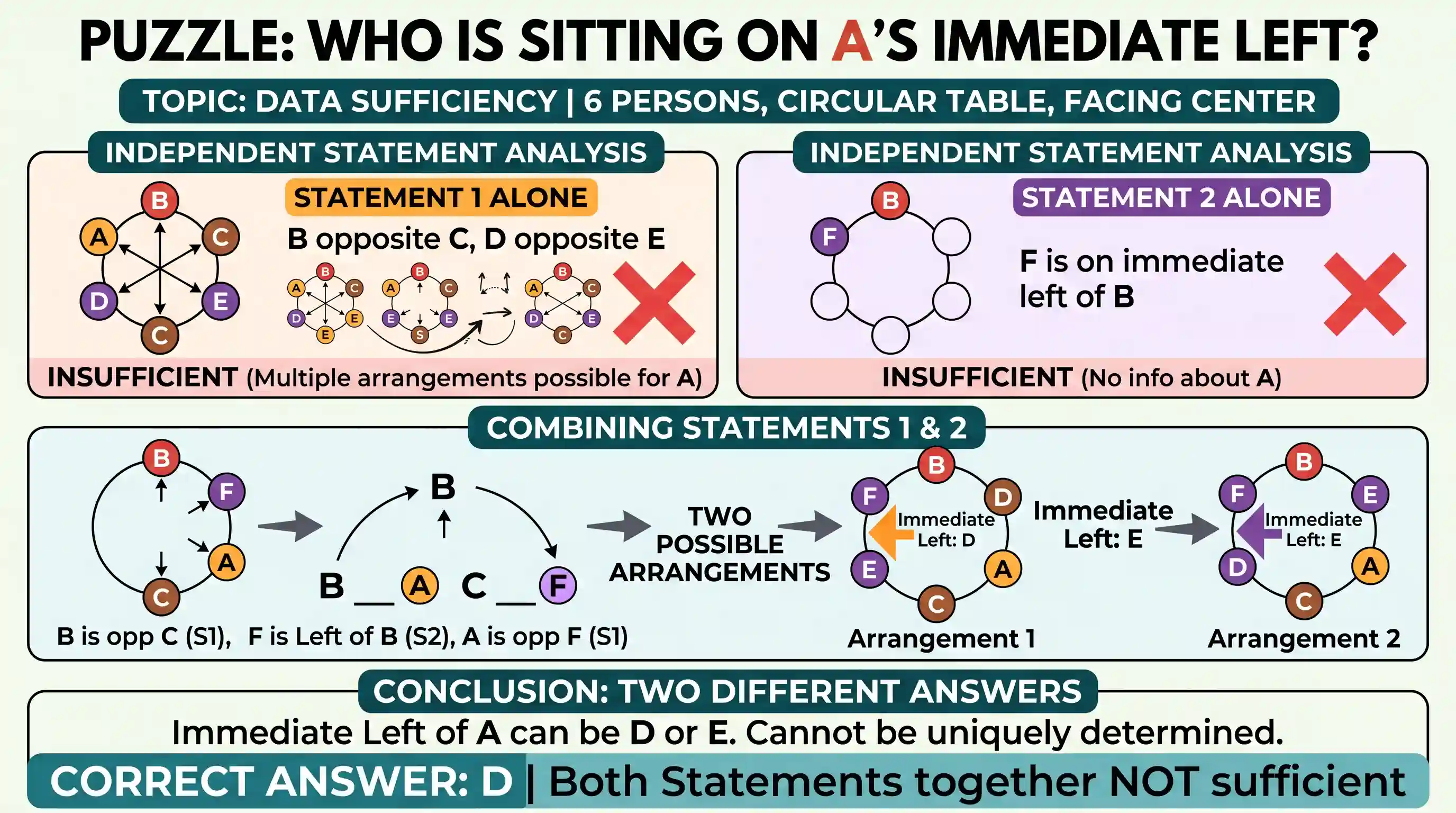
Analyze Statement-1 alone: Statement-1 tells us that B is opposite C, and D is opposite E. Since there are six people, this implies that A must be opposite F. However, this statement doesn't fix the relative positions of these pairs. For example, A could have D on its immediate left in one arrangement (e.g., B-D-A-C-E-F clockwise) or E on its immediate left in another arrangement (e.g., B-E-A-C-D-F clockwise). Therefore, Statement-1 alone is not sufficient.
-
Analyze Statement-2 alone: Statement-2 states that F is sitting on the immediate left of B. This gives a direct relationship between F and B, but it provides no information about A's position relative to anyone else. Thus, Statement-2 alone is not sufficient to determine who is on A's immediate left.
-
Analyze both Statement-1 and Statement-2 together: From Statement-2, we know F is on the immediate left of B. Let's fix B's position. B - F (clockwise arrangement) From Statement-1, C is opposite B, and A is opposite F. So, if B is at position 1, C is at position 4. If F is at position 6 (immediate left of B), then A is at position 3 (opposite F). Our current clockwise sequence is: B, _, A, C, _, F. The remaining persons are D and E, and the remaining seats are position 2 and position 5. From Statement-1, D is opposite E. Position 2 is opposite position 5. Case 1: D is at position 2, E is at position 5. The sequence is B, D, A, C, E, F. In this case, D is on the immediate left of A. Case 2: E is at position 2, D is at position 5. The sequence is B, E, A, C, D, F. In this case, E is on the immediate left of A. Since we get two different answers (D or E) for who is on the immediate left of A, even with both statements combined, the answer cannot be uniquely determined.
Therefore, both Statement-1 and Statement-2 are not sufficient to answer the question.
The final answer is D
Related questions
More UPSC Prelims practice from the same subject and topic.
- Prelims 2024CSATLogical Reasoning
Six lectures A B C D E and F, each of one hour duration, are scheduled between 8:00 am, and 2:00 p.m. Consider the Question and two Statements given below: Question: Which lecture is in the third peri…
- Prelims 2024CSATLogical Reasoning
Eight students A, B, C, D, E, F, G and H sit around a circular table, equidistant from each other, facing the centre of the table, not necessarily in the same order. B and D sit neither adjacent to C …
- Prelims 2024CSATLogical Reasoning
Consider the sequence: ABC _ _ ABC _ DABBCD _ ABCD Which one of the following completes the sequence?
- Prelims 2024CSATLogical Reasoning
What is the value of X in the sequence 2, 12, 36, 80, 150, X?
- Prelims 2024CSATLogical Reasoning
Consider the following statements: 1. Between 3:16 p.m. and 3:17 p.m., both hour hand and minute hand coincide. 2. Between 4:58 p.m. and 4:59 p.m., both minute hand and second hand coincide. Which of …
- Prelims 2024CSATLogical Reasoning
Three Statements followed by three Conclusions are given below. You have to take the Statements to be true even if they seem to be at variance from the commonly known facts. Read all the Conclusions a…