Eight students A, B, C, D, E, F, G and H sit around a circular table, equidistant from each other, facing the centre of the table, not necessarily in the same order. B and D sit neither adjacent to C nor opposite to C A sits in between E and D. and sits in between B and H. Which one of the following is definitely correct?

- AB sits in between A and G
- BC sits opposite to G
- CE sits opposite to F
- DNone of the aboveCorrect
Explanation
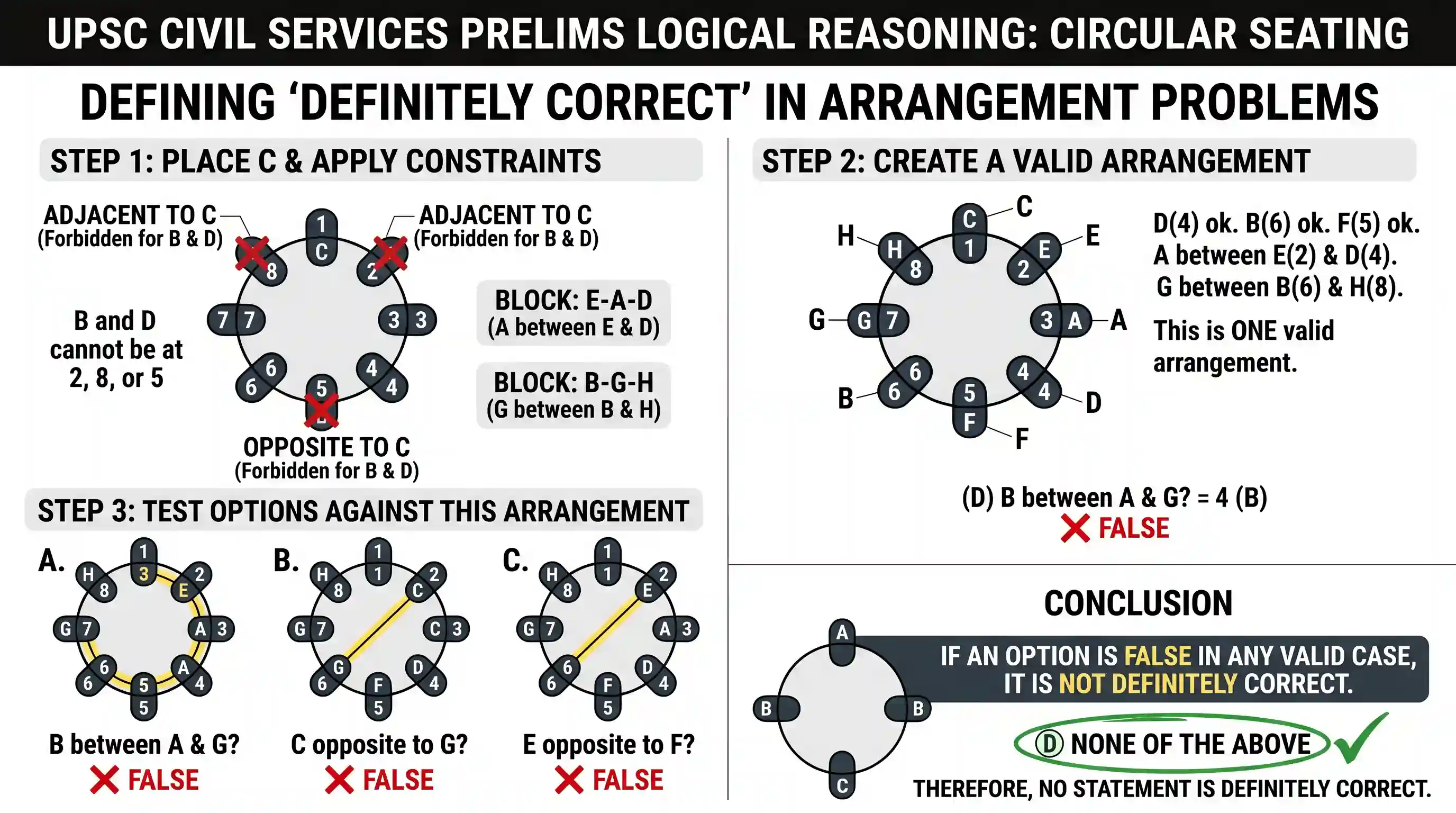
The problem asks us to identify a statement that is "definitely correct" based on the given seating arrangement conditions. This means the statement must be true for all possible valid arrangements. If we can find even one valid arrangement where an option is false, then that option is not definitely correct.
Let's list the conditions:
- Eight students A, B, C, D, E, F, G, H sit around a circular table, equidistant, facing the centre.
- B and D sit neither adjacent to C nor opposite to C.
- A sits in between E and D (forming a block E-A-D or D-A-E).
- G sits in between B and H (forming a block B-G-H or H-G-B).
The most restrictive condition is condition 2. Let's assume C is at position 1 (out of 8 positions).
- Adjacent positions to C are 2 and 8.
- The opposite position to C is 5. Therefore, B and D cannot be at positions 2, 8, or 5. This means B and D must be chosen from positions 3, 4, 6, or 7.
We have two blocks of three consecutive people: (E A D) and (B G H). The remaining two people are C and F.
Let's try to construct a valid arrangement: Arrangement 1:
- Place C at position 1.
- Place the block (E A D) starting at position 2: E(2), A(3), D(4).
- Here, D is at position 4, which is allowed (not 2, 8, or 5).
- Place the block (B G H) starting at position 6: B(6), G(7), H(8).
- Here, B is at position 6, which is allowed (not 2, 8, or 5).
- The remaining person, F, must be at position 5.
- This arrangement is: C(1) E(2) A(3) D(4) F(5) B(6) G(7) H(8).
- Let's verify condition 2: C is at 1. D is at 4 (not adjacent or opposite to C). B is at 6 (not adjacent or opposite to C). All conditions are satisfied. This is a valid arrangement.
Now, let's check the given options against Arrangement 1: A) B sits in between A and G.
- In Arrangement 1: A is at 3, B is at 6, G is at 7. The sequence is A-D-F-B-G. B is not between A and G. (False) B) C sits opposite to G.
- In Arrangement 1: C is at 1, G is at 7. Opposite to 1 is 5. C is not opposite to G. (False) C) E sits opposite to F.
- In Arrangement 1: E is at 2, F is at 5. Opposite to 2 is 6. E is not opposite to F. (False)
Since options A, B, and C are all false for this valid arrangement, none of them can be "definitely correct". Therefore, option D (None of the above) must be the correct answer.
(For completeness, we can also find another valid arrangement that yields the same conclusion for the options, confirming they are not universally true.)
The final answer is D.
Related questions
More UPSC Prelims practice from the same subject and topic.
- Prelims 2024CSATLogical Reasoning
Six lectures A B C D E and F, each of one hour duration, are scheduled between 8:00 am, and 2:00 p.m. Consider the Question and two Statements given below: Question: Which lecture is in the third peri…
- Prelims 2024CSATLogical Reasoning
Six Persons A, B, C, D, E and F are sitting equidistant form each other around a circular table (facing the centre of the table). Consider the Question and two statements given below: Question: Who is…
- Prelims 2024CSATLogical Reasoning
Consider the sequence: ABC _ _ ABC _ DABBCD _ ABCD Which one of the following completes the sequence?
- Prelims 2024CSATLogical Reasoning
What is the value of X in the sequence 2, 12, 36, 80, 150, X?
- Prelims 2024CSATLogical Reasoning
Consider the following statements: 1. Between 3:16 p.m. and 3:17 p.m., both hour hand and minute hand coincide. 2. Between 4:58 p.m. and 4:59 p.m., both minute hand and second hand coincide. Which of …
- Prelims 2024CSATLogical Reasoning
Three Statements followed by three Conclusions are given below. You have to take the Statements to be true even if they seem to be at variance from the commonly known facts. Read all the Conclusions a…