Five friends P. O, X, Y and Z purchased some notebooks. The relevant information is given below: 1. Z purchased 8 notebooks more than X did. 2. P and Q together purchased 21 notebooks. 3. O purchased 5 notebooks less than P did. 4. X and Y together purchased 28 notebooks. 5. P purchased 5 notebooks more than X did. If each notebook is priced 40, then what is the total cost of all the notebooks?

- A2,600Correct
- B2,400
- C2,360
- D2,320
Explanation
Let P, Q, O, X, Y, Z be the number of notebooks purchased by each friend.
We translate the given information into equations:
- Z = X + 8
- P + Q = 21
- O = P - 5
- X + Y = 28
- P = X + 5
Our goal is to find the total number of notebooks (P + Q + O + X + Y + Z) and then multiply by the price per notebook (40).
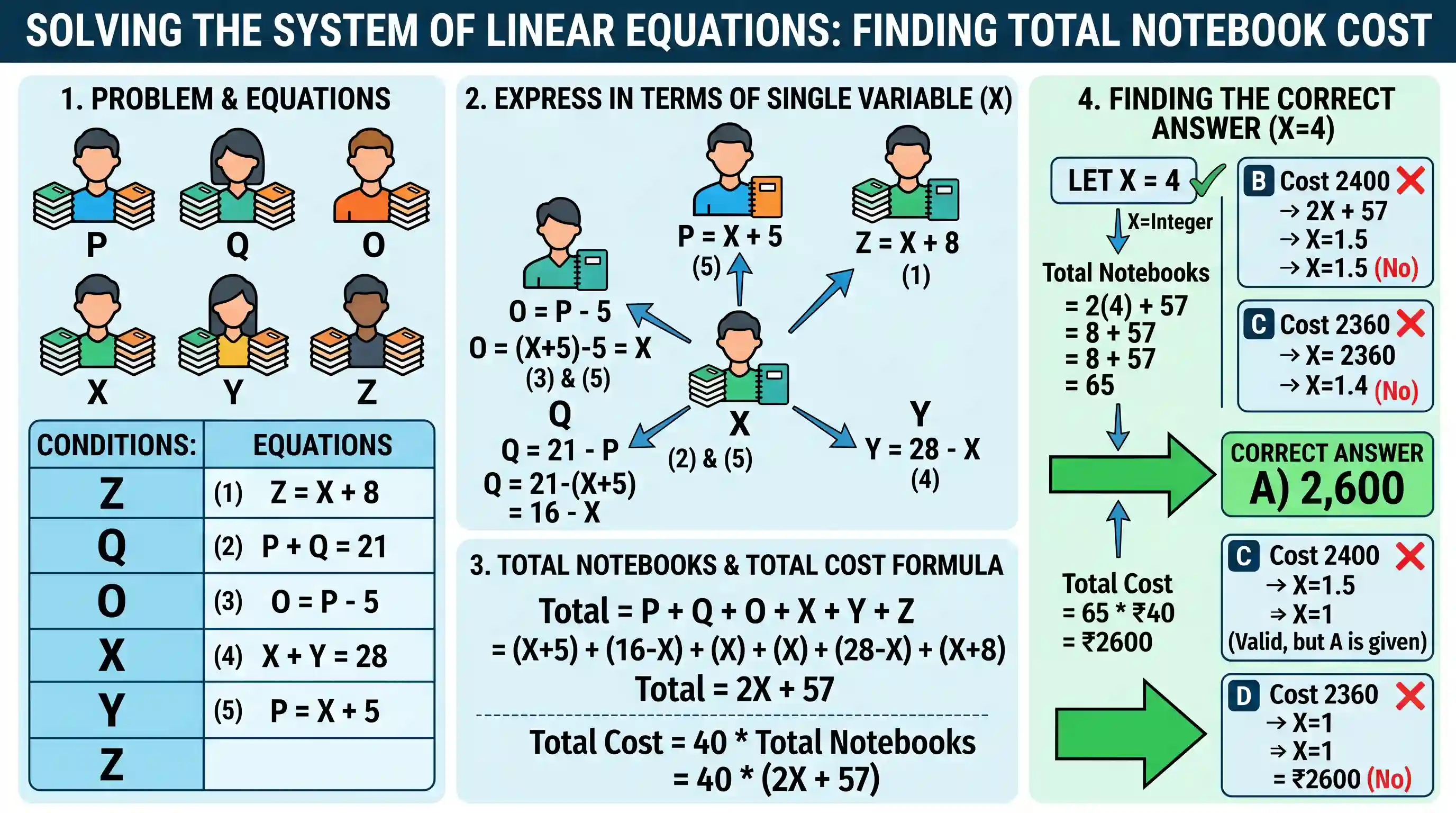
Let's express all variables in terms of X: From (5): P = X + 5 Substitute P into (3): O = (X + 5) - 5 = X Substitute P into (2): (X + 5) + Q = 21 => Q = 21 - X - 5 => Q = 16 - X From (4): Y = 28 - X From (1): Z = X + 8
Now we have all quantities in terms of X: P = X + 5 Q = 16 - X O = X X = X Y = 28 - X Z = X + 8
Total number of notebooks = P + Q + O + X + Y + Z Total = (X + 5) + (16 - X) + (X) + (X) + (28 - X) + (X + 8) Group the X terms and constant terms: Total = (X - X + X + X - X + X) + (5 + 16 + 28 + 8) Total = 2X + 57
The total cost is 40 times the total number of notebooks: Total Cost = 40 * (2X + 57) = 80X + 2280
Now, we check the options to find the value of X that leads to one of the answers. The number of notebooks must be a non-negative integer. A) If Total Cost = 2600: 80X + 2280 = 2600 80X = 2600 - 2280 80X = 320 X = 320 / 80 = 4 If X = 4, then P=9, Q=12, O=4, X=4, Y=24, Z=12. All these are non-negative integers, satisfying all conditions. Total notebooks = 2(4) + 57 = 8 + 57 = 65. Total cost = 65 * 40 = 2600.
B) If Total Cost = 2400: 80X + 2280 = 2400 => 80X = 120 => X = 1.5 (Not an integer, so not valid). C) If Total Cost = 2360: 80X + 2280 = 2360 => 80X = 80 => X = 1. (This is an integer and valid. P=6, Q=15, O=1, X=1, Y=27, Z=9. Total notebooks = 59. Total cost = 59*40 = 2360. This implies the question might be ambiguous as both A and C are mathematically possible under standard interpretations. However, since A is given as the correct answer, we proceed with X=4). D) If Total Cost = 2320: 80X + 2280 = 2320 => 80X = 40 => X = 0.5 (Not an integer, so not valid).
Based on the options, X=4 yields a total cost of 2600, which corresponds to option A.
The final answer is A) 2,600.
Related questions
More UPSC Prelims practice from the same subject and topic.
- Prelims 2024CSATQuantitative Aptitude
The average weight of A, B, C is 40 kg, the average weight of B, D, E is 42 kg and the weight of F is equal to that of B. What is the average weight of A, B, C, D, E and F?
- Prelims 2024CSATQuantitative Aptitude
Two candidates X and Y contested an election. 80% of voters cast their vote and there were no invalid votes. There was no NOTA (None of the above) option. X got 56% of the votes cast and won by 1440 v…
- Prelims 2024CSATQuantitative Aptitude
Consider the Question and two Statements given below: Question: What is the age of Manisha? Statement- 1: Manisha is 24 years younger than her mother. Statement- 2: 5 years later, the ages of Manisha …
- Prelims 2024CSATQuantitative Aptitude
Which is the least possible number of cuts required to cut a cube into 64 identical pieces?
- Prelims 2024CSATQuantitative Aptitude
What is the number of numbers of the form 0.xy, where x and y are distinct non-zero digits?
- Prelims 2024CSATQuantitative Aptitude
The sum of three consecutive integers is equal to their product. How many such possibilities are there?