Which one of the following is synthesised in human body that dilates blood vessels and increases blood flow?

- ANitric oxideCorrect
- BNitrous oxide
- CNitrogen dioxide
- DNitrogen pentoxide
Explanation
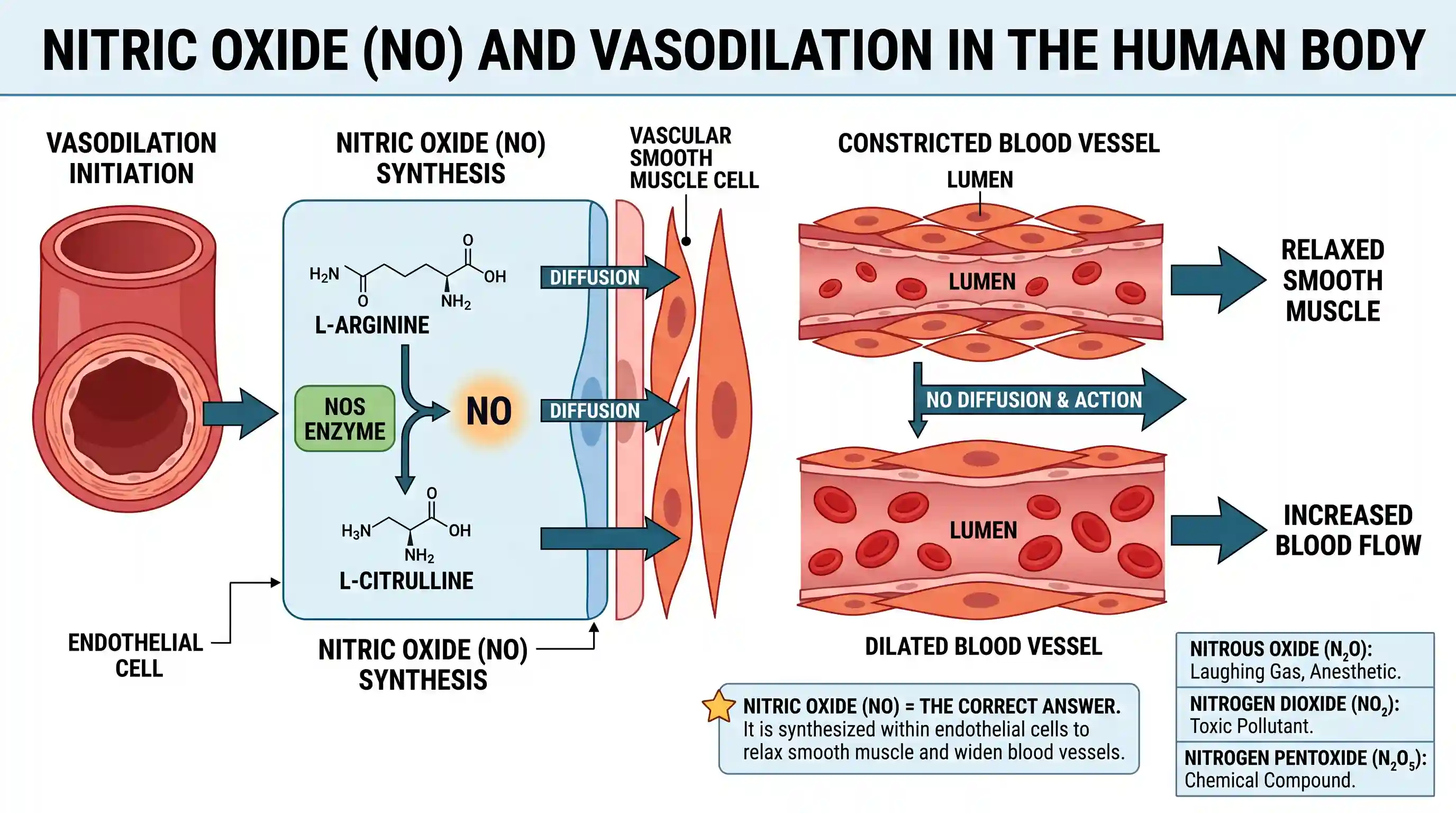
The correct answer is Nitric oxide (NO).
Nitric oxide is a crucial signaling molecule in the human body, playing a vital role in various physiological processes. One of its most important functions is its role as a vasodilator. It relaxes the smooth muscles in the walls of blood vessels, causing them to widen (dilate). This vasodilation leads to increased blood flow, which is essential for delivering oxygen and nutrients to tissues and organs, and for regulating blood pressure. Nitric oxide is synthesized in the body by the enzyme nitric oxide synthase (NOS).
- Nitrous oxide (N₂O): Known as 'laughing gas', used as an anesthetic, but not primarily for vasodilation in normal physiological processes.
- Nitrogen dioxide (NO₂): A toxic gas, primarily an air pollutant.
- Nitrogen pentoxide (N₂O₅): A chemical compound, not synthesized in the human body for physiological functions.
Therefore, Nitric oxide is the correct answer.
Related questions
More UPSC Prelims practice from the same subject and topic.
- Prelims 2024GS1science-and-technology
The organisms “Cicada, Froghopper and Pond skater" are:
- Prelims 2024GS1science-and-technology
Consider the following: 1. Battery storage 2. Biomass generators 3. Fuel cells 4. Rooftop solar photovoltaic units How many of the above are considered "Distributed Energy Resources"?
- Prelims 2024GS1science-and-technology
Consider the following statements: Statement-I: Giant stars live much longer than dwarf stars. Statement-II : Compared to dwarf stars, giant stars have a greater rate of nuclear reactions. Which one o…
- Prelims 2024GS1science-and-technology
Consider the following activities : 1. Identification of narcotics on passengers at airports or in aircraft 2. Monitoring of precipitation 3. Tracking the migration of animals In how many of the above…
- Prelims 2024GS1science-and-technology
Which one of the following is the exhaust pipe emission from Fuel Cell Electric Vehicles, powered by hydrogen ?
- Prelims 2024GS1science-and-technology
"Membrane Bioreactors" are often discussed in the context of: