With reference to the Indian Parliament, consider the following statements: 1. A bill pending in the Lok Sabha lapses on its dissolution. 2. A bill passed by the Lok Sabha and pending in the Rajya Sabha lapses on the dissolution of the Lok Sabha. 3. A bill in regard to which the President of India notified his/her intention to summon the Houses to a joint sitting lapses on the dissolution of the Lok Sabha. Which of the statements given above is/are correct?

- A1 only
- B1 and 2Correct
- C2 and 3
- D3 only
Explanation
Let's analyze the statements regarding the lapsing of bills on the dissolution of the Lok Sabha:
-
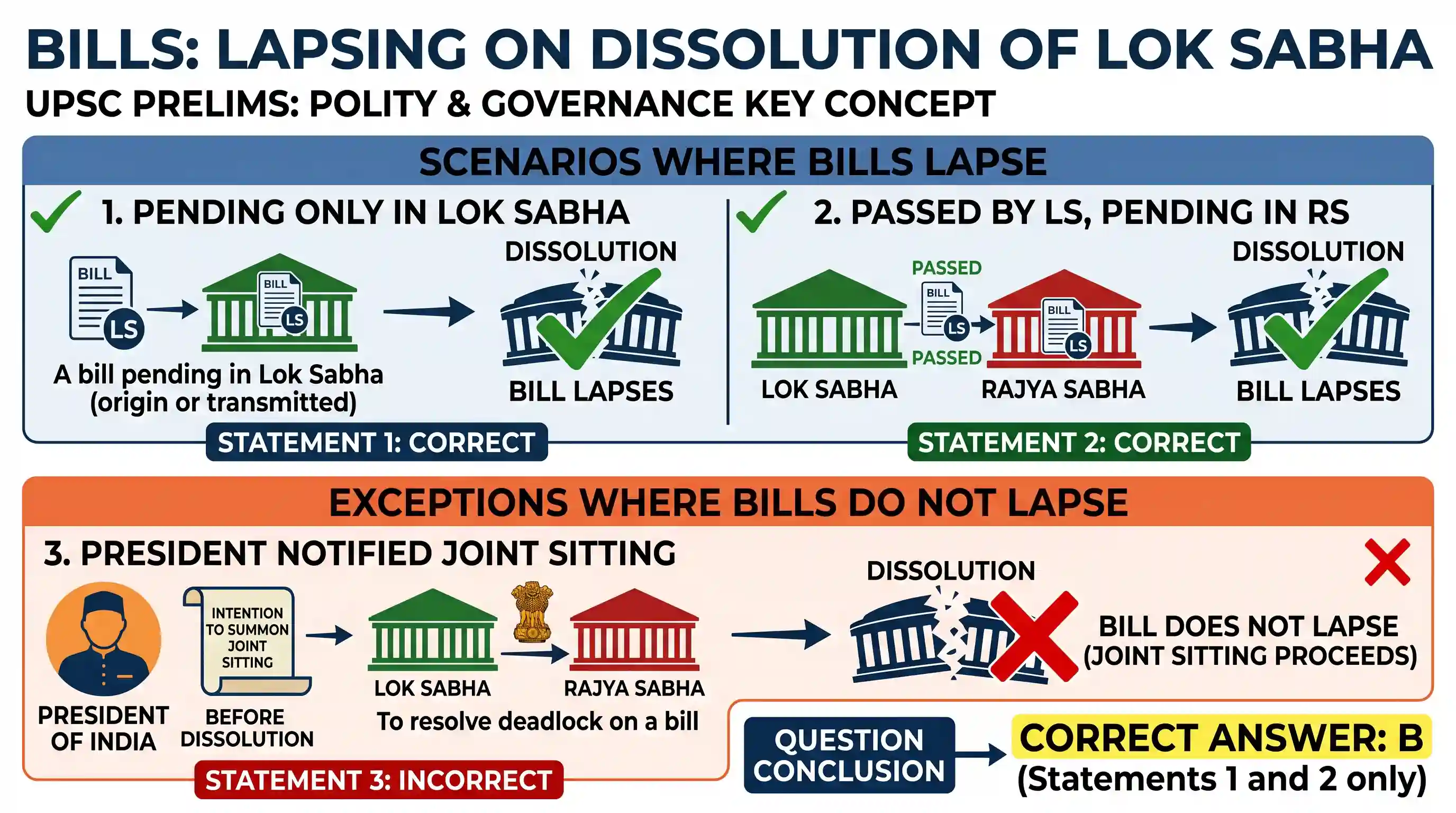
Statement 1 is correct. A bill pending in the Lok Sabha (whether originated there or transmitted from Rajya Sabha) lapses on the dissolution of the Lok Sabha. This is a fundamental principle.
-
Statement 2 is correct. A bill passed by the Lok Sabha but still pending in the Rajya Sabha also lapses on the dissolution of the Lok Sabha. This is because the original House (Lok Sabha) that passed it is dissolved.
-
Statement 3 is incorrect. This is a significant exception to the lapsing rule. If the President has notified his/her intention to summon a joint sitting of both Houses to resolve a deadlock on a bill before the dissolution of the Lok Sabha, the bill does not lapse on such dissolution. This provision is designed to ensure that the legislative process can continue to resolve disagreements on important bills, even if the Lok Sabha is dissolved.
Therefore, statements 1 and 2 are correct.
Related questions
More UPSC Prelims practice from the same subject and topic.
- Prelims 2024GS1polity-and-governance
With reference to the Speaker of the Lok Sabha, consider the following statements : While any resolution for the removal of the Speaker of the Lok Sabha is under consideration 1. He/She shall not pres…
- Prelims 2024GS1polity-and-governance
Consider the following statements regarding World Toilet Organization : 1. It is one of the agencies of the United Nations. 2. World Toilet Summit, World Toilet Day and World Toilet College are the in…
- Prelims 2024GS1polity-and-governance
Who was the Provisional President of the Constituent Assembly before Dr. Rajendra Prasad took over?
- Prelims 2024GS1polity-and-governance
With reference to the Government of India Act, 1935, consider the following statements : 1. It provided for the establishment of an All India Federation based on the union of the British Indian Provin…
- Prelims 2024GS1polity-and-governance
As per Article 368 of the Constitution of India, the Parliament may amend any provision of the Constitution by way of : 1. Addition 2. Variation 3. Repeal Select the correct answer using the code give…
- Prelims 2024GS1polity-and-governance
Which of the following statements are correct in respect of a Money Bill in the Parliament? 1. Article 109 mentions special procedure in respect of Money Bills. 2. A Money Bill shall not be introduced…