Three teams P, Q, R participated in a tournament in which the teams play with one another exactly once. A win fetches a team 2 points and a draw 1 point. A team gets no point for a loss. Each team scored exactly one goal in the tournament. The team P got 3 points, Q got 2 points and R got 1 point. Which of the following statements is/are correct? I. The result of the match between P and Q is a draw with the score 0-0. II. The number of goals scored by R against Q is 1. Which of the statements given above is/are correct?

- AI only
- BII only
- CBoth I and IICorrect
- DNeither I nor II
Explanation
The problem involves deducing the results and scores of three matches between teams P, Q, and R, given their final points and goal-scoring information.
- Total Matches: P vs Q, P vs R, Q vs R (3 matches).
- Points per match: A win gives 2 points, a draw gives 1 point to each team. In any match, a total of 2 points are distributed (2+0 for a win/loss, 1+1 for a draw).
- Total Points Distributed: 3 matches * 2 points/match = 6 points. The sum of points for P, Q, R (3+2+1 = 6) matches this, confirming consistency.
- Goal Scoring: Each team scored exactly one goal in the tournament. This means a total of 3 goals were scored across all matches.
Let's deduce the match outcomes based on points:
- P has 3 points. To get 3 points from two matches, P must have 1 Win (2 pts) and 1 Draw (1 pt).
- Q has 2 points. To get 2 points from two matches, Q could have 1 Win (2 pts) and 1 Loss (0 pts), OR 2 Draws (1+1 pts).
- R has 1 point. To get 1 point from two matches, R must have 1 Draw (1 pt) and 1 Loss (0 pts).
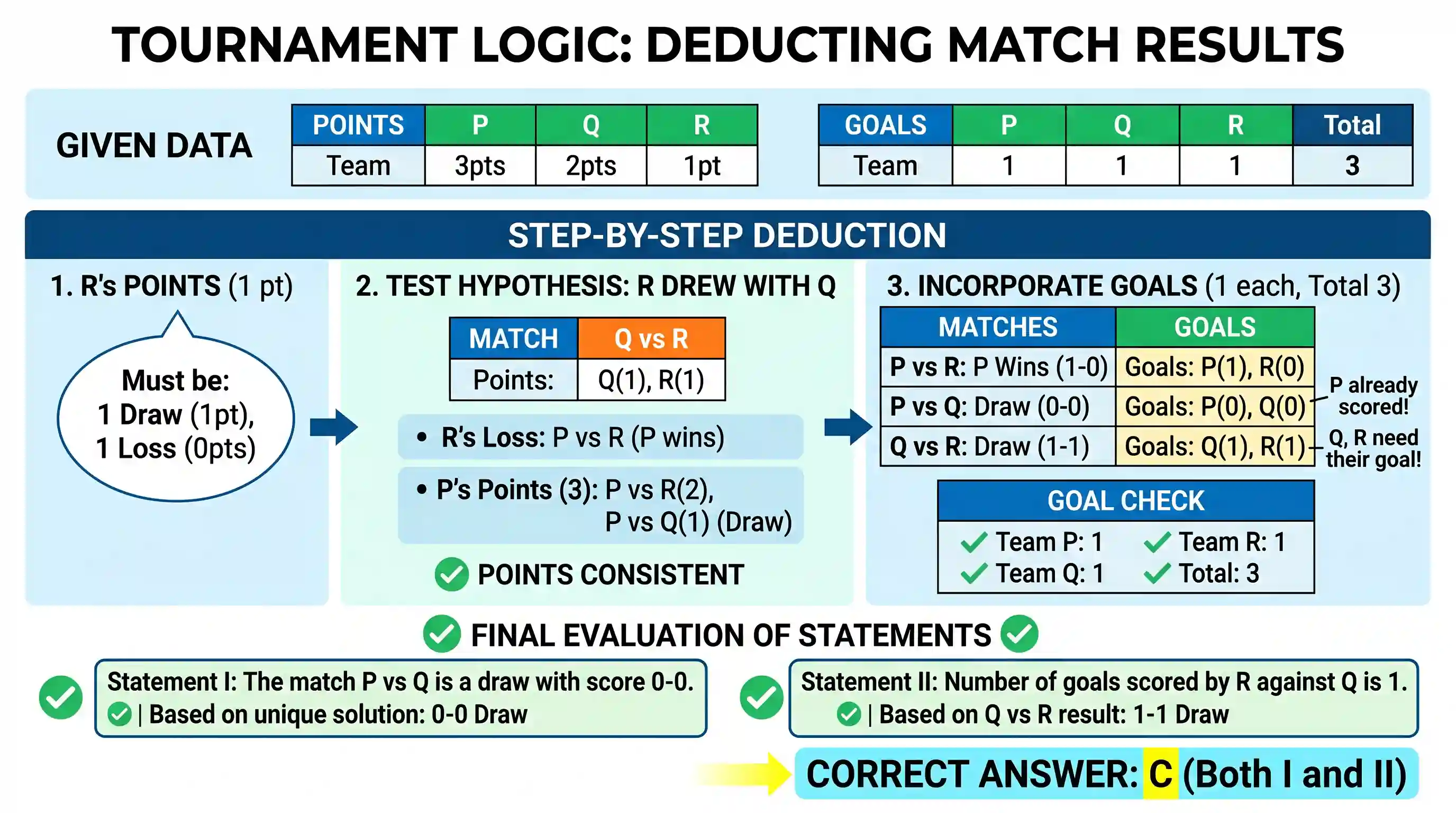
From R's points (1 Draw, 1 Loss), we know R drew one match. Let's consider the two possibilities for R's draw:
Case 1: R drew with P (P vs R is a Draw). * P gets 1 point from R, R gets 1 point from P. * Since P needs 3 points total, and has 1 from R, P must win its other match against Q. So, P vs Q is a Win for P (P gets 2 pts, Q gets 0 pts). * P's points: 1 (from R) + 2 (from Q) = 3 points (Consistent). * R's points: 1 (from P). R lost its other match, so R must have lost to Q (R gets 0 pts from Q). * R's points: 1 (from P) + 0 (from Q) = 1 point (Consistent). * Q's points: 0 (from P). Q must have won against R (Q gets 2 pts from R). * Q's points: 0 (from P) + 2 (from R) = 2 points (Consistent). * So, this point distribution (P vs R: Draw, P vs Q: P wins, Q vs R: Q wins) is consistent with total points.
Now, let's incorporate the goal information (each team scored 1 goal, total 3 goals):
*   P vs R: Draw. If it's 1-1, P and R have scored their goals.
*   P vs Q: P wins. If P already scored against R, P cannot score here. For P to win, it must be 1-0 (P scored) or 2-1 etc. If P already scored, this scenario is problematic.
*   Let's assume 0-0 draws where possible to save goals.
*   If P vs R is 0-0 Draw: P gets 1 pt, R gets 1 pt. Goals: P=0, R=0.
*   P vs Q: P wins. P needs to score its goal. Q has not scored. P wins 1-0. P gets 2 pts, Q gets 0 pts. Goals: P=1, Q=0.
*   Q vs R: Q wins. Q needs to score its goal. R has not scored. Q wins 1-0. Q gets 2 pts, R gets 0 pts. Goals: Q=1, R=0.
*   Total goals: P=1, Q=1, R=0. This contradicts the condition that R scored exactly one goal. So, Case 1 is incorrect.
Case 2: R drew with Q (Q vs R is a Draw). * Q gets 1 point from R, R gets 1 point from Q. * Since R needs 1 point total, and has 1 from Q, R must lose its other match against P. So, P vs R is a Win for P (P gets 2 pts, R gets 0 pts). * R's points: 1 (from Q) + 0 (from P) = 1 point (Consistent). * P's points: 2 (from R). P needs 3 points total, so P must draw its other match against Q. So, P vs Q is a Draw (P gets 1 pt, Q gets 1 pt). * P's points: 2 (from R) + 1 (from Q) = 3 points (Consistent). * Q's points: 1 (from R) + 1 (from P) = 2 points (Consistent). * This point distribution (P vs Q: Draw, P vs R: P wins, Q vs R: Draw) is consistent with total points.
Now, let's incorporate the goal information (each team scored 1 goal, total 3 goals):
*   P vs Q: Draw. If it's 1-1, P and Q have scored their goals. Then P won against R (P vs R: P wins). P cannot score again. This means P wins 1-0, but P has no goals left. This is a contradiction. Therefore, P vs Q must be a 0-0 draw.
*   P vs Q: 0-0 Draw. P gets 1 pt, Q gets 1 pt. Goals: P=0, Q=0.
*   P vs R: P wins. P needs to score its goal. R has not scored. P wins 1-0. P gets 2 pts, R gets 0 pts. Goals: P=1, R=0. (P has scored its only goal).
*   Q vs R: Draw. Q needs to score its goal. R needs to score its goal. This must be a 1-1 draw. Q gets 1 pt, R gets 1 pt. Goals: Q=1, R=1. (Q and R have scored their only goals).

Let's verify this final scenario:
*   Match Results & Scores:
    *   P vs Q: 0-0 Draw (P=1pt, Q=1pt)
    *   P vs R: P wins 1-0 (P=2pts, R=0pt)
    *   Q vs R: 1-1 Draw (Q=1pt, R=1pt)
*   Total Points:
    *   P: 1 + 2 = 3 points (Correct)
    *   Q: 1 + 1 = 2 points (Correct)
    *   R: 0 + 1 = 1 point (Correct)
*   Total Goals Scored by Each Team:
    *   P: 1 goal (against R) (Correct)
    *   Q: 1 goal (against R) (Correct)
    *   R: 1 goal (against Q) (Correct)
This scenario perfectly fits all given conditions.
Now, let's evaluate the statements:
Statement I: The result of the match between P and Q is a draw with the score 0-0. Based on our unique deduction, this statement is correct.
Statement II: The number of goals scored by R against Q is 1. In the Q vs R match, which was a 1-1 draw, R scored 1 goal against Q. This statement is also correct.
Since both statements I and II are correct, the answer is C.
The final answer is C
Related questions
More UPSC Prelims practice from the same subject and topic.
- Prelims 2025CSATQuantitative Aptitude
Team X scored a total of N runs in 20 overs. Team Y tied the score in 10% less overs. Had team Y's average run rate (runs per over) been 50% higher, the scores would have been tied in 12 overs. How ma…
- Prelims 2025CSATQuantitative Aptitude
The price (p) of a commodity is first increased by k% ; then decreased by k% ; again increased by k% ; and again decreased by k% . If the new price is q , then what is the relation between p and q ?
- Prelims 2025CSATQuantitative Aptitude
The petrol price shot up by 10% as a result of the hike in crude oil prices. The price of petrol before the hike was π 90 per litre. A person travels 2200km every month and his car gives a mileage of …
- Prelims 2025CSATQuantitative Aptitude
There are 7 places A, B, C, D, E, F and G in a city connected by various roads AB, AC, CD, DE, BF, EG and FG. A is 6 km south of B. A is 10 km west of C. D is 5 km east of E. C is 6 km north of D. F i…
- Prelims 2025CSATQuantitative Aptitude
In a T20 cricket match, three players X, Y and Z scored a total of 37 runs. The ratio of number of runs scored by X to the number of runs scored by Y is equal to ratio of number of runs scored by Y to…
- Prelims 2025CSATQuantitative Aptitude
The average of three numbers p , q and r is k . p is as much more than the average as q is less than the average. What is the value of r ?