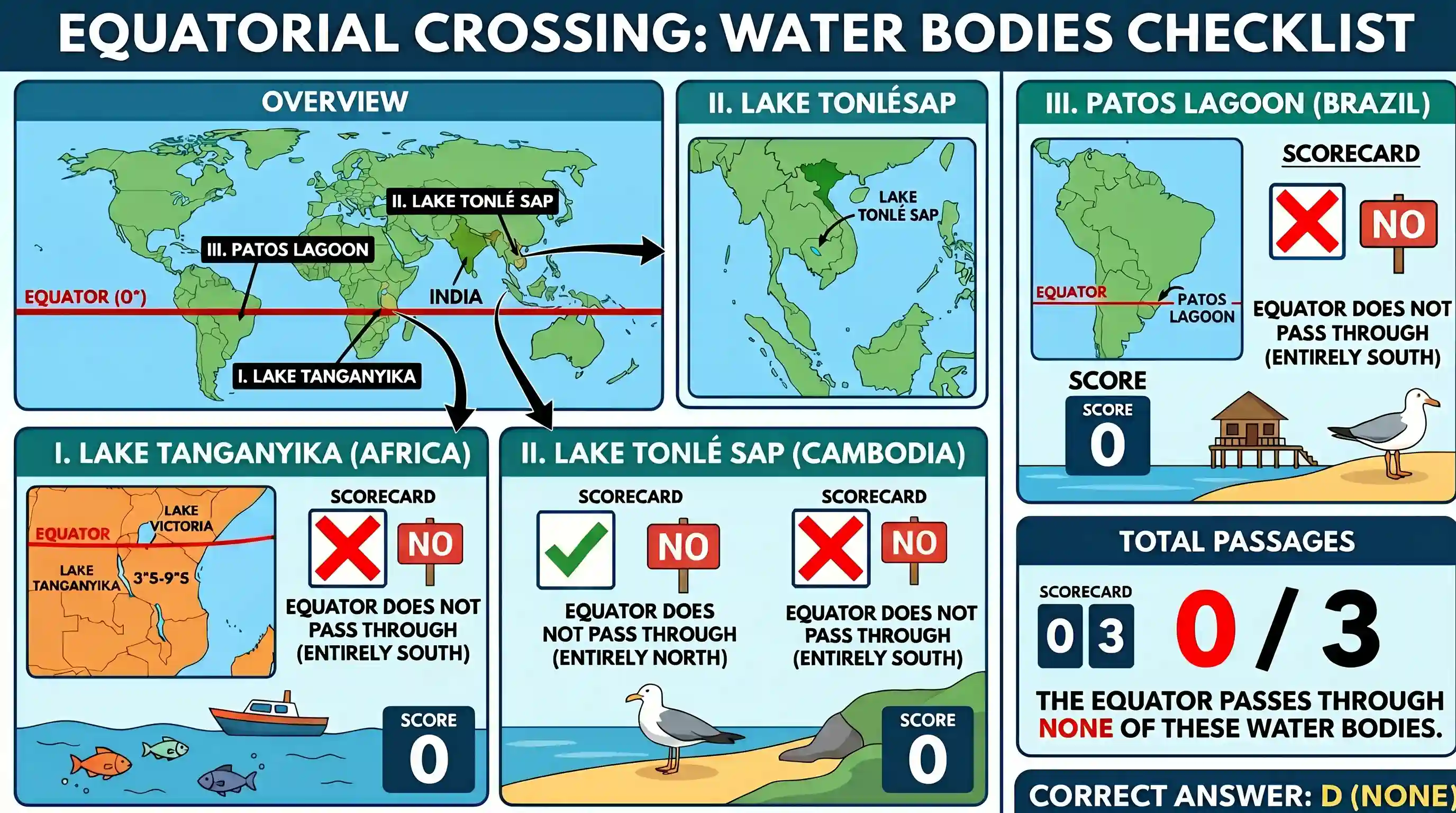
Consider the following water bodies : I. Lake Tanganyika II. Lake Tonlé Sap III. Patos Lagoon Through how many of them does the equator pass?

- AOnly one
- BOnly two
- CAll the three
- DNoneCorrect
Explanation
The equator does not pass through any of the listed water bodies:
I. Lake Tanganyika: No. Lake Tanganyika lies entirely between approximately 3°S and 9°S in East Africa. It is entirely south of the equator. The equator passes through the northern part of nearby Lake Victoria, not Lake Tanganyika.
II. Lake Tonle Sap: No. Lake Tonle Sap is located in Cambodia at approximately 13°N, well north of the equator.
III. Patos Lagoon: No. Patos Lagoon is located in southern Brazil at approximately 30°S, far south of the equator.
Therefore, the equator does not pass through any of these water bodies.
Related questions
More UPSC Prelims practice from the same subject and topic.
- Prelims 2025GS1geography
Consider the following countries : I. Bolivia II. Brazil III. Colombia IV. Ecuador V. Paraguay VI. Venezuela Andes mountains pass through how many of the above countries?
- Prelims 2025GS1geography
Consider the following countries : I. United Kingdom II. Denmark III. New Zealand IV. Australia V. Brazil How many of the above countries have more than four time zones?
- Prelims 2025GS1geography
Consider the following statements : I. Anadyr in Siberia and Nome in Alaska are a few kilometers from each other, but when people are waking up and getting set for breakfast in these cities, it would …
- Prelims 2025GS1geography
Consider the following statements : Statement I: Circular economy reduces the emissions of greenhouse gases. Statement II: Circular economy reduces the use of raw materials as inputs. Statement III : …
- Prelims 2025GS1geography
Which of the following are the evidences of the phenomenon of continental drift? I. The belt of ancient rocks from Brazil coast matches with those from Western Africa. II. The gold deposits of Ghana a…
- Prelims 2025GS1geography
Consider the following statements : Statement I: The amount of dust particles in the atmosphere is more in subtropical and temperate areas than in equatorial and polar regions. Statement II: Subtropic…