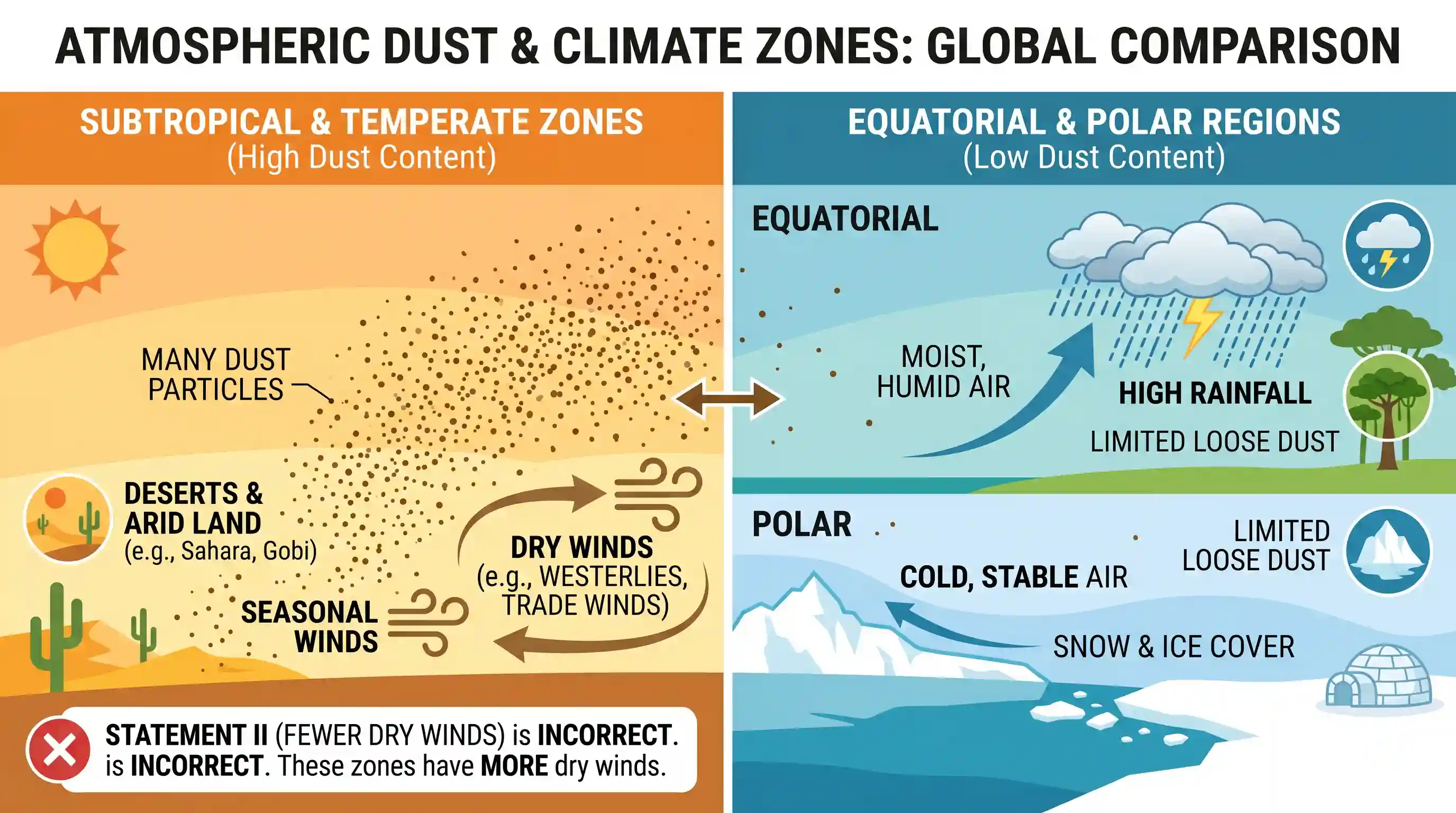
Consider the following statements : Statement I: The amount of dust particles in the atmosphere is more in subtropical and temperate areas than in equatorial and polar regions. Statement II: Subtropical and temperate areas have less dry winds. Which one of the following is correct in respect of the above statements?

- ABoth Statement I and Statement II are correct and Statement II explains Statement I
- BBoth Statement I and Statement II are correct but Statement II does not explain Statement I
- CStatement I is correct but Statement II is not correctCorrect
- DStatement I is not correct but Statement II is correct
Explanation
Statement I: Correct. Subtropical and temperate regions do have more dust particles in the atmosphere compared to equatorial and polar regions. This is due to factors like arid conditions, seasonal wind patterns, and human activities in these zones.
Statement II: Incorrect. Subtropical and temperate areas actually have more dry winds, not less. These regions experience dry winds like trade winds, westerlies, and seasonal monsoon winds that contribute to dust particle suspension. Areas like the subtropical deserts (Sahara, Thar) are major sources of atmospheric dust due to persistent dry winds.
The high dust content in subtropical regions is actually caused by the prevalence of dry winds, making Statement II incorrect as an explanation.
Related questions
More UPSC Prelims practice from the same subject and topic.
- Prelims 2025GS1geography
Consider the following statements : Statement I: In January, in the Northern Hemisphere, the isotherms bend equatorward while crossing the landmasses, and poleward while crossing the oceans. Statement…
- Prelims 2025GS1geography
Consider the following statements : I. Without the atmosphere, temperature would be well below freezing point everywhere on the Earth's surface. II. Heat absorbed and trapped by the atmosphere maintai…
- Prelims 2025GS1geography
Consider the following statements : Statement I: Scientific studies suggest that a shift is taking place in the Earth's rotation and axis. Statement II: Solar flares and associated coronal mass ejecti…
- Prelims 2025GS1geography
Consider the following statements : Statement I: Circular economy reduces the emissions of greenhouse gases. Statement II: Circular economy reduces the use of raw materials as inputs. Statement III : …
- Prelims 2025GS1geography
Consider the following countries : I. Bolivia II. Brazil III. Colombia IV. Ecuador V. Paraguay VI. Venezuela Andes mountains pass through how many of the above countries?
- Prelims 2025GS1geography
Consider the following water bodies : I. Lake Tanganyika II. Lake Tonlé Sap III. Patos Lagoon Through how many of them does the equator pass?