In the context of electric vehicle batteries, consider the following elements : I. Cobalt II. Graphite III. Lithium IV. Nickel How many of the above usually make up battery cathodes?

- AOnly one
- BOnly two
- COnly threeCorrect
- DAll the four
Explanation
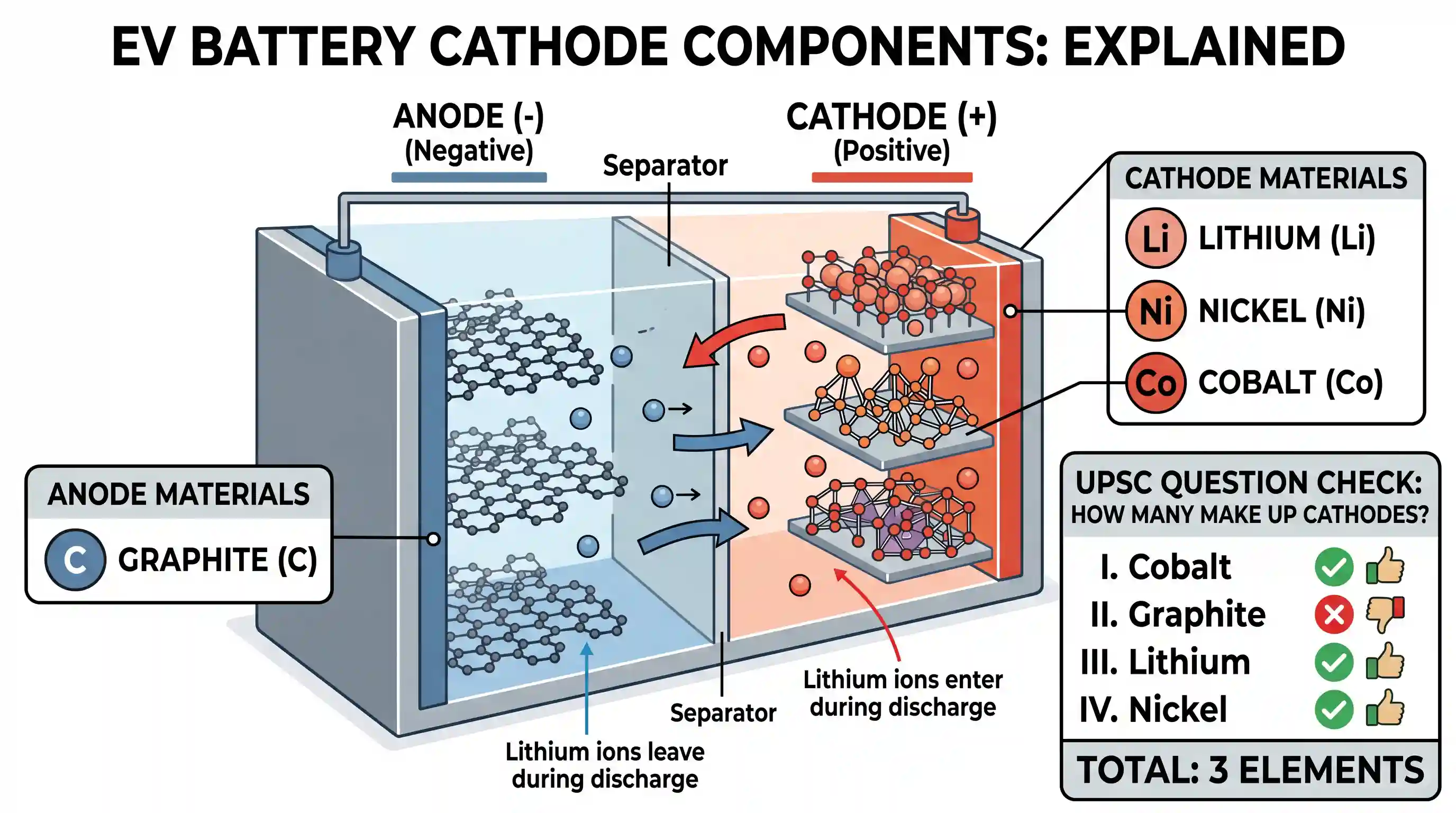
In electric vehicle batteries, typically three elements make up battery cathodes:
I. Cobalt: Yes, cobalt is a key component in many lithium-ion battery cathodes, particularly in NCM (Nickel-Cobalt-Manganese) and NCA (Nickel-Cobalt-Aluminum) chemistries.
II. Graphite: No, graphite is primarily used in the anode (negative electrode) of lithium-ion batteries, not the cathode.
III. Lithium: Yes, lithium compounds like lithium cobalt oxide (LiCoO2) or lithium iron phosphate (LiFePO4) form the base of most EV battery cathodes.
IV. Nickel: Yes, nickel is increasingly used in high-energy density cathodes, especially in NCM and NCA chemistries for better performance and reduced cobalt dependency.
Related questions
More UPSC Prelims practice from the same subject and topic.
- Prelims 2025GS1science-and-technology
Consider the following statements : Statement I: Activated carbon is a good and an attractive tool to remove pollutants from effluent streams and to remediate contaminants from various industries. Sta…
- Prelims 2025GS1science-and-technology
Consider the following statements : Statement I: Some rare earth elements are used in the manufacture of flat television screens and computer monitors. Statement II : Some rare earth elements have pho…
- Prelims 2025GS1science-and-technology
With reference to 'Direct Air Capture', an emerging technology, which of the following statements is/are correct? I. It can be used as a way of carbon sequestration. II. It can be a valuable approach …
- Prelims 2025GS1science-and-technology
Consider the following types of vehicles : I. Full battery electric vehicles II. Hydrogen fuel cell vehicles III. Fuel cell-electric hybrid vehicles How many of the above are considered as alternative…
- Prelims 2025GS1science-and-technology
With reference to Unmanned Aerial Vehicles (UAVs), consider the following statements : I. All types of UAVs can do vertical landing. II. All types of UAVs can do automated hovering. III. All types of …
- Prelims 2025GS1science-and-technology
Consider the following substances: I. Ethanol II. Nitroglycerine III. Urea Coal gasification technology can be used in the production of how many of them?