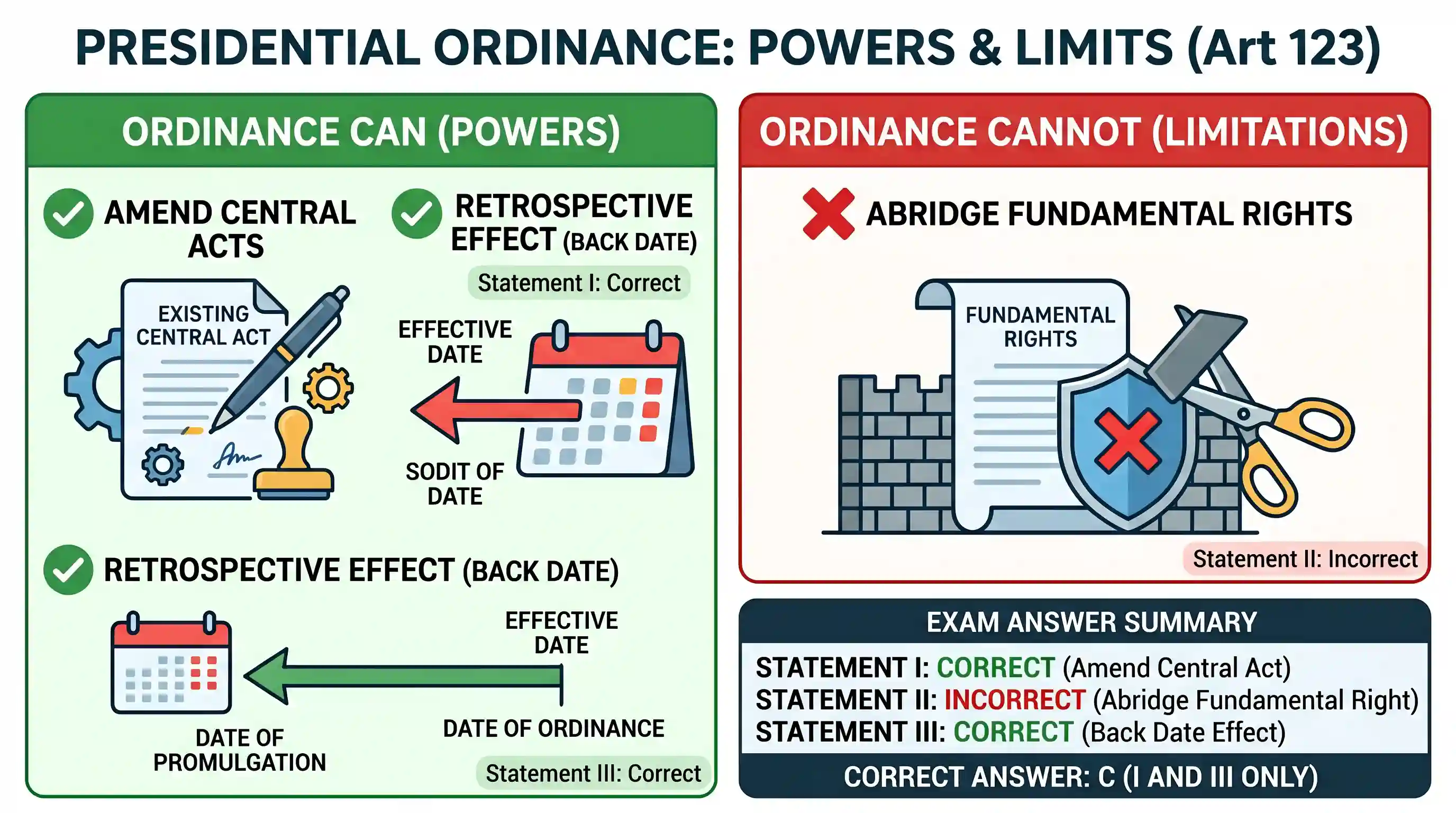
With reference to the Indian polity, consider the following statements : I. An Ordinance can amend any Central Act. II. An Ordinance can abridge a Fundamental Right. III. An Ordinance can come into effect from a back date. Which of the statements given above are correct?

- AI and II only
- BII and III only
- CI and III onlyCorrect
- DI, II and III
Explanation
Analyzing statements about Ordinances:
I. An Ordinance can amend any Central Act: Correct. The President can promulgate an Ordinance to amend any existing Central Act when Parliament is not in session, provided the circumstances require immediate action.
II. An Ordinance can abridge a Fundamental Right: Incorrect. An Ordinance cannot abridge or take away Fundamental Rights, as these are protected under the Constitution and can only be amended through the constitutional amendment process.
III. An Ordinance can come into effect from a back date: Correct. An Ordinance can be given retrospective effect and can come into operation from a date earlier than the date of its promulgation, if so specified in the Ordinance.
Related questions
More UPSC Prelims practice from the same subject and topic.
- Prelims 2025GS1polity-and-governance
Consider the following pairs : Provision in the Constitution of India Stated under I. Separation of Judiciary from the Executive in the public services of the State : The Directive Principles of the S…
- Prelims 2025GS1polity-and-governance
Consider the following statements with regard to pardoning power of the President of India : I. The exercise of this power by the President can be subjected to limited judicial review. II. The Preside…
- Prelims 2025GS1polity-and-governance
Consider the following statements : I. If any question arises as to whether a Member of the House of the People has become subject to disqualification under the 10th Schedule, the President's decision…
- Prelims 2025GS1polity-and-governance
With reference to the Government of India, consider the following information: Organization Some of its functions It works under I. Directorate of Enforcement Enforcement of the Fugitive Economic Offe…
- Prelims 2025GS1polity-and-governance
Consider the following countries : I. Austria II. Bulgaria III. Croatia IV. Serbia V. Sweden VI. North Macedonia How many of the above are members of the North Atlantic Treaty Organization?
- Prelims 2025GS1polity-and-governance
With reference to India, consider the following: I. The Inter-State Council II. The National Security Council III. Zonal Councils How many of the above were established as per the provisions of the Co…