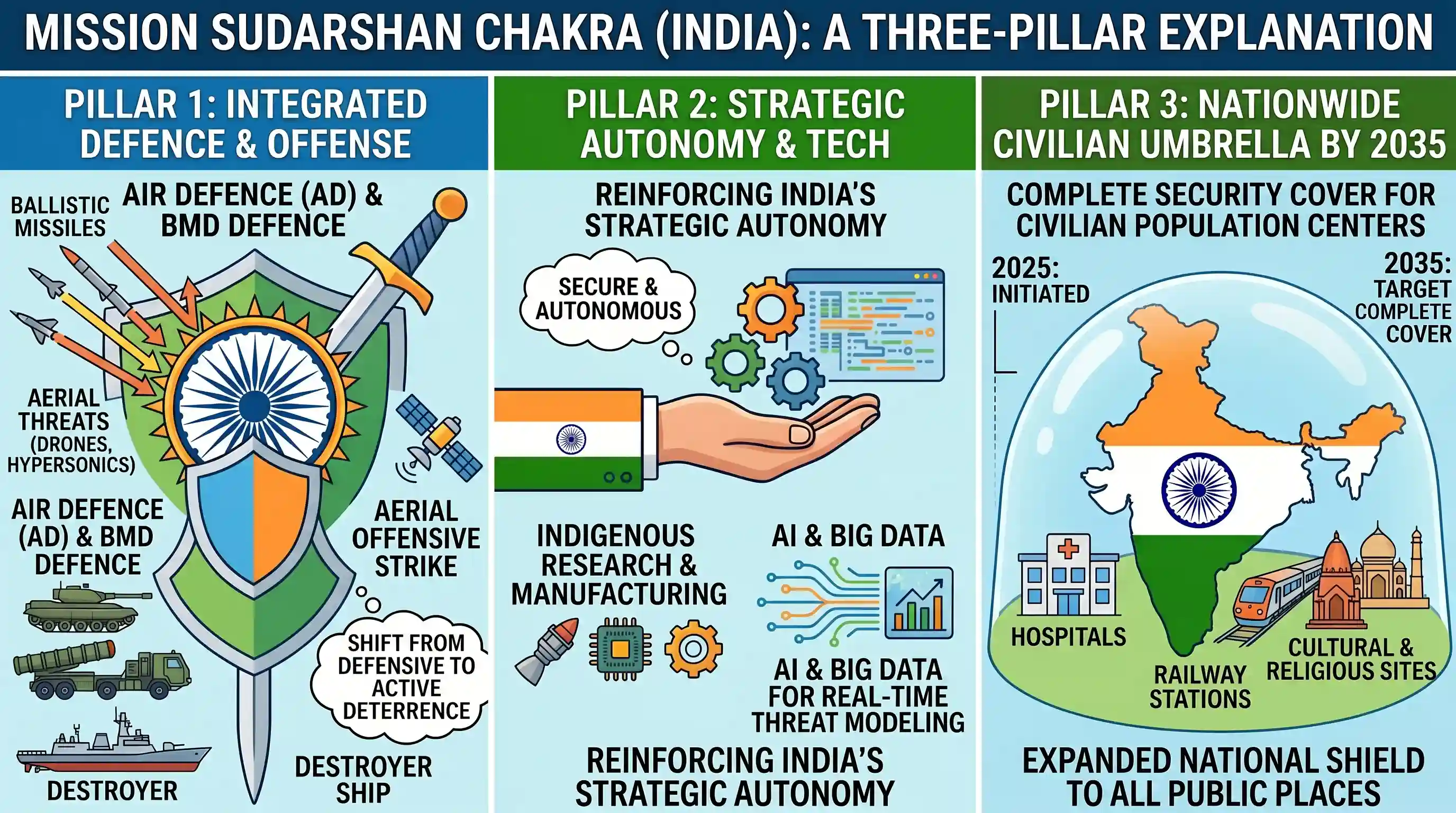
Consider the following statements about Mission Sudarshan Chakra of India : 1. It aims to enhance India's air defence, ballistic missile defence and aerial offensive capabilities. 2. This Mission is being designed to enhance rapid, precise, and powerful defence responses, reinforcing India's strategic autonomy. 3. One of the aims of this Mission is to cover all public places of India by an expanded nationwide security shield by 2035. Which of the statements given above is/are correct ?

- A1, 2 and 3Correct
- B1 and 2 only
- C2 and 3 only
- D1 only
Explanation
Correct Answer: A (1, 2 and 3)
Statement 1 is correct: Announced by Prime Minister Narendra Modi on Independence Day in August 2025, Mission Sudarshan Chakra functions as both a "shield and a sword." It aims to significantly enhance India's Air Defence (AD), Ballistic Missile Defence (BMD), and aerial offensive strike capabilities. The mission integrates land, sea, and space-based defenses (like the S-400 and Project Kusha) to shift India's posture from passive defense to active deterrence.
Statement 2 is correct: A core objective of the mission is to leverage Artificial Intelligence (AI) and Big Data for real-time threat modeling, enabling rapid, precise, and powerful responses to multi-vector threats like hypersonic missiles and drone swarms. By focusing on indigenous research and manufacturing under the Atmanirbhar Bharat framework, the mission critically reinforces India's strategic autonomy in defense technology.
Statement 3 is correct: Unlike conventional air defense networks that protect only strategic military assets, Mission Sudarshan Chakra is explicitly designed to expand into a nationwide security umbrella by 2035. A defining feature is its mandate to provide "complete security cover" for civilian population centers and public places, including hospitals, railway stations, and cultural or religious sites.
Why the other options are incorrect:
- Option B is incorrect because it excludes Statement 3, missing the mission's unprecedented goal to shield nationwide civilian and public infrastructure by 2035.
- Option C is incorrect because it excludes Statement 1, ignoring the vital integration of both Ballistic Missile Defence and aerial offensive capabilities.
- Option D is incorrect because it only recognizes Statement 1, omitting the critical aspects of indigenous strategic autonomy and the 2035 public rollout.
Takeaway: Remember the mythology of the Sudarshan Chakra—it acts as an impenetrable shield (nationwide civilian coverage by 2035) and a precise sword (offensive capabilities), manufactured fully at home for self-reliance.
Related questions
More UPSC Prelims practice from the same subject and topic.
- Prelims 2026GS1current-affairs
Which of the following is/are the most significant implication(s) of obtaining Oeko-Tex certification for Eri Silk in the global textile industry ? 1. It allows Indian exporters to compete in high-end…
- Prelims 2026GS1current-affairs
Match List I with List II and select the answer using the code given below the Lists : List I (INTERPOL Notice) A. Silver Notice B. Blue Notice C. Black Notice D. Green Notice List II (Description) 1.…
- Prelims 2026GS1current-affairs
The Chancellor of the Federal Republic of Germany visited India in January, 2026. Which of the following is/are not correct in terms of outcomes of this visit? 1. Signing of a Memorandum of Understand…
- Prelims 2026GS1current-affairs
The Bureau of Indian Standard (BIS) recently introduced a national standard to test and assess bomb disposal system. Which of the following statements with regard to this system is/are correct? 1. The…
- Prelims 2026GS1current-affairs
Consider the following statements with regard to the film 'Boong' : 1. The film has recently won the British Academy of Film and Television Arts (BAFTA) Award in the Children's and Family Film categor…
- Prelims 2026GS1current-affairs
Consider the following statements with respect to the AI Impact Summit, 2026 held in New Delhi : 1. The Summit's intellectual framework was based on three foundational Sutras : People, Planning, and P…