Which of the following is/are the most significant implication(s) of obtaining Oeko-Tex certification for Eri Silk in the global textile industry ? 1. It allows Indian exporters to compete in high-end markets that prioritise chemical-free products. 2. It confirms that Eri Silk meets international safety, environmental, and quality standards, enabling its entry into premium eco-conscious markets. Select the answer using the code given below :

- A1 only
- B2 only
- CBoth 1 and 2Correct
- DNeither 1 nor 2
Explanation
Correct Answer: C
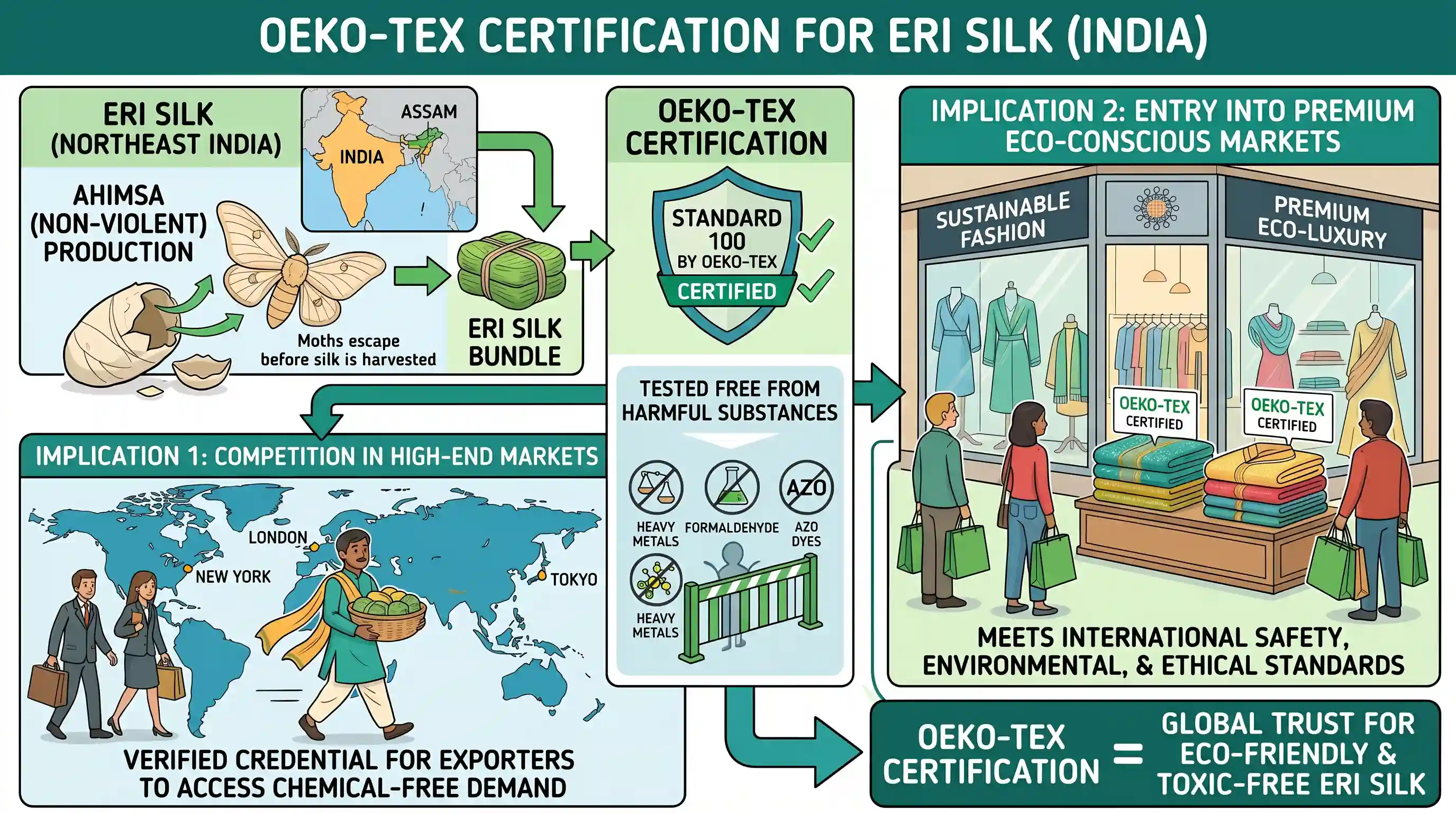
Why Option C is correct: Eri Silk, primarily produced in Assam and other Northeastern Indian states, is famously known as "Ahimsa" or vegan silk because its production allows moths to naturally emerge from their cocoons unharmed. In August 2024, the North Eastern Handicrafts and Handlooms Development Corporation (NEHHDC) successfully obtained the prestigious Oeko-Tex certification from Germany for its Eri Silk.
Statement 1 is correct: The Oeko-Tex certification is an internationally recognized standard that verifies textiles are rigorously tested and found free from harmful substances (such as heavy metals, formaldehyde, and azo dyes). This guarantees chemical-free safety, providing Indian exporters with a verifiable credential to successfully compete in high-end, sustainability-focused global markets.
Statement 2 is correct: Obtaining this standard definitively validates that the silk meets stringent international safety, environmental, and ethical quality parameters. Because global consumers are increasingly pivoting towards ethical fashion, this certification enables Eri Silk—already a Geographical Indication (GI) tagged product—to seamlessly enter premium, eco-conscious export markets worldwide.
Why the other options are wrong:
- Option A is incorrect because it ignores Statement 2; confirming international safety and environmental compliance is a primary function of the Oeko-Tex framework.
- Option B is incorrect because it ignores Statement 1; the certification directly verifies that the textiles are chemical-free, which explicitly boosts exporters' competitive edge.
- Option D is incorrect because both statements accurately describe the profound economic and market implications of achieving Oeko-Tex status.
Concluding Takeaway: Oeko-Tex certification transforms traditional Eri Silk from a regional specialty into a globally authenticated, eco-friendly luxury export. Remember: Oeko-Tex = Eco-friendly + Toxic-free textiles.
Related questions
More UPSC Prelims practice from the same subject and topic.
- Prelims 2026GS1current-affairs
Match List I with List II and select the answer using the code given below the Lists : List I (INTERPOL Notice) A. Silver Notice B. Blue Notice C. Black Notice D. Green Notice List II (Description) 1.…
- Prelims 2026GS1current-affairs
The Chancellor of the Federal Republic of Germany visited India in January, 2026. Which of the following is/are not correct in terms of outcomes of this visit? 1. Signing of a Memorandum of Understand…
- Prelims 2026GS1current-affairs
The Bureau of Indian Standard (BIS) recently introduced a national standard to test and assess bomb disposal system. Which of the following statements with regard to this system is/are correct? 1. The…
- Prelims 2026GS1current-affairs
Consider the following statements with regard to the film 'Boong' : 1. The film has recently won the British Academy of Film and Television Arts (BAFTA) Award in the Children's and Family Film categor…
- Prelims 2026GS1current-affairs
Consider the following statements about Mission Sudarshan Chakra of India : 1. It aims to enhance India's air defence, ballistic missile defence and aerial offensive capabilities. 2. This Mission is b…
- Prelims 2026GS1current-affairs
Consider the following statements with respect to the AI Impact Summit, 2026 held in New Delhi : 1. The Summit's intellectual framework was based on three foundational Sutras : People, Planning, and P…