Which among the following is/are the objective(s) of the Rainfed Area Development (RAD) initiative under the National Mission for Sustainable Agriculture (NMSA) ? 1. Encouraging monoculture in rainfed areas 2. Increasing rice cultivation in irrigated regions 3. Enhancing productivity and minimising climatic risks through Integrated Farming Systems (IFS) Select the answer using the code given below :

- A1 only
- B1 and 2
- C2 and 3
- D3 onlyCorrect
Explanation
The correct option is D (3 only).
The Rainfed Area Development (RAD) scheme was launched in 2014-15 as a core component of the National Mission for Sustainable Agriculture (NMSA), which operates under the National Action Plan on Climate Change (NAPCC). Its primary goal is to make rainfed agriculture more sustainable, productive, and resilient to climate variations.
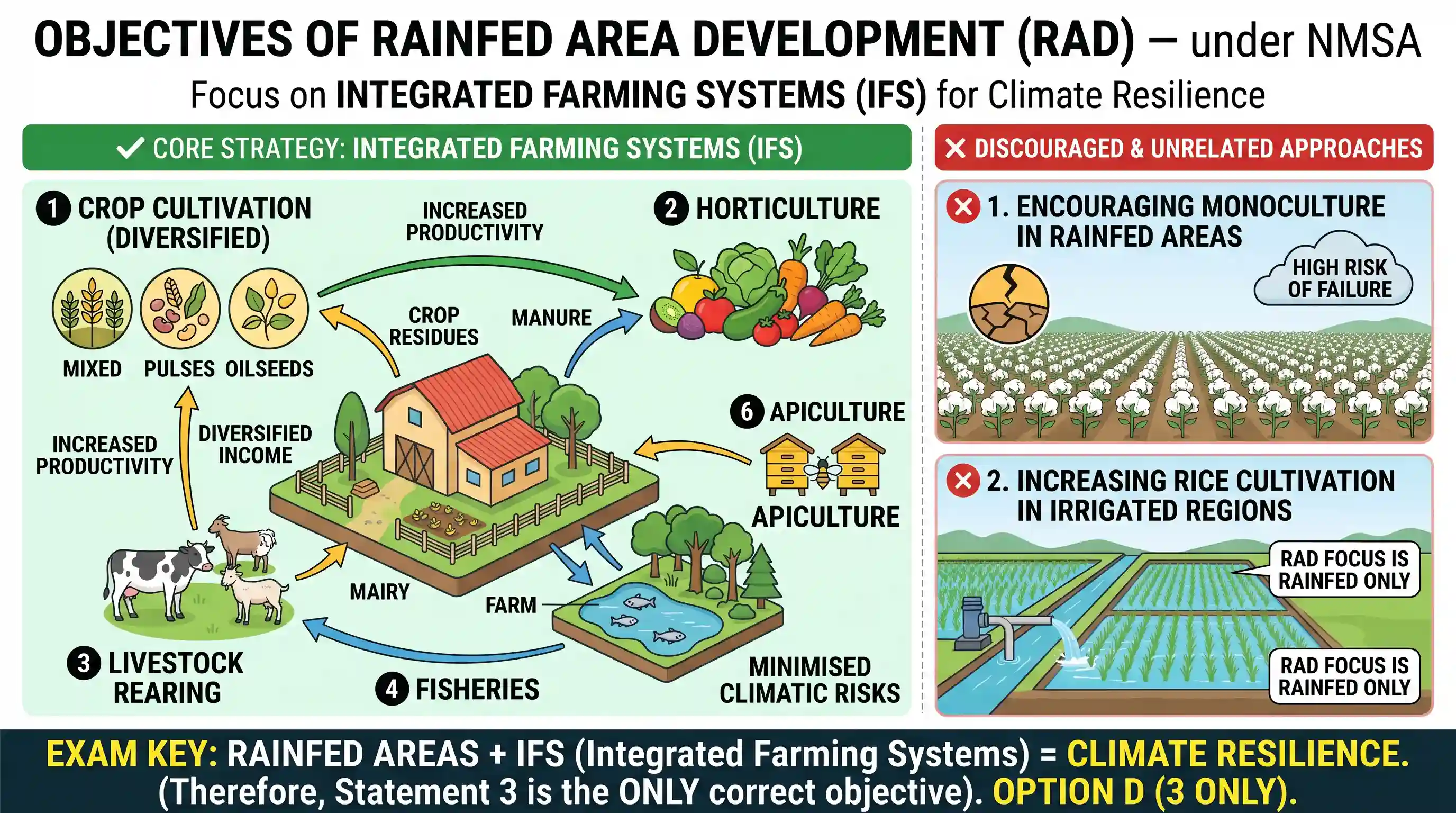
- Statement 1 is incorrect: RAD actively discourages monoculture. Instead, it promotes crop diversification (such as multi-cropping, rotational, inter-cropping, and mixed-cropping) because relying on a single crop in unpredictable rainfed conditions heavily increases the risk of total crop failure.
- Statement 2 is incorrect: As the name implies, RAD is exclusively designed for rainfed areas (regions dependent on monsoons lacking assured irrigation facilities) to improve their agricultural footprint. It does not target irrigated regions or specifically aim to increase water-intensive crop cultivation like rice in those areas.
- Statement 3 is correct: The hallmark of RAD is its area-based approach focusing on the Integrated Farming System (IFS). IFS integrates traditional crop cultivation with allied activities like horticulture, livestock rearing, fisheries, agro-forestry, and apiculture. This holistic integration maximizes farm returns and minimizes climatic risks (like droughts or extreme weather events) by providing farmers with alternative income opportunities if their primary crops fail.
Takeaway: Remember the core formula for RAD: Rainfed Areas + Integrated Farming Systems (IFS) = Climate Resilience. It shields farmers from the unpredictability of rain-dependent farming by diversifying their income sources.
Related questions
More UPSC Prelims practice from the same subject and topic.
- Prelims 2026GS1environment
With reference to Madhav National Park, which of the following statements is/are correct ? 1. It was declared a Tiger Reserve in India in 2025. 2. Sakhya Sagar, which is designated as a Ramsar Site, i…
- Prelims 2026GS1environment
Consider the following statements about Rhynchostylis retusa (Foxtail orchid) : 1. It is an epiphytic orchid. 2. The species is endemic to North-east India. 3. It is the State flower of Arunachal Prad…
- Prelims 2026GS1environment
At the United Nations Ocean Conference (UNOC) held in June, 2025 in France, the Food and Agricultural Organization (FAO) of the United Nations demonstrated its leading voice on marine and ocean issues…
- Prelims 2026GS1environment
Which one of the following is the first Plan Vivo certified Reducing Emissions from Deforestation and Forest Degradation (REDD+) project in India ?
- Prelims 2026GS1environment
Consider the following statements with reference to India's response to climate change : I. India's Long-Term Low Emission Development Strategy (LT-LEDS) is a crucial tool for achieving net-zero emiss…
- Prelims 2026GS1environment
With respect to the Western Hoolock Gibbons, which of the following statements is/are correct? 1. A Sanctuary in North-east India is home to this ape species listed as Endangered in the International …