At the United Nations Ocean Conference (UNOC) held in June, 2025 in France, the Food and Agricultural Organization (FAO) of the United Nations demonstrated its leading voice on marine and ocean issues, especially on sustainable fisheries and aquaculture for resilient livelihood and "Blue Transformation". Which of the following combinations about the "Four Betters" proposed by FAO for "Blue Transformation" is correct ?

- ABetter production, better nutrition, better environment and better ocean
- BBetter production, better nutrition, better environment and better lifeCorrect
- CBetter coral reefs, better nutrition, better environment and better life
- DBetter estuaries, better nutrition, better environment and better mangrove vegetation
Explanation
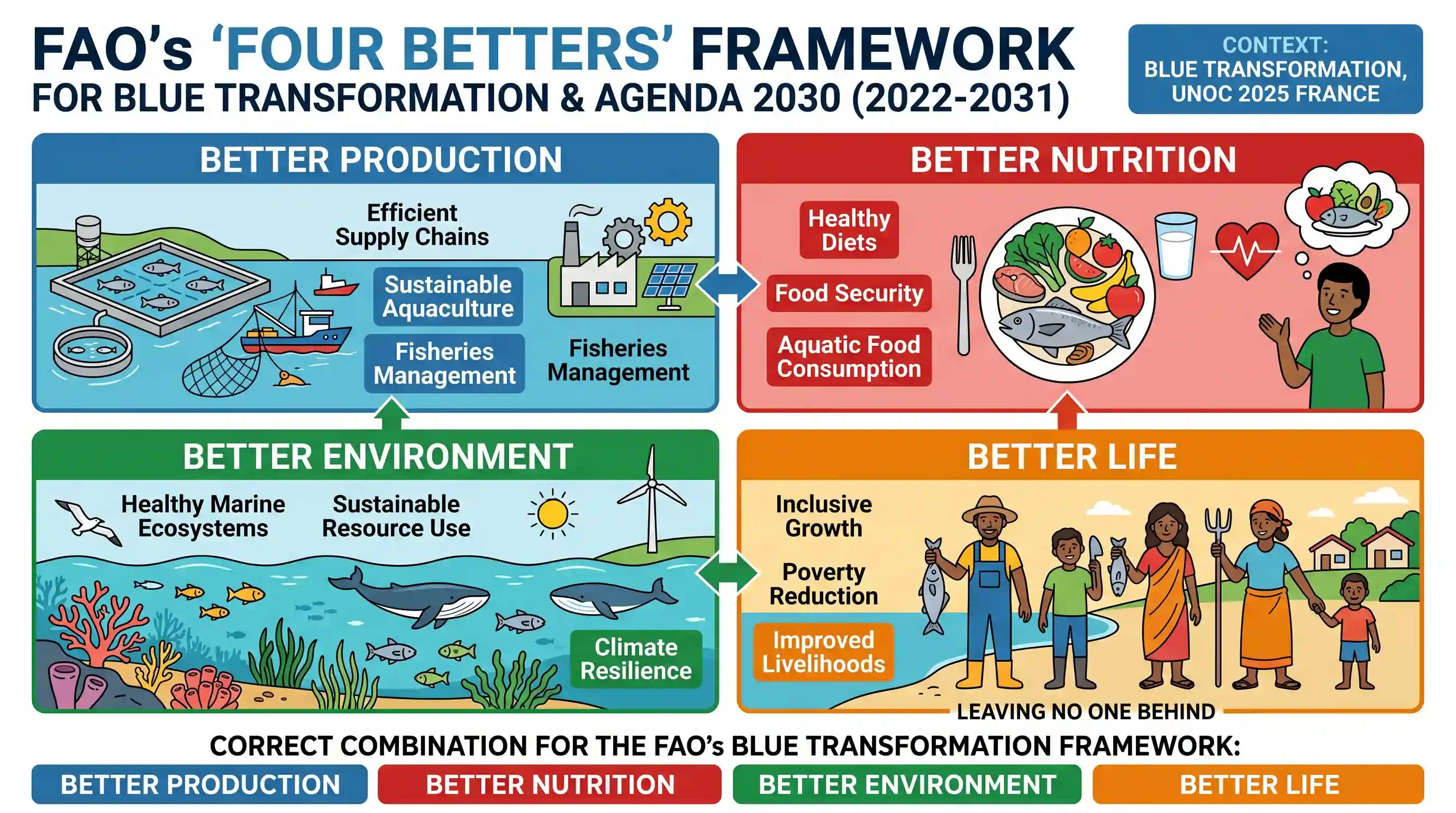
Why Option B is correct: The Food and Agriculture Organization (FAO) adopted its Strategic Framework 2022–2031 (endorsed in June 2021) to support the 2030 Agenda for Sustainable Development. The core organizing principle of this global framework is the "Four Betters": Better Production, Better Nutrition, a Better Environment, and a Better Life, leaving no one behind. "Blue Transformation" is a targeted FAO vision mapped under this framework. It aims to maximize the contribution of aquatic food systems to food security by expanding sustainable aquaculture, improving fisheries management, and upgrading value chains. At forums like the 2025 UN Ocean Conference (UNOC) in Nice, France, FAO prominently highlighted how Blue Transformation acts as a catalyst for achieving these four universal pillars.
Why the other options are incorrect:
- Option A is incorrect because it replaces "better life" with "better ocean." Although marine health is central to the Blue Transformation strategy, the official FAO framework uses "Better Life" to emphasize inclusive economic growth, reducing inequalities, and improving human well-being.
- Option C is incorrect as it replaces "better production" with "better coral reefs." The framework applies to broad global agrifood systems, focusing on "Better Production" to ensure efficient supply chains rather than ecosystem-specific metrics.
- Option D is incorrect because it lists "better estuaries" and "better mangrove vegetation" instead of the official developmental pillars of "Better Production" and "Better Life."
Concluding Takeaway: To easily recall the FAO's strategic priorities, remember the mnemonic PNEL: Production, Nutrition, Environment, and Life. These four interconnected goals guide all FAO interventions, ensuring that sustainable ecological practices translate directly into improved human livelihoods.
Related questions
More UPSC Prelims practice from the same subject and topic.
- Prelims 2026GS1environment
With reference to Madhav National Park, which of the following statements is/are correct ? 1. It was declared a Tiger Reserve in India in 2025. 2. Sakhya Sagar, which is designated as a Ramsar Site, i…
- Prelims 2026GS1environment
Consider the following statements about Rhynchostylis retusa (Foxtail orchid) : 1. It is an epiphytic orchid. 2. The species is endemic to North-east India. 3. It is the State flower of Arunachal Prad…
- Prelims 2026GS1environment
Which one of the following is the first Plan Vivo certified Reducing Emissions from Deforestation and Forest Degradation (REDD+) project in India ?
- Prelims 2026GS1environment
Consider the following statements with reference to India's response to climate change : I. India's Long-Term Low Emission Development Strategy (LT-LEDS) is a crucial tool for achieving net-zero emiss…
- Prelims 2026GS1environment
With respect to the Western Hoolock Gibbons, which of the following statements is/are correct? 1. A Sanctuary in North-east India is home to this ape species listed as Endangered in the International …
- Prelims 2026GS1environment
Which of the following best explain(s) the rationale for protecting mangrove ecosystems in the context of climate resilience? 1. Mangroves reduce tidal energy and store freshwater, making them ideal s…