Which one of the following is the first Plan Vivo certified Reducing Emissions from Deforestation and Forest Degradation (REDD+) project in India ?

- AUttarakhand REDD+ project
- BICFRE-ICIMOD Transboundary REDD+ project in North-Eastern Himalayas
- CKhasi Hills Community REDD+ projectCorrect
- DSikkim Mamley Kamrang Community REDD+ project
Explanation
The correct answer is Option C.
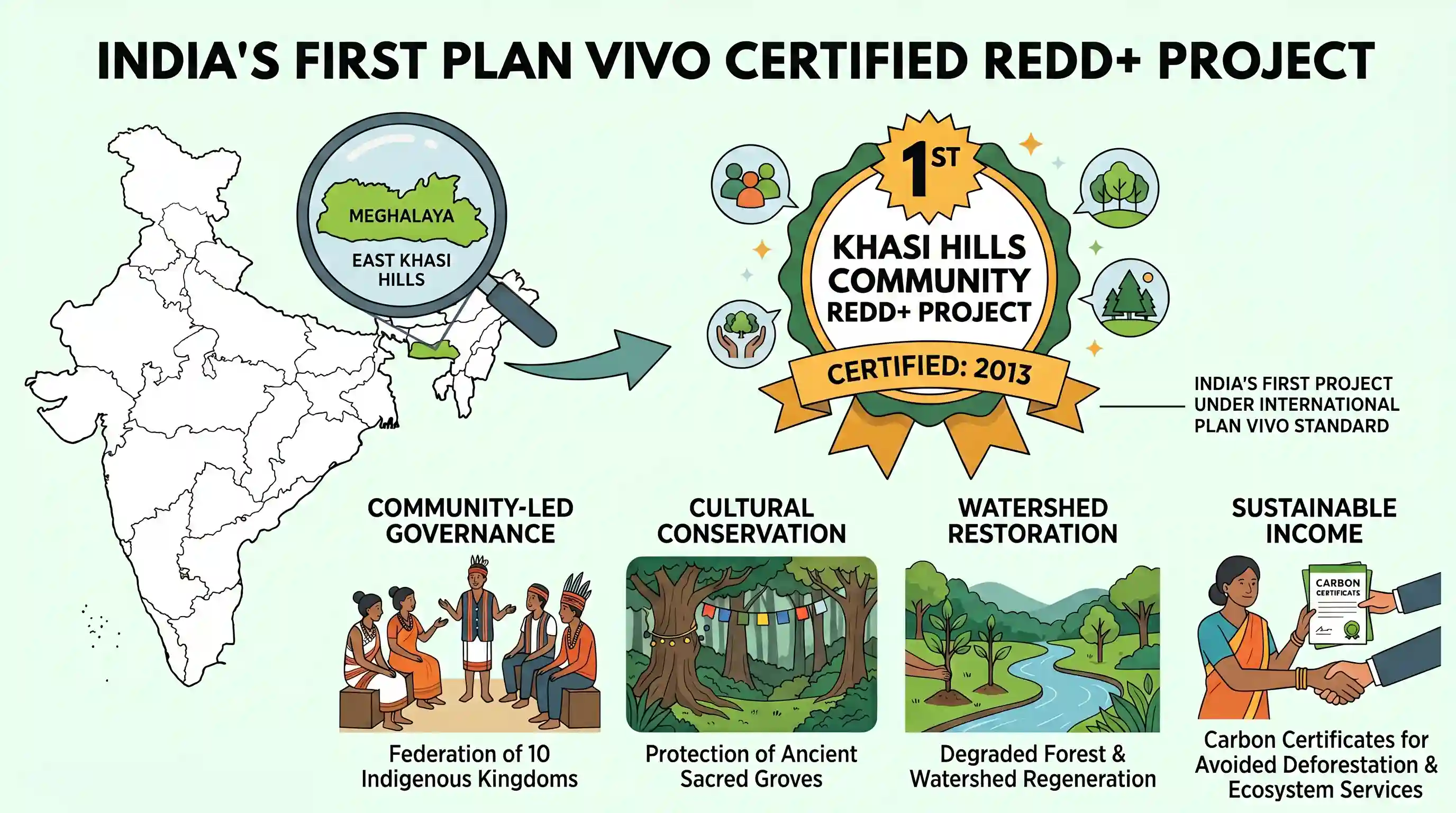
Why it is correct: The Khasi Hills Community REDD+ project, located in the East Khasi Hills of Meghalaya, is India’s first community-based REDD+ (Reducing Emissions from Deforestation and Forest Degradation) project. It holds the distinction of being the first project in India to be certified under the international Plan Vivo standard (certified in 2013). The initiative is implemented by a federation of 10 indigenous Khasi tribal kingdoms. It focuses on the conservation of ancient sacred groves and the restoration of degraded watersheds, allowing local communities to earn carbon certificates (and sustainable income) for avoided deforestation and assisted natural regeneration.
Why the other options are incorrect:
- Option A (Uttarakhand REDD+ project): This is a pilot project initiated by the Indian Council of Forestry Research and Education (ICFRE) focusing on carbon inventory and capacity building within local Van Panchayats (village forests). It is not the first Plan Vivo certified project in India.
- Option B (ICFRE-ICIMOD Transboundary REDD+ project): Launched in 2016, this is a joint multi-country capacity-building programme covering Himalayan regions across India, Nepal, Bhutan, and Myanmar to address drivers of deforestation, not a specific, first-certified carbon market project.
- Option D (Sikkim Mamley Kamrang Community REDD+ project): This is a much newer community-led REDD+ initiative developed in the Mamley watershed of South Sikkim to build ecosystem resilience, but it does not hold the title of the first Plan Vivo certified project in India.
Concluding Takeaway: Plan Vivo is a voluntary carbon market standard designed specifically for community-led land use projects. The Khasi Hills project is a vital case study for UPSC aspirants, demonstrating how indigenous governance and traditional conservation can successfully integrate with global climate mitigation.
Related questions
More UPSC Prelims practice from the same subject and topic.
- Prelims 2026GS1environment
Which of the following statements with regard to Green Hydrogen is/are correct ? 1. It is decarbonized hydrogen obtained from natural gas reforming combined with carbon capture and storage (CCS). 2. I…
- Prelims 2026GS1environment
With reference to Madhav National Park, which of the following statements is/are correct ? 1. It was declared a Tiger Reserve in India in 2025. 2. Sakhya Sagar, which is designated as a Ramsar Site, i…
- Prelims 2026GS1environment
Consider the following statements about Rhynchostylis retusa (Foxtail orchid) : 1. It is an epiphytic orchid. 2. The species is endemic to North-east India. 3. It is the State flower of Arunachal Prad…
- Prelims 2026GS1environment
At the United Nations Ocean Conference (UNOC) held in June, 2025 in France, the Food and Agricultural Organization (FAO) of the United Nations demonstrated its leading voice on marine and ocean issues…
- Prelims 2026GS1environment
Consider the following statements with reference to India's response to climate change : I. India's Long-Term Low Emission Development Strategy (LT-LEDS) is a crucial tool for achieving net-zero emiss…
- Prelims 2026GS1environment
With respect to the Western Hoolock Gibbons, which of the following statements is/are correct? 1. A Sanctuary in North-east India is home to this ape species listed as Endangered in the International …