Consider the following statements with reference to India's response to climate change : I. India's Long-Term Low Emission Development Strategy (LT-LEDS) is a crucial tool for achieving net-zero emissions by 2070. II. India's 4th Biennial Update Report (BUR-4) submitted in December, 2024 recorded around 8% decrease in Greenhouse gas emissions in 2020 over 2019. III. Climate-resilient development necessarily depends on quick and short-term achievement of emission reduction targets. Which of the following relationships among the above statements is/are correct ? 1. Statement I is empirically supported by statement II. 2. Statement III contradicts the approach implicit in statement I. 3. Statement I and statement III together establish the premise of long-term sustainability. Select the answer using the code given below :

- A1 only
- B1 and 2Correct
- C2 and 3
- D3 only
Explanation
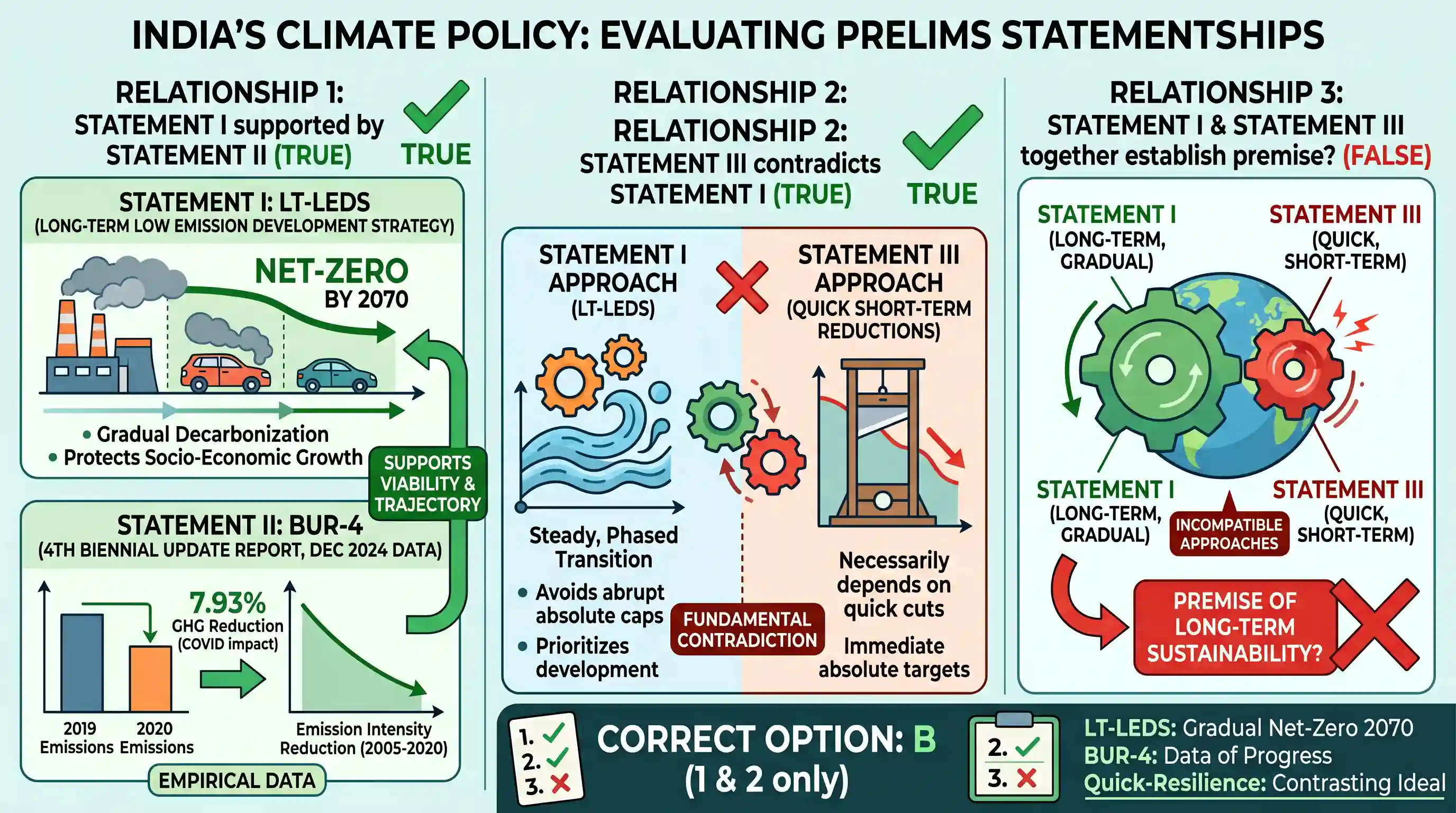
The correct answer is B (1 and 2).
Why Option B is correct: Statement I is factually accurate. India submitted its Long-Term Low Emission Development Strategy (LT-LEDS) at the UNFCCC COP27 in November 2022, outlining a phased, developmental framework to achieve net-zero emissions by 2070. Statement II is also factually accurate. On December 30, 2024, India submitted its 4th Biennial Update Report (BUR-4) to the UNFCCC. The report officially documented a 7.93% (approximately 8%) decrease in greenhouse gas emissions in 2020 relative to 2019—largely reflecting the impact of the COVID-19 pandemic—alongside a 36% reduction in GDP emission intensity from 2005 to 2020.
Relationship 1 is correct: The measured reduction in emissions and emission intensity documented in BUR-4 (Statement II) provides concrete empirical evidence that supports the trajectory and viability of the decarbonization goals outlined in the LT-LEDS (Statement I). Relationship 2 is correct: Statement III asserts that climate-resilient development necessitates "quick and short-term" emission reductions. This fundamentally contradicts the approach implicit in Statement I. India's LT-LEDS relies on the principle of Common But Differentiated Responsibilities (CBDR), intentionally avoiding abrupt, short-term absolute emission caps to protect socio-economic growth, aiming instead for a gradual transition to net-zero by 2070.
Why the other options are wrong:
- Option A (1 only) is incomplete because Relationship 2 is also valid.
- Options C and D are incorrect because Relationship 3 is logically invalid. Statement I (gradual long-term transition) and Statement III (immediate short-term targets) are conceptually opposed; therefore, they cannot "together" establish a coherent premise for long-term sustainability.
Takeaway: India's climate policy deliberately balances ecological commitments with economic growth, prioritizing phased, long-term strategies (LT-LEDS) over binding short-term absolute reduction targets.
Related questions
More UPSC Prelims practice from the same subject and topic.
- Prelims 2026CSATenvironment
Consider the following three statements, namely S1, S2 and S3 : S1. Protecting the environment is an existential exigency for humans, given the impact of environmental degradation on climate change. S…
- Prelims 2026GS1environment
With reference to Madhav National Park, which of the following statements is/are correct ? 1. It was declared a Tiger Reserve in India in 2025. 2. Sakhya Sagar, which is designated as a Ramsar Site, i…
- Prelims 2026GS1environment
Consider the following statements about Rhynchostylis retusa (Foxtail orchid) : 1. It is an epiphytic orchid. 2. The species is endemic to North-east India. 3. It is the State flower of Arunachal Prad…
- Prelims 2026GS1environment
At the United Nations Ocean Conference (UNOC) held in June, 2025 in France, the Food and Agricultural Organization (FAO) of the United Nations demonstrated its leading voice on marine and ocean issues…
- Prelims 2026GS1environment
Which one of the following is the first Plan Vivo certified Reducing Emissions from Deforestation and Forest Degradation (REDD+) project in India ?
- Prelims 2026GS1environment
With respect to the Western Hoolock Gibbons, which of the following statements is/are correct? 1. A Sanctuary in North-east India is home to this ape species listed as Endangered in the International …